The Looking Glass cover art

The Looking Glass

The Looking Glass

Written by: The SAIS Review of International Affairs
Listen for free

About this listen

The Looking Glass is the premier international relations podcast by The SAIS Review of International Affairs with support from The Foreign Policy Institute. Showcasing fresh, policy-relevant perspectives from professional and student experts, The Looking Glass is dedicated to advancing the debate on leading contemporary issues in world affairs.


*The views and opinions expressed in this podcast are the speakers' own, and they do not represent the views or opinions of The SAIS Review of International Affairs, its Editorial Board, or its Advisory Board; the SAIS Foreign Policy Institute; SAIS; or The Johns Hopkins University.*

© 2026 The Looking Glass
Political Science Politics & Government
Episodes
  • Ballots, Ousters, Repeat: Peru’s Political Cycle
    Apr 15 2026

    Peru’s 2026 election season is occurring amid a deepening crisis of political legitimacy. Public confidence in Congress has collapsed to some of the lowest levels in the Western Hemisphere, and Peruvians increasingly doubt whether their institutions can deliver stability, security, and responsive governance. Adding to this political unease, Keiko Fujimori, a polarizing figure and leader of the right‑wing Popular Force party, has launched a renewed presidential bid despite multiple corruption investigations and past electoral defeats. This context raises urgent questions about what has changed, or worsened, in Peru’s political trust since the last election cycle, what factors are driving voter decisions this time around, and how issues such as crime and insecurity are reshaping the electoral landscape. To help unpack these dynamics, we are joined by Martin Cassinelli, an assistant director at the Atlantic Council’s Latin America Center, who brings deep regional insight into Peru’s political evolution and democratic challenges.

    Martin Cassinelli is an assistant director at the Atlantic Council’s Adrienne Arsht Latin America Center, where he advances the Center’s work on the region’s economic development and the Andes region. In this role, he advances the center’s work on investment and trade policy in Latin America, as well as leads the center’s work on Peru. During his time at the Atlantic Council, Cassinelli has led the Nearshoring Working Group, co-authored a report on attracting US investment to the Americas, and written several articles on Latin America’s and Peru’s economic challenges. His work has been featured in the Miami Herald, the Diplomat, the China Wire, and La Presse. Prior to joining the Atlantic Council, Cassinelli worked in cluster development projects in Peru. Cassinelli holds a master’s degree in international economics from the Johns Hopkins University School of Advanced International Studies and a bachelor’s degree in political science from the University of Heidelberg.

    This episode was recording on March 26th, 2026

    Remember to leave 5-stars and share with a friend!

    Show More Show Less
    31 mins
  • A Stress Test for Democracy: Latin America’s Elections and U.S. Influence
    Apr 9 2026

    2026 is a decisive year for Latin American democracy, as democratic institutions across the region are being tested by public distrust and upcoming elections in Colombia, Peru and Brazil. This year, however, it happens under a very different backdrop: The U.S.’s capture of Venezuela's dictator Nicolas Maduro and Washington’s renewed desire to maintain a regional sphere of influence. These developments raise critical questions about the extent of U.S. influence over Latin America’s democratic trajectories, how US political signals affect electoral legitimacy and what this means for the future of democratic governance in the region. To discuss these issues, joining us today is Michael Shifter - former President of the Inter-American Dialogue and Professor at the Georgetown University’s School of Foreign Service.

    Michael Shifter is a political analyst and expert on Latin American affairs. He previously served as President of the Inter-American Dialogue, a leading think tank focused on democracy, governance, and U.S.–Latin America relations. Since 1993, Shifter has been an adjunct professor at Georgetown University’s School of Foreign Service, where he teaches Latin American politics. He is a member of the Council on Foreign Relations and the Latin American Studies Association and is a contributing editor of Current History. He is currently a board member of InSight Crime and serves on the Advisory Committee of Human Rights Watch/Americas Division. His work explores the intersection of politics, foreign policy, and democratic governance, with particular attention to how domestic institutions, electoral processes, and external influences shape political outcomes across the hemisphere. Shifter’s comparative research analyzes trends in democratic backsliding, institutional consolidation, and the role of U.S. policy in shaping regional political dynamics. Widely published and frequently consulted by policymakers and media outlets, Shifter offers a nuanced perspective on the challenges and opportunities facing democracy in Latin America.

    Remember to leave 5-stars and share with a friend!

    Show More Show Less
    27 mins
  • Lessons from the FSO Safer
    Jan 27 2026

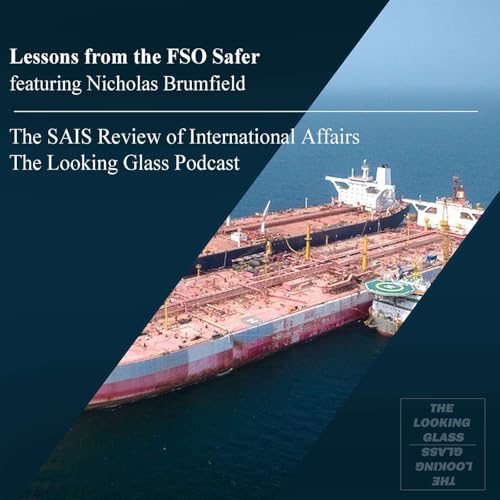
    Welcome to the SAIS Review’s The Looking Glass Podcast. This episode is part of our collaborative series with the Politics of Disaster class at SAIS. We explore how crises unfold at the intersection of conflict, governance, and environmental risk. My name is Andrea Majert Galera, and I am joined by my co-host Marcel Kolb. Today, we turn to the story of the FSO Safer. FSO Safer is a deteriorating oil tanker off Yemen’s coast that, for years, threatened to unleash one of the world’s largest man-made environmental disasters. The multinational effort to avert this catastrophe became a success story of cooperation amid an active war. It nevertheless raises more profound questions about responsibility, prevention, and the governance of high-risk infrastructure in conflict zones. Joining us today on the podcast is Nicholas Brumfield.

    Nicholas Brumfield graduated with an MA in Arab Studies from Georgetown University and has worked since 2018 as a researcher on Middle East politics and security. He has specifically developed an interest in maritime security. His analysis can be seen in publications including Al-Jazeera, the Daily Beast, the Foreign Policy Research Institute, Amwaj Media, and L'Orient L'Jour. We hope you enjoy this episode of the Looking Glass Podcast.

    Remember to leave 5-stars and share with a friend!

    Show More Show Less
    33 mins
No reviews yet