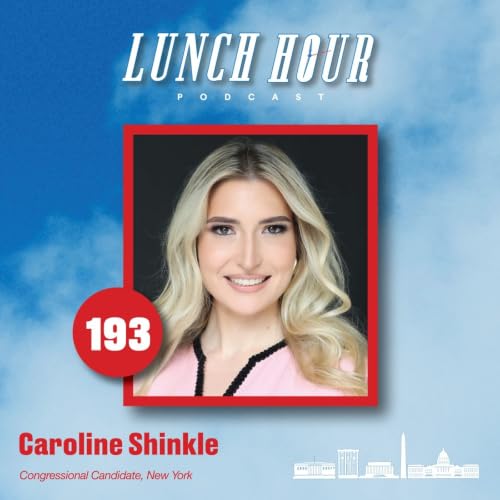
• Ep. 193 - Reviving New York Through Free Markets & Growth w/Caroline Shinkle
    Jun 29 2026

    Can New York reclaim its position as the world's premier center of opportunity and economic growth?

    On this episode of the Washington Signal Lunch Hour Podcast, host Andrew Langer sits down with Caroline Shinkle, Republican candidate for New York's 12th Congressional District. A graduate of MIT and Harvard Law School, Shinkle previously worked at Cravath, Swaine & Moore LLP and the Federal Reserve Bank of New York, bringing a unique blend of legal, economic, and financial expertise to the conversation.

    Shinkle discusses her vision for New York City, arguing that economic empowerment, fiscal responsibility, and pro-growth policies can restore opportunity while strengthening America's financial capital.

    The conversation covers:

    • Reviving New York through free-market economic policies
    • Balancing the federal budget and addressing the national debt
    • AI, innovation, and the future of government
    • America's role in global energy and foreign policy
    • The challenges facing New York City and its future

    Throughout the discussion, Shinkle shares how her background in economics, law, and finance has shaped her views on public policy, while emphasizing the importance of individual opportunity, entrepreneurship, and long-term economic growth.

    00:00 — Intro + Meet Caroline Shinkle
    01:03 — Why she's running for Congress
    03:17 — Economic empowerment and free markets
    10:13 — Balancing the budget and lowering taxes
    13:07 — Is New York better off today?
    18:52 — Lessons from New York's past
    25:16 — AI and the future of government
    32:01 — Energy policy and America's global role
    37:21 — Life outside politics
    39:55 — Campaign, website, and closing thoughts

    Follow us on social media

    X: @TheLunchHourPod

    Instagram: the_lunchhour_pod

    LinkedIn: Lunch Hour Podcast

    TikTok: lunchhourpod

    Find more at Washington Signal

    Your source for policy, national security, and investigative journalism.

    https://washingtonsignal.com/

    Show More Show Less
    42 mins
  • Ep. 192 - Free Markets, Shareholder Activism, & Public Policy Reform w/Dan Faoro
    Jun 22 2026

    How can free-market principles address some of America’s biggest policy challenges?

    On this episode of the Washington Signal Lunch Hour Podcast, host Andrew Langer sits down with Dan Faoro, President of the National Center for Public Policy Research (NCPPR), for a wide-ranging conversation about public policy, shareholder activism, economic freedom, disability policy, education, and the future of conservative advocacy.

    Faoro discusses the mission of the National Center for Public Policy Research and its key initiatives, including Project 21, the Free Enterprise Project, and Able Americans. He explains how these programs seek to expand opportunity, promote free-market solutions, and challenge policies that often create unintended consequences.

    The conversation covers:

    • The mission and history of the National Center for Public Policy Research
    • Project 21 and conservative outreach in Black communities
    • Shareholder activism and corporate governance
    • ESG, DEI, and fiduciary responsibility
    • Disability policy and the Able Americans initiative
    • Regulatory barriers and unintended consequences in public policy
    • Consistency in conservative principles and policymaking
    • The role of trade associations and policy organizations
    • Free markets, economic freedom, and government intervention
    • China, economic competition, and national security concerns
    • The legacy of communism and lessons from Eastern Europe
    • Family, fatherhood, and leadership development initiatives

    Faoro also discusses the Free Enterprise Project’s efforts to challenge corporate activism through shareholder proposals and litigation, including a successful legal challenge to Nasdaq board diversity requirements that he argues reinforced shareholder rights and corporate independence.

    Throughout the discussion, Andrew and Dan explore the tension between good intentions and real-world outcomes, emphasizing the importance of evaluating policies based on results rather than rhetoric.

    The episode concludes with a conversation about family, mentorship, leadership development, and the importance of cultivating the next generation of policy advocates.

    00:00 — Intro + Meet Dan Faoro
    01:24 — The National Center for Public Policy Research
    03:02 — Project 21 and outreach efforts
    04:05 — The Free Enterprise Project
    05:05 — Able Americans and disability policy
    06:01 — Unintended consequences in public policy
    09:37 — Consistency in conservative principles
    13:03 — Holding policymakers accountable
    16:05 — Populism and the political landscape
    20:15 — Shareholder activism and corporate governance
    21:18 — The Nasdaq board diversity lawsuit
    24:30 — ESG, DEI, and corporate influence
    27:19 — China, economic competition, and national security
    30:39 — Lessons from communism and Eastern Europe
    33:21 — New initiatives at NCPPR
    35:07 — Life outside policy work
    35:43 — Where to learn more about NCPPR
    36:14 — Closing thoughts

    Follow us on social media

    X: @TheLunchHourPod

    Instagram: the_lunchhour_pod

    LinkedIn: Lunch Hour Podcast

    TikTok: lunchhourpod

    Find more at Washington Signal

    Your source for policy, national security, and investigative journalism.

    https://washingtonsignal.com/

    Show More Show Less
    37 mins
  • Ep. 191 - Taxes, Free Markets & the Future of Conservatism w/Grover Norquist
    Jun 15 2026

    What happens when political movements abandon the principles that made them successful?

    On this episode of the Washington Signal Lunch Hour Podcast, host Andrew Langer sits down with Grover Norquist, founder and president of Americans for Tax Reform (ATR), for a wide-ranging conversation on free markets, limited government, federalism, taxation, trade, labor policy, and the future of the conservative movement.

    Drawing on decades of experience in public policy and political advocacy, Norquist discusses why ideological consistency remains essential, how federalism serves as one of America's greatest strengths, and why he believes economic freedom continues to outperform centralized government planning.

    The conversation covers:

    • The importance of principle-driven policymaking
    • Limited government and the role of federalism
    • Tax reform and the Taxpayer Protection Pledge
    • Organized labor and worker freedom
    • The East Palestine rail derailment and rail policy debates
    • Government regulation and unintended consequences
    • Tariffs, free trade, and industrial policy
    • Artificial intelligence and regulatory challenges
    • California’s wealth tax proposal and interstate competition
    • Energy policy, nuclear power, and economic growth
    • Property taxes and local government spending

    Norquist also reflects on the evolution of the conservative movement, the importance of maintaining intellectual consistency in public policy debates, and why he believes competition among states helps drive innovation, growth, and accountability.

    Throughout the discussion, he argues that government solutions often become larger and more permanent than the problems they were intended to solve, while market-based approaches tend to produce better outcomes for workers, consumers, and taxpayers.

    The episode concludes with a look at future policy battles at the federal, state, and local levels, along with a personal discussion about history and travel.

    00:00 — Intro + Grover Norquist joins
    01:27 — Why principles matter in politics
    05:20 — Bipartisanship versus philosophy
    09:01 — The Taxpayer Protection Pledge
    12:01 — Labor unions and worker freedom
    14:43 — The East Palestine rail debate
    18:50 — Government responses to crises
    22:22 — Tariffs, trade, and industrial policy
    26:55 — Federalism and state competition
    27:22 — Artificial intelligence and regulation
    30:42 — California’s wealth tax proposal
    35:23 — Energy policy and nuclear power
    39:32 — Grover Norquist’s interests outside politics
    40:23 — Property taxes and local government reform
    41:32 — Closing thoughts

    Follow us on social media

    X: @TheLunchHourPod

    Instagram: the_lunchhour_pod

    LinkedIn: Lunch Hour Podcast

    TikTok: lunchhourpod

    Find more at Washington Signal

    Your source for policy, national security, and investigative journalism.

    https://washingtonsignal.com/
    Show More Show Less
    43 mins
  • Ep. 190 - Parents’ Rights, Education Reform & Defending Education w/Nicole Neily
    Jun 8 2026

    What happens when parents finally get a firsthand look at what their children are being taught in school?

    On this episode of the Washington Signal Lunch Hour Podcast, host Andrew Langer sits down with Nicole Neily, President and Founder of Defending Education, a national organization focused on parental rights, academic transparency, and accountability in K-12 and higher education. Prior to founding Defending Education, Neily also founded Speech First, a leading campus free speech organization that challenged First Amendment violations at public universities.

    Drawing on years of work in education policy and civil liberties, Neily discusses how COVID-era school closures transformed the national debate over education and why parental involvement has become one of the defining policy issues of the past decade.

    The conversation covers:

    • The rise of the parental rights movement
    • COVID-19 and the public’s renewed focus on education
    • The history and role of the U.S. Department of Education
    • Teachers unions and their influence on public policy
    • School choice and educational competition
    • DEI programs in K-12 and higher education
    • Campus free speech and Speech First’s legal battles
    • Accreditation agencies and higher education reform
    • The future of colleges and universities amid declining enrollment
    • Parental notification policies and transparency in schools
    • State-level education reforms and the role of federalism

    Neily also explains the origins of Defending Education, how the organization investigates school policies and curricula, and why she believes many parents have become more engaged in education than ever before.

    The discussion explores broader questions about accountability, educational outcomes, bureaucratic growth, and whether America’s education system is preparing students for future success.

    Throughout the episode, Neily argues that meaningful reform will require greater transparency, stronger parental involvement, and a renewed focus on academic achievement rather than ideological activism.

    00:00 — Intro + Nicole Neily joins
    01:00 — Why education became a national issue
    03:05 — How America’s education system changed
    06:06 — Declining academic standards and outcomes
    07:25 — Schools of education and ideological influence
    10:33 — Founding Defending Education
    13:13 — COVID, parents, and public awareness
    17:24 — Teachers unions and political influence
    19:30 — School choice and education reform
    23:20 — Why some states are improving outcomes
    26:00 — Trump administration education reforms
    29:31 — Accreditation and higher education
    34:25 — Campus free speech and Speech First
    37:25 — Current battles in K-12 education
    40:08 — Travel, family, and personal interests
    40:36 — Where to learn more about Defending Education
    41:12 — Closing thoughts

    Follow us on social media

    X: @TheLunchHourPod

    Instagram: the_lunchhour_pod

    LinkedIn: Lunch Hour Podcast

    TikTok: lunchhourpod

    Find more at Washington Signal

    Your source for policy, national security, and investigative journalism.

    https://washingtonsignal.com/

    Show More Show Less
    42 mins
  • Ep. 189 - Aluminum, China, & America’s Supply Chain Future w/Anthony Musto & Ben Carlson
    Jun 1 2026

    How can a recycled soda can become a national security issue?

    On this episode of the Washington Signal's Lunch Hour Podcast, host Andrew Langer is joined by Anthony Musto, North American Strategy & Growth Lead at Constellium, and Ben Carlson, Director of the Center for Strategic Industrial Materials at SAFE, for a discussion on aluminum manufacturing, recycling, supply chains, and the growing competition between the United States and China.

    The conversation explores why aluminum remains one of the most important materials in the modern economy and how recycling infrastructure has become increasingly tied to economic security, energy policy, manufacturing competitiveness, and national defense.

    Major topics include:

    • Why aluminum is critical to transportation, aerospace, energy, and defense
    • The economic and energy benefits of aluminum recycling
    • America’s growing dependence on imported aluminum inputs
    • Chinese industrial policy and global aluminum markets
    • Why millions of tons of aluminum scrap leave the U.S. each year
    • Supply chain resilience, national security, and critical materials
    • Recycling infrastructure and sorting technology challenges
    • The role of permitting reform and industrial policy
    • Building a stronger domestic manufacturing base

    The discussion also examines how China has expanded its aluminum production and recycling capacity, why U.S. manufacturers are concerned about scrap exports, and what policymakers can do to strengthen domestic supply chains.

    Throughout the episode, both guests argue that aluminum recycling should be viewed not simply as an environmental issue, but as an economic and strategic opportunity that can support American manufacturing, reduce energy consumption, and improve supply chain security.

    00:00 — Intro + Meet Anthony Musto and Ben Carlson
    01:39 — What Constellium does
    02:43 — SAFE and strategic industrial materials
    03:28 — Why aluminum matters to the modern economy
    05:14 — The power of aluminum recycling
    06:18 — Manufacturing jobs and economic impact
    07:39 — The aluminum scrap export problem
    10:00 — AI, energy demand, and supply chain security
    11:58 — Why recycling infrastructure matters
    16:30 — Permitting reform and recycling facilities
    20:21 — Aluminum, energy use, and facility footprints
    23:23 — Policy solutions and domestic investment
    26:32 — Sorting technology and recycling innovation
    30:11 — China’s influence on aluminum markets
    33:15 — What policymakers should do next
    35:14 — Outside interests and personal stories
    37:31 — Closing thoughts

    Follow us on social media

    X: @TheLunchHourPod

    Instagram: the_lunchhour_pod

    LinkedIn: Lunch Hour Podcast

    TikTok: lunchhourpod

    Find more at Washington Signal

    Your source for policy, national security, and investigative journalism.

    https://washingtonsignal.com/

    Show More Show Less
    38 mins
  • Ep. 188 - Tariffs, Food Security & the Future of American Manufacturing w/Scott Breen
    May 25 2026

    How does a tariff on steel end up affecting the price of canned food at the grocery store?

    On this episode of the Federal Newswire Lunch Hour Podcast, host Andrew Langer sits down with Scott Breen, President of the Can Manufacturers Institute (CMI), to discuss the intersection of trade policy, food security, manufacturing, and consumer prices.

    Breen explains how steel tariffs are impacting the American food can supply chain, why domestic tinplate steel production has declined dramatically over the past decade, and what that means for farmers, manufacturers, retailers, and consumers.

    The conversation explores a fundamental policy question: how can the United States strengthen domestic manufacturing while avoiding unintended consequences that increase costs for American families?

    Major topics include:
    • The role canned food plays in food security and emergency preparedness
    • Why U.S. tinplate steel production has fallen from 12 lines to 3
    • How steel tariffs affect food prices at the grocery store
    • Competition from imported canned food products
    • Buy American policies and country-of-origin labeling
    • SNAP benefits, public procurement, and domestic agriculture
    • Supply chain resilience and national security concerns
    • Recycling, sustainability, and the future of metal packaging

    The discussion also examines bipartisan legislation designed to improve country-of-origin labeling and proposals aimed at ensuring federal food purchases better support American farmers and manufacturers.

    Throughout the episode, Breen argues that strengthening domestic manufacturing requires a balanced approach—one that supports upstream steel production while also protecting downstream industries that employ thousands of American workers.

    00:00 — Intro + Scott Breen joins
    01:25 — What the Can Manufacturers Institute does
    02:42 — Food security and the importance of canned goods
    04:08 — Steel tariffs and rising grocery prices
    05:11 — Why domestic tinplate production declined
    09:19 — Manufacturing jobs and downstream impacts
    10:58 — Imported canned foods and competitive disadvantages
    14:48 — American farmers and the food supply chain
    17:14 — SNAP benefits and Buy American policies
    20:08 — The American CANS Act explained
    21:34 — Food security, sustainability, and preparedness
    27:05 — What consumers and lawmakers can do
    29:18 — Scott Breen’s interests outside work
    30:06 — Where to learn more about CMI
    31:05 — Closing

    Follow us on social media

    X: @TheLunchHourPod

    Instagram: the_lunchhour_pod

    LinkedIn: Lunch Hour Podcast

    TikTok: lunchhourpod

    Find more at Washington Signal

    Your source for policy, national security, and investigative journalism.

    https://washingtonsignal.com/

    Show More Show Less
    32 mins
  • Ep. 187 - Recycling, Waste Policy & Remaking in America w/Heidi Sanborn
    May 18 2026

    How can America reduce waste, strengthen domestic manufacturing, and rebuild its recycling infrastructure at the same time?

    On this episode of the Federal Newswire Lunch Hour Podcast, host Andrew Langer sits down with Heidi Sanborn, founding director and CEO of the National Stewardship Action Council (NSAC) and the National Stewardship Action Foundation.

    Sanborn discusses the growing crisis facing America’s recycling and waste management systems, why domestic recycling infrastructure is collapsing, and how short-term economic thinking has made the United States increasingly dependent on China for recycled materials and manufacturing inputs.

    The conversation explores how environmental stewardship, economic resilience, permitting reform, and supply chain security increasingly overlap — and why policies designed to promote sustainability can sometimes unintentionally undermine it.

    Major topics include:
    • Why waste and pollution are closely connected
    • The collapse of America’s recycling infrastructure
    • China’s influence over global recycled material markets
    • The Remade in America Pledge
    • Trade policy, tariffs, and domestic manufacturing
    • Recycling, permitting reform, and regulatory barriers
    • Mechanical vs. chemical recycling systems
    • Hazardous waste disposal and marine flare safety
    • Producer responsibility and product stewardship laws
    • How AI and technology are changing recycling operations

    Sanborn also explains how the National Stewardship Action Council works with states across the country to create policies focused on producer responsibility, safer waste management systems, and stronger domestic recycling markets.

    The discussion closes with a broader conversation about balancing environmental goals, affordability, regulation, and long-term economic sustainability.

    00:00 — Intro + Heidi Sanborn joins the show
    01:25 — How Heidi got started in recycling
    02:10 — Why waste equals inefficiency
    05:18 — Recycling policy and regulatory challenges
    08:14 — Why companies buy recycled materials from China
    11:19 — Recycling, trade policy, and American manufacturing
    16:28 — The Remade in America Pledge
    20:08 — Chemical recycling vs. mechanical recycling
    22:26 — Permitting reform and environmental policy
    27:17 — Marine flare disposal challenges
    30:04 — What the National Stewardship Action Council does
    32:29 — Life in Sacramento and Lake Tahoe
    33:14 — Where to follow NSAC and support the mission

    Follow us on social media

    X: @TheLunchHourPod

    Instagram: the_lunchhour_pod

    LinkedIn: Lunch Hour Podcast

    TikTok: lunchhourpod

    Find more at Washington Signal

    Your source for policy, national security, and investigative journalism.

    https://washingtonsignal.com/

    Show More Show Less
    35 mins
  • Ep. 186 - Faith, Persecution & the Story Behind Faith Under Siege w/Sarah Makin
    May 11 2026

    Why does religion remain at the center of so many global conflicts — and why do policymakers often ignore it?

    On this episode of the Federal Newswire Lunch Hour Podcast, host Andrew Langer is joined by Sarah Makin, religious freedom advocate and producer of Faith Under Siege, to explore the role of faith in global conflict, diplomacy, and human rights.

    Drawing on her experience in government and international advocacy, Makin argues that one of the biggest blind spots in U.S. foreign policy is a failure to understand religion as a core driver of identity, motivation, and conflict.

    A major theme of the conversation is how authoritarian regimes view faith as a threat — because it represents a source of authority beyond the state.

    The discussion covers:
    • Why religion plays a central role in global conflicts
    • How U.S. diplomacy often misunderstands religious dynamics
    • Why authoritarian regimes fear people of faith
    • Religious persecution in China (Uyghurs, Christians, others)
    • The crisis in Nigeria and the role of extremist ideology
    • Why religious persecution is a “canary in the coal mine” for genocide
    • Lessons from Iraq and the Yazidi genocide
    • The role of faith-based organizations in humanitarian work
    • Why smaller NGOs often outperform large aid institutions
    • The importance of religious literacy in foreign policy

    The conversation also takes a deep look at the war in Ukraine — particularly the often-overlooked issue of religious persecution.

    Additional topics include:
    • Russia’s use of the Orthodox Church as a political tool
    • The myth of Ukrainian religious persecution
    • Documented attacks on churches, clergy, and faith communities
    • The targeting of evangelical, Catholic, Jewish, and Orthodox groups
    • The broader role of faith in Ukrainian society

    Makin also discusses her film project, Faith Under Siege, a documentary series highlighting the persecution of religious communities in Ukraine under Russian occupation. The project includes both a full-length film and shorter features focused on specific faith groups and stories.

    The episode closes with a broader reflection: ignoring religion in policy discussions doesn’t eliminate its influence — it simply makes decision-makers less equipped to understand the world.

    00:00 — Intro + Sarah Makin joins
    01:06 — Why religion drives global conflict
    03:13 — U.S. foreign policy blind spots on faith
    05:42 — Authoritarian regimes vs people of faith
    07:19 — Religious persecution in China and beyond
    10:01 — Nigeria crisis and extremist ideology
    12:40 — “Canary in the coal mine” for genocide
    13:58 — Iraq, Yazidis, and humanitarian work
    16:08 — Faith-based NGOs vs large aid systems
    23:50 — Ukraine: churches, war, and persecution
    26:18 — Russia, the Orthodox Church, and propaganda
    33:58 — Faith Under Siege documentary
    37:49 — Personal interests + closing

    Follow us on social media

    X: @TheLunchHourPod

    Instagram: the_lunchhour_pod

    LinkedIn: Lunch Hour Podcast

    TikTok: lunchhourpod

    Find more at Washington Signal

    Your source for policy, national security, and investigative journalism.

    https://washingtonsignal.com/

    Show More Show Less
    40 mins