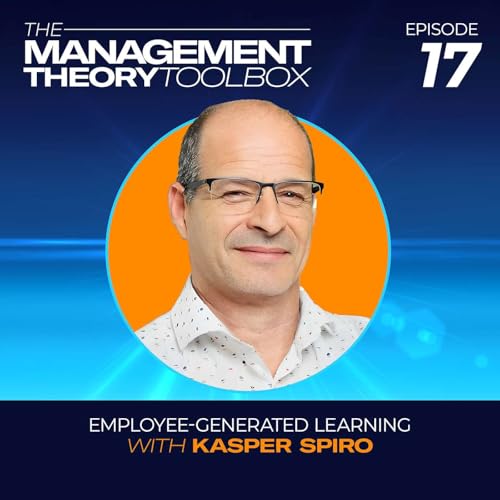
The Management Theory Toolbox cover art

The Management Theory Toolbox

The Management Theory Toolbox

Written by: Travis Mallett
Listen for free

About this listen

Imagine boldly navigating the complex world of management with a broad range of management theories at your disposal. The Management Theory Toolbox promises you a mind-expanding experience. Prepare to think, rethink, and discover the theory that underlies management practices.

This isn't your typical management podcast. Yes, there are plenty of resources out there that will give you the ABCs of how to run a meeting, hire someone, or even how to fake a sick day without getting caught, but here we like to talk about the behind-the-scenes topics, those concepts and ideas which transcend specific management practices, the ideas which give birth to good management and business practices, rather than simply restate them. We aren’t going to give you specific tips and tricks for becoming an effective manager. Here at The Management Theory Toolbox, we’re interested in the why behind it all, the discoveries of behavioral science, psychology, business, and economics that will open our eyes to what’s happening behind the scenes.

If you're a manager, team leader, aspiring entrepreneur, business student or simply someone toying around with the idea of starting a business and you’re interested in a scientifically rooted discussion of management and business, one which systematically discusses the ideas behind the specific practices you’ve probably already heard a lot about, then this podcast is for you. One thing you’ll be able to count on in this podcast is that every statement is supported by research, and you’ll be able to download the show notes for each episode to find links and references to the source material for everything taught in each episode.

© 2025 The Management Theory Toolbox
Economics Leadership Management Management & Leadership Marketing Marketing & Sales
Episodes
  • Episode 17: Employee-Generated Learning with Kasper Spiro
    Feb 26 2025

    In this action-packed episode of The Management Theory Toolbox, host Travis Mallett and guest Kasper Spiro, Chief Learning Strategist & Co-founder of EasyGenerator, dive deep into the paradigm shift from traditional, top‐down corporate training to a dynamic, employee generated learning (EGL) model. Discover how real-world practice, authentic peer feedback, and cutting-edge technologies like AI are transforming learning—and why “practice makes permanent” is the mantra for today’s modern workplace.

    Key Takeaways

    • Practice Over Passive Learning:
      • Explore why hands-on practice is not just beneficial but essential, and how “practice makes permanent” can solidify skills better than rote education alone.
    • The Four Pillars of Effective Learning:
      • Know the Why: Understanding the purpose behind learning content fuels motivation.
      • Leverage Personal Experience: Connect new insights with your own professional journey.
      • Engage in Real Practice: Apply what you learn immediately to build expertise.
      • Seek Constructive Feedback: Use peer insights and data (e.g., via XAPI and Learning Record Stores) to continuously refine performance.
    • Employee Generated Learning (EGL) vs. Traditional Training:
      • Break away from outdated, one-size-fits-all courses. Empower employees to create, update, and own their learning experiences.
      • Discover how EGL fosters trust, engagement, and relevance—resulting in higher completion and success rates.
    • Future-Proofing Corporate Learning:
      • The integration of AI and advanced tracking transforms static learning management systems into interactive, on-demand “corporate brains” that deliver instant, personalized answers.

    Resources & Additional Reading

    • EasyGenerator:
      Learn more about their innovative approach to employee generated learning at EasyGenerator.
    • Employee Generated Learning (Book):
      Dive into Kasper Spiro’s insights by checking out his book, “Employee Generated Learning: How to Develop Training that Drives Performance”, published by Kogan Page.
    • Bloom’s Taxonomy:
      Enhance your understanding of effective learning objectives with Bloom’s Taxonomy.
    • Five Moments of Learning Model:
      Explore the Five Moments of Need framework, which redefines how and when learning occurs on the job.
    • 70-20-10 Learning Model:
      Discover the breakdown of effective learning strategies in the 70-20-10 Model, emphasizing that 70% of learning happens through hands-on experience, 20% via collaboration, and only 10% through formal training.

    Connect & Engage

    • Join the Conversation:
      Share your insights and experiences in the comments below, or reach out to us on LinkedIn.
    • Meet Our Guest:
      Follow Kasper Spiro on LinkedIn for more on his innovative work with EGL and learn about upcoming events, webinars, and speaking engagements.

    For more transformative insights and in-depth discussions, visit our website and subscribe to The Management Theory Toolbox podcast.

    Show More Show Less
    28 mins
  • Episode 16: Don't Learn Alone—How Real-Time Connection Supercharges Your Brain with Dr. Sara De Felice
    Feb 12 2025
    Key Topics & Takeaways:
    • Learning in a Social Context:
      • Social vs. Solo Learning: Understand the critical differences between learning “from” others (e.g., recorded lectures) and learning “with” others (live, interactive sessions), and why the latter can boost retention and engagement.
      • The Role of Joint Attention: Learn how simultaneous focus (e.g., both teacher and learner attending to the same object or idea) enhances brain synchrony and memory consolidation.
    • Theoretical Perspectives:
      • Operant Conditioning vs. Social Cognitive Theory: Explore how traditional action-consequence learning compares with social cognitive approaches where observation, anticipation, and modeling play key roles.
      • Interactivity’s Hidden Benefits: Discover how even subtle non-verbal cues (like eye contact and nodding) facilitate dynamic, real-time adjustments during teaching and learning.
    • Neuroscience of Social Interaction:
      • Key Brain Regions: Insights into the medial dorsolateral prefrontal cortex and the temporal parietal junction—the hubs of our “social brain” that process shared attention and perspective-taking.
      • Hyperscanning Techniques: An introduction to how neuroscientists measure simultaneous brain activity in interacting individuals to better understand live social learning.
    • Implications for Education and the Workplace:
      • Enhancing Learning Environments: Discussion on the growing trend toward interactive and collaborative learning—both in academia and corporate training—and how these approaches can lead to improved outcomes.
      • Future Research Directions: A look ahead at how further study into the quality of social interactions (e.g., the impact of relationship dynamics on learning) could reshape our understanding of education and organizational behavior.
    Guest Information & Resources:


    Dr. Sara De Felice

    • Position: Research Associate, Department of Psychology, University of Cambridge
    • Research Interests: Cognitive and neural mechanisms of human learning, social interaction, and the use of multi-modal approaches (including hyperscanning) to study interacting brains.

    Connect with Sara:

    • Google Scholar: Sara De Felice
    • Twitter: @sara_de_felice
    • LinkedIn: Sara De Felice
    • University Profile: Sara De Felice – University of Cambridge

    Key Publication:

    • Article: “Learning from others is good, with others is better: the role of social interaction in human acquisition of new knowledge”
      • Citation: De Felice S, Hamilton AFC, Ponari M, Vigliocco G. Philos Trans R Soc Lond B Biol Sci. 2023 Feb 13;378(1870):20210357. doi: 10.1098/rstb.2021.0357.
      • PubMed: Link
    Show More Show Less
    32 mins
  • Episode 15: Shaping Behavior—The Unique Power of Each Reinforcement Schedule with Dr. Hank Schlinger, Jr.
    Aug 28 2024

    Ever wonder why your team behaves the way they do? In this episode of The Management Theory Toolbox, we pull back the curtain on the psychology of reinforcement schedules—techniques that could be the secret sauce to boosting your team’s motivation and performance. Whether you're looking to fine-tune your leadership style or curious about the science behind behavior, this episode is a must-listen!

    Episode Summary:
    Welcome back to The Management Theory Toolbox! I'm your host, Travis Mallett, and today, we're wrapping up our series on operant conditioning with a deep dive into the powerful concept of reinforcement schedules. These are the invisible forces that shape behavior in the workplace—and beyond.

    Joined by Dr. Hank Schlinger, a renowned expert in behavior analysis from California State University, we explore different types of reinforcement schedules, including fixed and variable intervals and ratios, and their profound impact on employee behavior. We’ll discuss real-world applications, like how slot machines and even smartphones use these principles to keep us hooked, and how you can ethically apply them in your organization to boost morale and productivity.

    We also address a critical question: Can manipulating reinforcement schedules turn employees into mere machines? Dr. Schlinger sheds light on this ethical dilemma, arguing that when done right, these techniques can actually make your team feel more valued and motivated.

    Guest Resources:

    • Dr. Hank Schlinger
      • Google Scholar - Explore Dr. Schlinger’s extensive research in behavior analysis.
      • California State University, Los Angeles Profile - Learn more about Dr. Schlinger’s academic contributions.
      • How to Build Good Behavior and Self-Esteem in Children (and other books) - Dr. Schlinger’s latest book, a practical guide for parents and educators.
      • www.buildgoodbehavior.com - Website for Dr. Schlinger's latest book.

    Key Takeaways:

    • Variable Ratio Schedules: These schedules can lead to high levels of persistence in behavior, making them powerful tools in both motivation and habit formation.
    • Ethical Considerations: Reinforcement schedules aren’t just about getting what you want; they can also be used to make employees feel acknowledged and valued.
    • Real-World Applications: From casinos to classrooms, understanding the science behind reinforcement can help you design more effective and ethical management strategies.

    Call to Action:
    This week, take a moment to reflect on the reinforcements you’re offering in your workplace. Are you consistently rewarding the behaviors you want to see, or are you leaving it up to chance? Try experimenting with a variable ratio schedule and see if it leads to better results. And remember, it’s not just about productivity—it's about creating a work environment where your team feels genuinely valued.

    Thank you for joining us on this episode of The Management Theory Toolbox. Don’t forget to subscribe, leave a review, and share this episode with fellow managers and leaders who are keen to unlock the full potential of their teams. Stay tuned for our next episode, where we’ll explore the impact of social interactions on employee learning. Until then, keep learning, keep growing, and keep adding to your management theory toolbox!

    Show More Show Less
    36 mins
No reviews yet