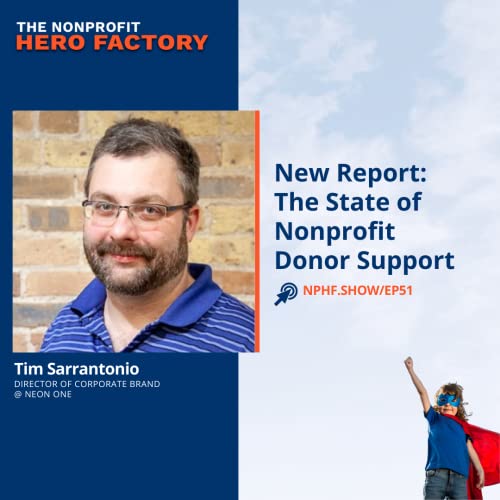
The Nonprofit Hero Factory cover art

The Nonprofit Hero Factory

The Nonprofit Hero Factory

Written by: dotOrgStrategy
Listen for free

About this listen

Join us for conversations with experts and thought-leaders on how to tap into storytelling, technology, best practices and latest trends to augment your communications and fundraising, maximize your resources, develop and deliver new programs, and generate revenue … so you can create a better world for all of us.dotOrgStrategy Economics Management Management & Leadership
Episodes
  • Episode 53: How Nonprofits Successfully Navigated the Pandemic, with Steven Shattuck
    Mar 31 2022
    How can nonprofits fundraise during a crisis without sounding opportunistic or worse, tone-deaf? Whether it’s disease, war or natural disaster, there always seems to be an emergency in the headlines. One thing is clear: in times of crisis, people become more empathetic and generous—and not just to causes directly related to the emergency. Data from the pandemic now shows that people gave to a wide diversity of nonprofit organizations. So why were some nonprofits able to expand while others felt sidelined and had to consolidate? A more nuanced look at the data delivered across the board revealed that those that did the best during the pandemic did two things: They asked for donations often, and they contextualized their appeals. Steven Shattuck, the Chief Engagement Officer at Bloomerang, looks at the data they and others collected and shares the takeaways that nonprofits can apply to their development strategy. ** Episode Links and Shownotes: https://nphf.show/ep53 ** What we discussed: • Why directly addressing a crisis can help you raise money • How to avoid the trap of a scarcity mindset • What is necessary for a humanistic appeal to supporters • Blending old and new technologies to build strong connections
    Show More Show Less
    36 mins
  • Episode 52: Nonprofit Supporter Communities with ROI for All, with Louis Diez
    Mar 24 2022
    The word “community” is frequently thrown around in nonprofit communications. But what does it actually mean, and what does it take to form a true community that provides value and drives increased repeat giving? At a time when nonprofits struggle with donor retention, efforts to tap into identity, increase value to donors, make them feel more invested, and retain them year after year, have to be a top priority for every nonprofit development, marketing and communications professional. Louis Diez, Director of the Annual Fund at Muhlenberg College believes describes his superpower as building communities of purpose that energize donors and raise donor participation and major gifts—and he has the numbers to prove it. Louis joins The Nonprofit Hero Factory to share how he builds communities that deliver ROI both to donors and to the organization, and how other nonprofits can do the same. ** Episode Links and Shownotes: https://nphf.show/ep52 ** What we’ll be discussing: • Why communities are critical to nonprofit organizations • Four factors that define community • How building communities of purpose energizes donors and raises donor participation and major gifts • How to create a community where people are so involved that it becomes a part of their identity • The best way to get donations without asking for them directly
    Show More Show Less
    35 mins
  • Episode 51: New Report: The State of Nonprofit Donor Support, with Tim Sarrantonio
    Mar 17 2022
    There’s a new individual giving report, and the good news is that household charitable giving is on the rise. The bad news is that over 80% of new donors don’t give to the same nonprofit again the following year. The biggest difference maker? Treating donors as individuals, understanding their motivations, and reinforcing how your work connects to their personal identity. In other words: personalized, story-based communication. Today, for example, people are generously donating in support of Ukraine, which is on our minds because of the invasion, violence and humanitarian crisis we are witnessing. For Boris, the crisis in Ukraine goes much deeper than what we are seeing on TV, but how likely are most people to continue giving when another crisis dominates headlines? Are we just locked in a cycle of emergency response giving? Tim Sarrantonio, the Director of Corporate Brand at Neon One, an integrated network of products and support for nonprofits, knows that finding accurate data and making connections between data and the broader story is the key to successful nonprofit fundraising. Neon One’s data report, Donors: Understanding the Future of Individual Giving, was released on March 8. He’s here to talk about what they discovered. ** Episode Links and Shownotes: https://nphf.show/ep51 ** What we’ll be discussing: • Where to find strong, relevant and timely data about individual giving behavior • What objective data says about what’s actually happening now • How data and storytelling come together to improve donor retention
    Show More Show Less
    39 mins
adbl_web_anon_alc_button_suppression_c
No reviews yet