• Architects of Change: A Six-Part Leadership Roadmap for the AI Era
    Jun 30 2026

    In this episode of The Practitioner Scholar, Dr. Sharon Ravitch sits down with Dr. Bridie Fanning, Managing Director at Accenture and former Chief HR Officer, to discuss her critical contributing chapter to the ground-breaking new book, Leaders as Architects of Change (edited by Dr. Sharon Ravitch and Dr. Raghu Krishnamoorthy). While modern headlines focus heavily on what artificial intelligence can automate, Dr. Bridie Fanning argues that the future of work will not be dictated by technology, but by leadership choices. This conversation dives deep into her chapter's core ethos: that AI is fundamentally a human learning story, that leaders must build psychological safety for continuous experimentation, and that traditional, linear change management models must be entirely rewritten to align with the framework of the book.

    Key Takeaways:

    • Amara’s Law in Action: Why we are currently overestimating AI's short-term hype while drastically underestimating its massive, long-term societal and operational impact.
    • The Death of Traditional Change Management: Moving away from traditional "Point A to Point B" transition models and adopting dynamic, continuous, and iterative organizational capabilities.
    • The "Inverted" Problem-Solving Approach: Why leaders must stop asking "What can AI do?" and instead start with their biggest organizational pain points, working backward to find technical solutions.
    Show More Show Less
    37 mins
  • Leaders as Architects of Collaboration
    May 28 2026

    Great collaboration doesn't happen. It's designed. So why do so many leadership teams still treat it as something that should just emerge naturally?

    In this episode of the PennCLO Podcast, The Practitioner Scholar, Dr. Sharon M. Ravitch speaks with PennCLO mentor and lecturer Dr. Phillip Ellis about designing organizations for collaboration, resilience, and adaptive leadership.

    Based on Phillip’s chapter in Leaders as Architects of Change: Designing Organizations for Connection and Resilience in Times of Uncertainty, this conversation explores why many teams struggle to collaborate in a world of uncertainty,and how leaders can create the conditions for deeper trust, innovation, and collective problem-solving.

    Together, they unpack:

    Why collaboration is a leadership design challenge

    • How “systems of knowing” shape teams and organizations
    • Why traditional leadership models struggle in uncertain environments
    • How leaders can foster more adaptive and resilient cultures

    Leaders who treat collaboration as a soft skill keep getting stuck results. This conversation makes the case for designing it instead.

    Show More Show Less
    44 mins
  • Designing for Uncertainty: Rethinking Leadership Beyond Control
    Apr 29 2026

    What if uncertainty isn’t the problem—but the point?

    In this episode of the PennCLO Podcast, Dr. Jennifer Neumaier sits down with Penn CLO doctoral alum Dr. Lucrecia Grandolini about her chapter on leading through uncertainty from the book Leaders as Architects: Designing Organizations for Connection and Resilience, co-edited by Dr. Sharon Ravitch (University of Pennsylvania Graduate School of Education) and Dr. Ragu Krishnamoorthy, Director of the Penn CLO program.

    Drawing on her global experience across financial services, consulting, and clinical psychology, Lucrecia challenges the traditional “plan–predict–control” model of leadership—and offers a compelling alternative.


    Together, they unpack:

    • Why uncertainty is both deeply human—and deeply misunderstood
    • The hidden cost of control: how it erodes trust and psychological safety
    • The “living iceberg” metaphor—and what leaders miss beneath the surface
    • What uncertainty-friendly organizations actually look like in practice
    • Four essential leadership practices for thriving in complexity

    This conversation is a powerful invitation to stop trying to eliminate uncertainty—and start designing for it.

    Show More Show Less
    29 mins
  • When the Map Disappears: Architecting Adaptability in a World That Won’t Slow Down
    Apr 2 2026

    Dr. Sharon Ravitch (University of Pennsylvania Graduate School of Education) interviews Penn CLO doctoral alum Oscar Arias about his chapter, “Leading in Flux,” from the book Leaders as Architects: Designing Organizations for Connection and Resilience, co-edited by Ravitch and Dr. Ragu Krishnamoorthy. Arias explains “flux” as leading when conditions constantly shift, and describes a move from VUCA to a BANI world where systems are brittle, anxiety rises, and change is non-linear and hard to comprehend. He argues many organizations are still built for stability, while disruptions like AI, low barriers to entry, and shifting customer behaviors erode old “moats.” Warning signs of brittleness include slow sharing of bad news, coverups, and inability to detect signals.

    Arias emphasizes trust, recovery, cultural intelligence, and leaders as architects who design rituals, structures, and decision rules for adaptability. He contrasts resilience (returning to baseline) with anti-fragility (getting stronger), highlighting learning agility through reflection, feedback seeking, experimentation, and diverse dissenting networks.

    Show More Show Less
    38 mins
  • How Motherhood Creates Stronger Leaders and The Hidden ROI of Working Parents
    Mar 24 2026

    What if one of the most powerful leadership development experiences doesn’t happen in the workplace at all?


    In this episode of The Practitioner Scholar: The Penn CLO Podcast, Gwen Mdinaradze, CEO of Edbridge, sits down with Dr. Becca Clanton, Ed.D., Americas Learning & Talent Development Leader at WSAudiology.

    Dr. Clanton shares findings from her research her own personal and professional stories about how motherhood grows leadership and strengthens other work-related skills. From navigating competing priorities to building deeper empathy and resilience, the experience of parenting can cultivate capabilities that organizations deeply need in their leaders.


    Together, Gwen and Dr. Clanton unpack the hidden value that working parents bring to organizations—and why recognizing this “invisible leadership training” can transform how companies think about leadership development.

    In this episode:

    • How motherhood strengthens key leadership capabilities
    • The hidden ROI organizations gain from supporting working parents
    • Lessons from the intersection of scholarship and real-world leadership
    • How companies can better support parents in the workplace
    Show More Show Less
    56 mins
  • PennCLO Presents: Leaders as Architects of Change - A pre-launch conversation for the forthcoming book
    Feb 24 2026

    In this special episode of the Practitioner Scholar podcast from the Penn Chief Learning Officer Doctoral program, Dr. Ragu Krishnamoorthy and Dr. Sharon Ravitch introduce their new book, 'Leaders as Architects of Change.' The discussion covers how modern leadership demands adaptability, resilience, and innovative thinking to navigate a world defined by rapid, unpredictable change.

    They explore the book’s two main parts: laying the foundation for understanding the current complexities and designing systems for sustainable growth. The episode delves into key insights from chapters on topics like adaptability, artificial intelligence, resilience, emotional intelligence in virtual teams, and designing for dissent. Each chapter is authored by practitioner scholars who share their unique perspectives and research. The hosts conclude by urging leaders to rethink their approaches, embed new logics, and foster environments where inquiry and collaboration thrive.

    Show More Show Less
    37 mins
  • Rethinking Psychological Safety: What Sales Can Teach Anyone About Cooperation and Trust
    Jan 24 2026

    In this episode of The Penn CLO Podcast, host Emma Zumsen sits down with Dr. Jess Jones, a recent graduate of the CLO program, to delve into her groundbreaking research on the intersection of B2B sales and psychological safety. Dr. Jones highlights how psychological safety, often focused on team dynamics within organizations, plays a crucial role in B2B sales environments.

    Moving beyond sales, the conversation delves into the concept of 'small L leaders,' who can foster psychological safety even without positional authority by applying three key principles. Specifically, Dr. Jones's research emphasizes strategies for building trust without positional authority, enabling respectful cooperation, and applying strategic patience. She also hints at her ongoing research exploring the application of these principles in broader workplace contexts. This episode is a must-listen for those interested in leadership, sales, and creating effective, trust-based professional relationships.

    Show More Show Less
    26 mins
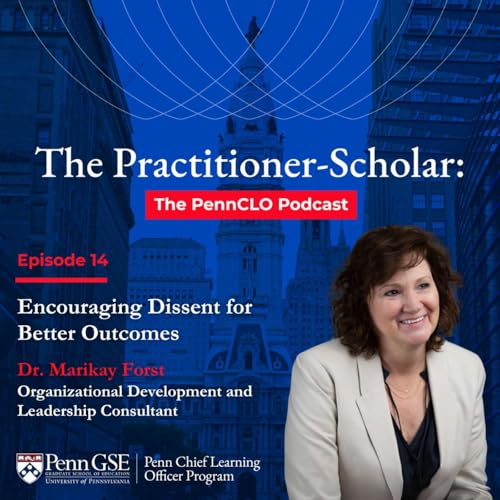
  • Encouraging Dissent for Better Outcomes
    May 29 2025

    In this episode of the Practitioner Scholar podcast, host Julio Zelaya sits down with Dr. Marikay Forst, a distinguished alumna of the Penn Chief Learning Officer program with over 25 years of experience in learning and development, human resources, and organizational behavior. Dr. Forst shares her academic journey, including her decision to join the Penn CLO program after gaining substantial professional experience.


    The central theme of discussion is the role of organizational practices in encouraging dissent and its importance in decision-making. Dr. Forst delves into her research findings, which included interviewing leaders across diverse organizations, revealing surprising insights like 'dissent ambivalence' and the impact of power dynamics on employee feedback. She emphasizes the significance of designing processes that foster healthy dissent and shares practical recommendations such as using facilitators, conducting interviews, and organizing innovation contests. Dr. Forst's expertise offers valuable lessons for leaders aiming to create environments where diverse viewpoints are heard and valued.

    Show More Show Less
    36 mins