The Road to Accountable AI cover art

The Road to Accountable AI

The Road to Accountable AI

Written by: Kevin Werbach
Listen for free

About this listen

Artificial intelligence is changing business, and the world. How can you navigate through the hype to understand AI's true potential, and the ways it can be implemented effectively, responsibly, and safely? Wharton Professor and Chair of Legal Studies and Business Ethics Kevin Werbach has analyzed emerging technologies for thirty years, and created one of the first business school course on legal and ethical considerations of AI in 2016. He interviews the experts and executives building accountable AI systems in the real world, today.2024 Economics
Episodes
  • Alexandru Voica: Responsible AI Video
    Dec 18 2025

    Alexandru Voica, Head of Corporate Affairs and Policy at Synthesia, discusses how the world's largest enterprise AI video platform has approached trust and safety from day one. He explains Synthesia's "three C's" framework—consent, control, and collaboration: never creating digital replicas without explicit permission, moderating every video before rendering, and engaging with policymakers to shape practical regulation. Voica acknowledges these safeguards have cost some business, but argues that for enterprise sales, trust is competitively essential. The company's content moderation has evolved from simple keyword detection to sophisticated LLM-based analysis, recently withstanding a rigorous public red team test organized by NIST and Humane Intelligence.

    Voica criticizes the EU AI Act's approach of regulating how AI systems are built rather than focusing on harmful outcomes, noting that smaller models can now match frontier capabilities while evading compute-threshold regulations. He points to the UK's outcome-focused approach—like criminalizing non-consensual deepfake pornography—as more effective. On adoption, Voica argues that AI companies should submit to rigorous third-party audits using ISO standards rather than publishing philosophical position papers—the thesis of his essay "Audits, Not Essays." The conversation closes personally: growing up in 1990s Romania with rare access to English tutoring, Voica sees AI-powered personalized education as a transformative opportunity to democratize learning.

    Alexandru Voica is the Head of Corporate Affairs and Policy at Synthesia, the UK's largest generative AI company and the world's leading AI video platform. He has worked in the technology industry for over 15 years, holding public affairs and engineering roles at Meta, NetEase, Ocado, and Arm. Voica holds an MSc in Computer Science from the Sant'Anna School of Advanced Studies and serves as an advisor to MBZUAI, the world's first AI university.

    Transcript

    Audits, Not Essays: How to Win Trust for Enterprise AI (Transformer)

    Synthesia's Content Moderation Systems Withstand Rigorous NIST, Humane Intelligence Red Team Test (Synthesia)

    Computerspeak Newsletter

    Show More Show Less
    38 mins
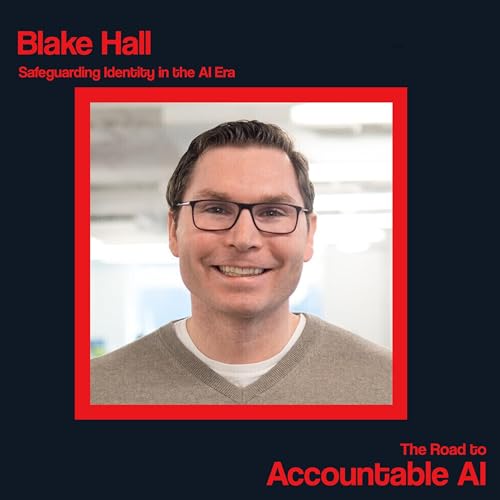
  • Blake Hall: Safeguarding Identity in the AI Era
    Dec 11 2025

    In this episode, Blake Hall, CEO of ID.me, discusses the massive escalation in online fraud driven by generative AI, noting that attacks have evolved from "Nigerian prince" scams to sophisticated, scalable social engineering campaigns that threaten even the most digital-savvy users. He explains that traditional knowledge-based verification methods are now obsolete due to data breaches, shifting the security battleground to biometric and possession-based verification. Hall details how his company uses advanced techniques—like analyzing light refraction on skin versus screens—to detect deepfakes, while emphasizing a "best of breed" approach that relies on government-tested vendors.

    Beyond the threats, Hall outlines a positive vision for a digital wallet that functions as a user-controlled "digital twin," allowing individuals to share only necessary data (tokenized identity) rather than overexposing personal information. He argues that government agencies must play a stronger role in validating core identity attributes to stop synthetic fraud and suggests that future AI "agents" will rely on cryptographically signed credentials to act on our behalf securely. Ultimately, he advocates for a model where companies "sell trust, not data," empowering users to control their own digital identity across finance, healthcare, and government services.

    Blake Hall is the Co-Founder and CEO of ID.me, a digital identity network with over 150 million members that simplifies how individuals prove and share their identity online. A former U.S. Army Ranger, Hall led a reconnaissance platoon in Iraq and was awarded two Bronze Stars, including one for valor, before earning his MBA from Harvard Business School. He has been recognized as CEO of the Year by One World Identity and an Entrepreneur of the Year by Ernst & Young for his work in pioneering secure, user-centric digital identity solutions.

    Transcript

    He Once Hunted Terrorists in Iraq. Now He Runs a $2 Billion Identity Verification Company (Inc., November 11, 2025)

    "No Identity Left Behind": How Identity Verification Can Improve Digital Equity (ID.me)

    Show More Show Less
    34 mins
  • Mitch Kapor: AI Gap-Closing
    Dec 4 2025

    Legendary entrepreneur and investor Mitch Kapor draws on his decades of experience to argue that while AI represents a massive wave of disruptive innovation, it also represents an opportunity to avoid mistakes made with social media and the early internet. In this episode, he contends that technologists tend toward over-optimism about technology solving human problems while underestimating downsides. Self-regulation by large AI companies like OpenAI and Anthropic is likely to fail, he suggests, because incentives to aggregate power and wealth are too strong, requiring external pressure and oversight. Kapor explains that his responsible investing approach at his venture capital firm, Kapor Capital, focuses on gap-closing rather than diversity for its own sake, funding startups that address structural inequalities in access, opportunity, or outcomes, regardless of founder demographics. He discusses the Humanity AI initiative and argues that philanthropy needs to develop AI literacy and technical capacity, with some foundations hiring chief technology officers to effectively engage with these issues. He believes targeted interventions can create meaningful change without matching the massive investments of the major AI labs. Kapor expresses hope that a younger generation of leaders in tech and philanthropy can step up to make positive differences, emphasizing that his generation should empower them rather than occupying seats at the table.

    Mitch Kapor is a pioneering technology entrepreneur, investor, and philanthropist who founded Lotus Development Corporation and created Lotus 1-2-3, the breakthrough spreadsheet software that helped establish the PC software industry in the 1980s. He co-founded the Electronic Frontier Foundation to advocate for digital rights and civil liberties, and later established Kapor Capital with his wife Freada Kapor Klein to invest in startups that close gaps of access, opportunity, and outcome for underrepresented communities. Kapor recently completed a masters degree at the MIT Sloan School focused on gap-closing investing, returning to finish what he started 45 years earlier when he left MIT to pursue his career in Silicon Valley. He serves on the steering committee of Humanity AI, a $500 million initiative to ensure AI benefits society broadly.

    Show More Show Less
    32 mins
No reviews yet