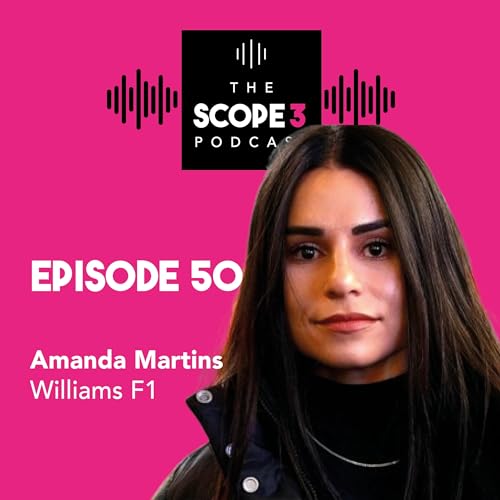
The Scope 3 Podcast cover art

The Scope 3 Podcast

The Scope 3 Podcast

Written by: Narrative Matters
Listen for free

About this listen

A podcast for business leaders looking to discover solutions, insights and best practice to address their Scope 3 emissions.Narrative Matters Economics
Episodes
  • Ep 50: Williams F1 and Neutreeno
    May 6 2026

    This episode features two very different conversations, but both land on the same core question: how do companies actually make Scope 3 decisions in the real world when cost, speed, suppliers, engineering, data quality, and commercial pressure all collide?

    First up, Ollie speaks with Amanda Martins, Head of Sustainability at Williams F1 Racing. Amanda brings a procurement and supply chain mindset into sustainability – and it completely changes the conversation. Instead of focusing purely on frameworks and reporting, she talks about supplier maturity, operational decision-making, multidisciplinary teams, and why sustainability teams need to add value rather than create noise.

    The discussion explores:

    • What Scope 3 looks like inside a Formula 1 team

    • Why procurement professionals are often best placed to drive decarbonisation

    • The challenge of forecasting emissions in a hyper-fast-moving environment

    • Supplier engagement in highly competitive and IP-sensitive industries

    • Building teams capable of turning sustainability ambition into execution

    • Why ‘getting sh*t done’ matters more than sustainability theatre

    Then, Tom sits down with Spencer Brennan, founder and CEO of Neutreeno, a Cambridge spinout using engineering intelligence to help companies reduce emissions and costs simultaneously. Spencer explains why industrial decarbonisation is being held back by a focus on reporting over action, and introduces the idea of “action-grade data”: information that is credible, scalable, and good enough to make real operational decisions quickly.

    That conversation covers:

    • Why Scope 3 has become stuck as a reporting exercise

    • The tension between speed and accuracy in emissions data

    • The risks and limitations of AI-generated emissions modelling

    • How manufacturers can reduce emissions through material and energy efficiency

    • Why supplier engagement still remains one of the biggest blockers

    • The commercial case for decarbonisation through performance, resilience, and cost reduction

    Elsewhere in the episode:

    • Roee Goldberg from Atmospheric AI joins the show to discuss the Strait of Hormuz crisis and what it reveals about supply chain transparency, petrochemical pricing, resilience, and procurement intelligence. He has produced a fascinating paper on the subject, which is available here

    • Ollie, Tom, and Dexter unpack the proposed GHG Protocol changes – and what a 95% Scope 3 reporting requirement could mean in practice

    • The team also discuss the launch of the latest Scope 3 Tools Intelligence report, including the explosion of platforms, AI-driven risk tools, and the growing challenge of navigating the market

    If you work in procurement, sustainability, supply chain, carbon accounting, supplier engagement, or industrial decarbonisation – this episode is jam-packed with practical insight, honest discussion, and plenty of opinions.


    🎧 Enjoy. And remember: all of our previous episodes are available online at www.scope3peergroup.com/podcast.

    Show More Show Less
    1 hr and 11 mins
  • Ep 49: $20k for Scope 3? Not even close. Plus, insights from WAP Sustainability
    Apr 22 2026

    In this episode, Ollie, Tom and Dexter unpack a rapidly shifting landscape – from regulation and standards to the reality of making Scope 3 actually work in practice.

    They start by exploring what’s happening across the Scope 3 market right now:

    • why regulation like CBAM – the Carbon Border Adjustment Mechanism – is starting to force real change and drive demand for primary data

    • what the latest GHG Protocol updates mean in practice, including the push for 95% coverage and better data quality

    • the emergence of new frameworks like the AIM Platform and what they signal about how companies will account for “real world” decarbonisation actions

    • the wave of market consolidation, including major moves from Makersite, SiGreen and Carbon Maps, as the tools landscape begins to mature

    They also reflect on new research showing a growing gap: companies are broadly on track for Scope 1 and 2, but still significantly off track on Scope 3 – with 2030 targets fast approaching.

    Then, it’s time to revisit the controversial figures coming out of the California Air Resources Board (CARB), which suggest Scope 3 reporting could cost as little as $8,000-$20,000. The team dig into why those numbers don’t stack up in the real world, what might be driving them politically, and the risk of oversimplifying what Scope 3 really involves once companies move beyond basic reporting.

    Ollie catches up with environmental lawyer and former Navistar sustainability leader Chris Perzan, who gives a grounded, insider view of what’s really happening behind the CARB proposals. They explore how California has effectively become the centre of gravity for Scope 3 regulation in the US, why translating voluntary standards like the GHG Protocol into enforceable rules is so difficult, and the risk that companies default to easier, less accurate approaches like spend-based data. Chris also shares his perspective on the wider regulatory upheaval in the US, including major rollbacks in federal climate policy and what that could mean for companies trying to plan and hit their targets.

    In the second half, Tom sits down with William Paddock, founder of WAP Sustainability, for a deep dive into the reality of Scope 3 execution. This is a conversation about what actually breaks once companies move from reporting to action. William explains why “lower carbon” purchasing decisions often fail to show up in Scope 3 numbers, how disconnected tools and methodologies are creating confusion, and why he sees Scope 3 fundamentally as a data and structure problem.

    They get into the practicalities of supplier engagement – why most emissions sit with a relatively small number of suppliers, why companies underestimate how much data already exists, and why simply asking for it is often the biggest unlock. The discussion also challenges some of the prevailing narratives in sustainability, arguing that real progress often comes not from big, headline-grabbing innovations, but from better data, better accounting, and smarter procurement decisions.

    It’s another wide-ranging episode that moves from policy to practice, from theory to execution – and ultimately asks what it will take to turn Scope 3 from a reporting exercise into something that genuinely drives change.


    🎧 Enjoy. And remember: all of our previous episodes are available online at www.scope3peergroup.com/podcast.

    Show More Show Less
    1 hr and 3 mins
  • Ep 48: The Warehouse Group, PACT and RESET Carbon
    Apr 8 2026

    Ollie (broken rib et al), Tom and Dexter open episode 48 with a discussion on new developments from the California Air Resources Board around the Corporate Climate Data Accountability Act. A key point of debate is the estimated cost of Scope 3 reporting, quoted at $8,000–$20,000, which the hosts suggest is likely understated and politically positioned to help legislation pass. It’s a chat that highlights the wide gap between basic reporting approaches and the far more resource-intensive work of supplier engagement and emissions reduction, alongside growing demand for clearer business cases tied to cost savings and resilience.

    Then, Izzy Farnsworth senior associate at PACT, joins the studio to introduce a new white paper focused on how companies can actually use product carbon footprint data. Rather than focusing on calculation, the work addresses the practical challenge of applying uneven, incomplete supplier data. The key shift is from asking whether data is ‘high quality’ to whether it’s ‘fit for purpose’, helping companies make better decisions with imperfect inputs. The white paper is being piloted throughout 2026, with the aim of embedding this approach into PACT’s methodology and broader infrastructure, which enables standardised exchange of product-level emissions data across supply chains.

    Phil Cumming then shares his perspective from leading sustainability at The Warehouse Group in New Zealand, drawing on a career that spans the London 2012 Olympics, Kingfisher and Marks & Spencer. He describes how around 90 percent of the company’s impact sits in the supply chain and outlines practical steps being taken, including a supplier carbon engagement programme covering around 300 suppliers and a sustainability-linked supply chain finance initiative with HSBC to incentivise action. He also reflects on New Zealand’s evolving regulatory landscape and the growing importance of peer collaboration, particularly in regions where capability gaps remain.

    A central theme of Phil’s interview is that many of the core challenges haven’t fundamentally changed. Supplier engagement remains the top priority, but there is still a lack of consensus on data, tools and methodologies. He argues that progress will not come from solution providers alone, but from peers working together to define shared principles and reduce fragmentation across the market.

    The episode then shifts to Liam Salter, CEO of RESET Carbon, which is part of the LRQA group, a leading global assurance provider operating in over 150 countries. He focuses on what it actually takes to deliver decarbonisation inside supply chains across Asia. He explains that many companies arrive with ambitious targets but no clear plan, and that the biggest barrier is often the absence of a compelling commercial value proposition for suppliers. Without clear incentives linked to business outcomes, suppliers are unlikely to prioritise investment, even where returns are positive.
    🎧 Enjoy. And remember: all of our previous episodes are available online at www.scope3peergroup.com/podcast.

    Show More Show Less
    1 hr and 27 mins
adbl_web_anon_alc_button_suppression_c
No reviews yet