The Spillover cover art

The Spillover

The Spillover

Written by: Council on Foreign Relations
Listen for free

About this listen

How do critical international developments shape economic and financial markets worldwide? Each week, The Spillover examines the ripple effects of global events across policy, geopolitics, economics, finance, and technology. This podcast helps you better understand what’s happening, and why it matters to businesses, global markets, and the world.

Copyright 2026 All rights reserved.
Economics Politics & Government
Episodes
  • K-Shaped Everything + Affordability Crisis + Trump vs. Mamdani Populism
    Apr 28 2026

    This episode unpacks the concept of a K-shaped economy, examines how AI, war, and climate shocks may be widening inequality within and between countries, and explains why the divide is so hard to measure. It also explores competing responses to the affordability crisis—from Trump’s to Mamdani’s—and asks if a more centrist path could offer better solutions.

    Hosts:

    Rebecca Patterson, Senior Fellow, Council on Foreign Relations (CFR)

    Sebastian Mallaby, Paul A. Volcker Senior Fellow for International Economics, Council on Foreign Relations (CFR)

    We discuss:

    • How a true K-shaped economy features a widening divergence in which some groups accelerate upward while others fall behind.
    • Why measuring the K-shaped economy is complicated, with major disagreements over data and methodology.
    • How asset ownership, not just wages, helps explain why wealthier households pulled ahead during and after COVID through equities, housing, and cheap credit.
    • Why inflation, war-driven energy and food shocks, and different household spending patterns can deepen economic divergence, especially for lower-income households.
    • How the “mega K” concept applies globally, with geopolitical shocks like the Iran and Ukraine wars worsening divides between rich and poor countries.
    • How artificial intelligence and climate change could worsen the K phenomenon, disproportionately pressuring workers, poorer countries, and those without capital.
    • How contrasting policy prescriptions—from Trump’s tariffs and immigration restrictions to Mamdani’s proposed taxes on wealthy second-home owners—reflect competing populist approaches to affordability.
    • How a revival of “radical centrism,” combining fiscally responsible reforms with practical policies to manage inequality, AI disruption, and long-term economic inclusion might help.

    Mentioned on the Episode:

    “America’s Affordability Crisis Is (Mostly) a Mirage,” The Economist

    “Going Bananas Over Affordability,” Inside Economics

    “Compare Wealth Components Across Groups,” The Federal Reserve

    Want to keep up with The Spillover? Sign up to receive an email alert when new episodes are released.

    The Spillover is a production of the Council on Foreign Relations. The opinions expressed on the show are solely those of the hosts and guests, not of the Council, which takes no institutional positions on matters of policy.

    Show More Show Less
    51 mins
  • Is the Gulf Still the Capital of Capital? + How War Could Hurt America’s Tech Funding
    Apr 22 2026

    This episode explores how the Gulf region transformed into a global “capital of capital,” and the risk of the Iran conflict disrupting that role. It examines the ripple effects on global markets, U.S. tech and AI investment, and the broader balance of economic power if Gulf capital starts turning inward to focus on defense.

    Hosts:

    Rebecca Patterson, Senior Fellow, CFR

    Sebastian Mallaby, Paul A. Volcker Senior Fellow for International Economics, CFR

    We discuss:

    • How the Gulf transformed itself from a group of oil-dependent economies into a global “capital of capital,” attracting trillions in investment, talent, and tech partnerships.
    • The scale of Gulf sovereign wealth funds and why it became a critical funding source for global markets, especially U.S. tech and AI.
    • How a prolonged conflict could force Gulf states to redirect capital inward toward defense and reconstruction.
    • As Sebastian Mallaby puts it: “If the capital of capital turns inward in any significant way, the global effects could be profound.”
    • How the Iran war challenges the core assumption that the Gulf could remain insulated from geopolitics.
    • The Gulf's history of boom-bust cycles and a key difference in the current bust: it's not about price, but the ability to move energy through key chokepoints like the Strait of Hormuz.
    • How disruptions hit different Gulf economies in different ways, from physical damage in energy exporters to confidence shocks in hubs like Dubai.
    • The potential global spillover of less Gulf capital flowing into U.S. markets, private equity, and AI infrastructure and what that means for everyday outcomes—higher bond yields, slower asset growth, and ripple effects on things like mortgage rates.
    • The big open question: if the Gulf steps back as a global capital provider, who, if anyone, can replace it?

    Mentioned on the Episode:

    “How the US grows from PIF’s pioneering investments,” Newswire

    “Sovereign Wealth Funds and Public Pension Funds Tracker,” Global SWF

    Want to keep up with The Spillover? Sign up to receive an email alert when new episodes are released.

    The Spillover is a production of the Council on Foreign Relations. The opinions expressed on the show are solely those of the hosts and guests, not of the Council, which takes no institutional positions on matters of policy.

    Show More Show Less
    43 mins
  • The Hormuz Shock + Why the Fed is “On Hold”
    Apr 16 2026

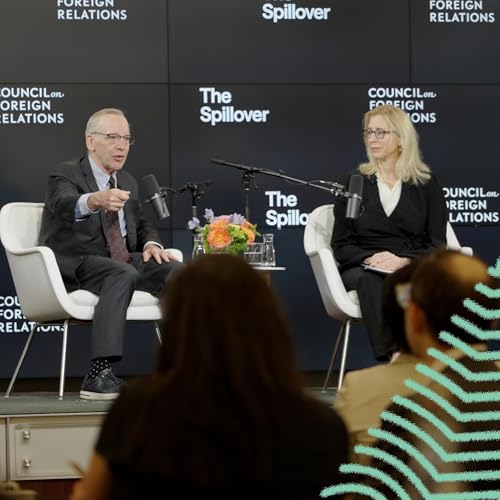
    Live from Washington, DC, this episode unpacks how war, AI, financial innovation, and global institutions are reshaping monetary policy, market stability, and the future of the international economic order.

    Host:

    Rebecca Patterson, Senior Fellow, Council on Foreign Relations

    Guest:

    William C. Dudley, Chair, Bretton Woods Committee; Former President and CEO, Federal Reserve Bank of New York

    We discuss:

    • Whether monetary policy can still do the heavy lifting in a war-shaken macro environment.
    • AI, productivity, and the inflation debate.
    • The future of the Fed as an institution.
    • The rise of non-bank finance and new financial stability risks.
    • How global financial institutions and digital finance must adapt to structural change.

    Mentioned on the Episode:

    Pierre-Olivier Gourinchas, “War Darkens Global Economic Outlook and Reshapes Policy Priorities,” International Monetary Fund (IMF)

    “Chair Powell’s Press Conference”

    The Bretton Woods Committee

    Want to keep up with The Spillover? Sign up to receive an email alert when new episodes are released.

    The Spillover is a production of the Council on Foreign Relations. The opinions expressed on the show are solely those of the hosts and guests, not of the Council, which takes no institutional positions on matters of policy.

    Show More Show Less
    30 mins
No reviews yet