The TWIML AI Podcast (formerly This Week in Machine Learning & Artificial Intelligence) cover art

The TWIML AI Podcast (formerly This Week in Machine Learning & Artificial Intelligence)

The TWIML AI Podcast (formerly This Week in Machine Learning & Artificial Intelligence)

Written by: Sam Charrington
Listen for free

Machine learning and artificial intelligence are dramatically changing the way businesses operate and people live. The TWIML AI Podcast brings the top minds and ideas from the world of ML and AI to a broad and influential community of ML/AI researchers, data scientists, engineers and tech-savvy business and IT leaders. Hosted by Sam Charrington, a sought after industry analyst, speaker, commentator and thought leader. Technologies covered include machine learning, artificial intelligence, deep learning, natural language processing, neural networks, analytics, computer science, data science and more.All rights reserved Politics & Government Science
Episodes
  • Do AI Tokenomics Matter More Than Model Benchmarks? with Chris Potts - #776
    Sep 9 2026
    As reasoning models consume more tokens and AI systems become more expensive to run, understanding what those tokens actually buy is becoming increasingly important. In this episode, Stanford professor and Big Spin co-founder Chris Potts joins us to discuss AI tokenomics and his research into “tokenflation”—the possibility that token usage is growing faster than the measurable value those tokens produce. We explore how to measure the return on AI spending, why benchmarks alone provide an incomplete picture of model progress, and what inference-time scaling means for the economics of increasingly capable models. Chris also explains why expert AI users tend to get better results by challenging and iterating with models, how AI fluency affects outcomes, and why more efficient architectures could change the underlying economics. We also discuss DSPy, interpretability, the limits of today’s transformer architectures, and where Chris sees opportunities for more fundamental innovation in AI. 🗒️ Full show notes: ⁠⁠https://twimlai.com/go/776.
    Show More Show Less
    59 mins
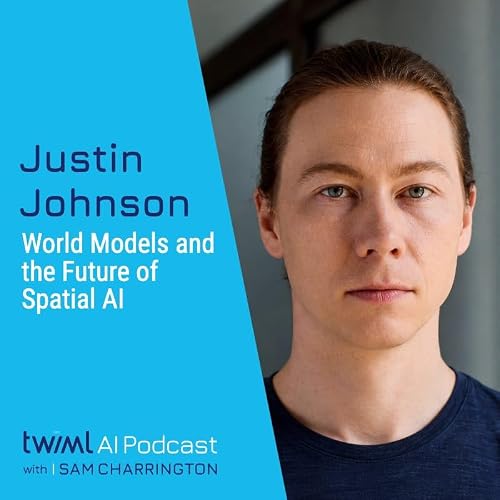
  • World Models and the Future of Spatial AI with Justin Johnson - #775
    Sep 1 2026
    In this episode, Justin Johnson, co-founder of World Labs, joins us to discuss world models and the emerging field of spatial AI. We explore why many researchers see capabilities beyond language as an important frontier for AI, and what it means to build models that can understand, generate, and simulate the environments around them. Justin explains the different approaches to world modeling, including explicit 3D representations and generative models, and why there is still no established recipe for building these systems. We also discuss World Labs’ Marble system, which can generate navigable 3D worlds from images and other inputs, the challenges of evaluating world models, and the role of simulation, planning, and action. Finally, Justin shares his vision for models that bring these capabilities together, supporting everything from interactive virtual environments to agents and robots that can operate in the physical world. 🗒️ Full show notes: ⁠https://twimlai.com/go/775.
    Show More Show Less
    1 hr and 6 mins
  • Why the Next AI Breakthrough May Come from Physics with Max Welling - #774
    Aug 26 2026
    The conventional wisdom in AI is that the next breakthrough will come from more compute, more data, and larger models. But what if the next leap comes from somewhere else? In this episode, Max Welling—co-founder and CTO of CuspAI and professor at the University of Amsterdam—argues that physics may provide some of the ideas behind the next generation of AI systems. We begin with CuspAI’s work using generative AI to design entirely new materials for semiconductors, batteries, carbon capture, and clean energy. Max explains how foundation models for chemistry, agentic workflows, simulation, and automated experimentation are dramatically accelerating the search for new materials and reshaping scientific discovery. The conversation then broadens into a deeper question. Beyond giving AI new scientific problems to solve, can physics also teach us how to build better AI? Max explores surprising connections between machine learning and thermodynamics, why waves may become a new computational primitive for neural networks, and how concepts like symmetry breaking and statistical physics could inspire AI architectures beyond today’s scaling paradigm. 🗒️ Full show notes: https://twimlai.com/go/774.
    Show More Show Less
    58 mins
adbl_web_anon_alc_button_suppression_t1
No reviews yet