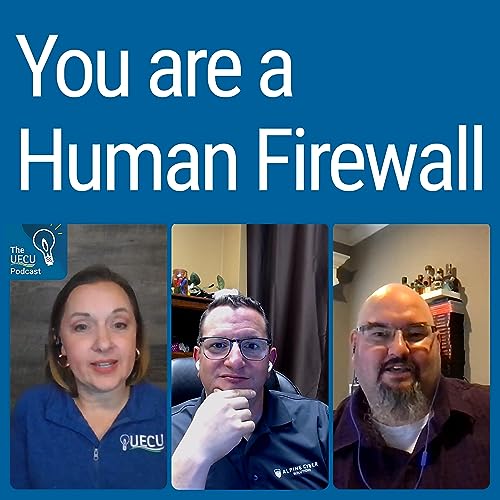
• You are a Human Firewall
    Aug 8 2023
    Cybersecurity is a partnership.

    UECU plays an active role in keeping our members' information and accounts safe from troublemakers. Our dedicated staff works with great people from Alpine Cyber Solutions to make sure we head off trouble. But we can't do it alone.

    Account owners have an important role to play, because safe and secure technology is just one piece of the cybersecurity puzzle. UECU consistently strives to improve and increase account security through ongoing testing, training and new technology. Unfortunately, all it takes is a shared password or personal information, outdated account owner contact information, or responding to a troublemaker's urgent and anxiety-inducing email, call or text message to break through the firewall; namely, the human one. 

    Today, we talk with Alpine Cyber Solutions President and Chief Technology Officer Steven Pressman and Alpine's Technical Business Analyst David Bock to understand the roles that both organizations and individuals play in keeping their information and their accounts safe. For both sides of that equation, the human firewall is the most important variable.

    Learn how to become a great human firewall at work and at home. Our digital footprint is only getting bigger. Secure yours today.

    Topics & Timing

    (00:28) Today's topic is cybersecurity: how to keep your information and your accounts safe and secure

    (01:06) Why do security breaches happen? 1) It's easy money, and 2) humans make mistakes.

    (01:24) UECU works hard to protect our members' accounts and information, but individuals have an important role to play as well. It's a partnership.

    (01:44) Cybersecurity facts to consider: the average cost of a data breach so far in 2023 is $4.45M; The financial industry has the second highest average cost of $5.9M; and the two most used methods to secure that information is phishing and stolen credentials.

    (02:40) Meet our guests from Alpine Cyber Solutions: Technical Business Analyst David Bock, and President/Chief Technology Officer Steven Pressman. Learn how they made their way to their current career and what they like to do for fun.

    (13:20) Topic discussion about Cybersecurity begins with an overview of how UECU, with help from Alpine, keeps on top of Cybersecurity.

    (14:11) What is Vulnerability Management? It's not the plot to a Rom-Com!

    (15:07) QUOTE "Literally everything that we're going to talk about what we do with the Credit Union, applies to everyone's personal life in some way, shape or form. There's nothing different that a company needs to do to protect data that a person doesn't need to do to protect their data." - Steve

    (15:45) Vulnerabilities are something that are known (or unknown) to be wrong on a device, such as a flaw in a piece of software. We have to search for those that are known, and indicators of the unknown. In both cases, we then overcome them. Today, these scans are continuous.

    (23:15) Penetration Testing is when we rely on trusted individuals/services to try to access our systems/information by either physically entering the building in an unofficial capacity, creating a relationship with an employee to gain needed information, or looking for known system vulnerabilities that haven't been patched yet to "get in."

    (26:50) Many people think a hacker gets in by penetrating the system firewall. It very rarely works if the firewall is being kept up-to-date. It more often happens by getting through the "Squishy Parts" (the humans) as Steve refers to them.

    (27:25) QUOTE "There's a term we like to use called the Human Firewall, where we train people to understand that they have a very active role in cybersecurity." - Dave

    (27:36) Phishing and Social Engineering are attacks aimed at people (employees and individuals). People try to "fish" for information through various contact methods, perhaps providing a link that downloads...

    Show More Show Less
    1 hr and 55 mins
  • People Helping People, UECU-Style
    Sep 29 2022
    People Helping People is more than just a philosophy.

    It is part of UECU's employee experience all year long. While we support local organizations with our personal and corporate gifts, we also get to know the organizations we support and the people they serve by "getting out there."

    It is one thing (and an important one!) to give financially to help further the work of important services and organizations in our community. It just means so much more when we join in the effort personally.

    However, UECU's community goes far beyond just our geographical hometown. We are equally connected to the utility and energy industry nationwide. It is simply part of UECU's DNA and we look forward to opportunities to travel and participate in events where they gather and celebrate the work they do. We enjoy celebrating with them!

    Today we talk with Dawn Pavlick and Kaitlin Keck, two UECU staff members who help lead our charge for giving and volunteering in our community and beyond. Press "play" and you'll see just how much "People Helping People" really means to us.

    Topics & Timing

    (0:37) Today’s discussion is out UECU’s commitment to our community, through direct employee involvement and support as well as the organization’s outreach and sponsorship of local and industry-related causes and events.

    (1:10) Meet our guests, and Janene’s UECU co-workers: Dawn Pavlick, Loan Processing Manager & Co-Chair of the Employee Volunteer Program Committee, and Kaitlyn Keck, Business Development Specialist & Chair of our United Way Committee.

    (2:18) The credit union industry’s collective philosophy is “People Helping People.”

    (2:45) That philosophy was a natural outcome of the credit union industry’s creation to meet the post-depression-era need for personal and small business banking services left unmet during that tumultuous time.

    (4:12) If the motto of the industry is “People Helping People,” then our goal is to do more than just offering banking services. We also want to make a difference.

    (5:05) Get to know Kaitlin and Dawn, how they came to be part of the UECU team and the things that make them happy outside of the workday.

    (8:30) UECU’s history of supporting our local United Way of Berks County.

    (8:52) UECU has been financially supporting United Way since 1996, encouraging employees to help meet our community’s needs.

    (10:23) Overview of United Way of Berks County: they support over 30 non-profit agencies that meet direct community needs. The majority of the work they do is managed by volunteers and is the direct result of community assessments, often responding to needs that arise quickly, like Covid’s affect on personal finances that increased needs for food and housing, and more.

    (13:01) Another value of United Way is the opportunity to provide a credible option for general community giving, for those individuals who want to give but don’t know who to support.

    (14:35) How does the UECU team support United Way specifically? 10 staff are currently on the United Way Committee. That’s 10% of UECU staff!

    (15:20) UECU is currently in the top 50 United Way of Berks County Business Supporters (31st).

    (15:50) The United Way committee at UECU holds monthly fundraisers and events to raise funds to put toward our annual campaign gift, and to provide ongoing awareness of United Way and the great work they do.

    (18:00) Overview of our experiences during the annual fall United Way fundraising campaign, and how that’s not the beginning and the end of UECU’s work to support United Way.

    (19:44) UECU as an organization supports and encourages UECU campaign giving with unique gifts that employees enjoy, such as give-a-day, get-a-day where UECU gives employees a day of PTO if they pledge an annual gift equal or more than a single day of pay…and so much more.

    (21:23) The annual campaign raffle is one way that the...

    Show More Show Less
    1 hr and 1 min
  • I Want the Guys Behind Me to Be Better Linemen Than I Am
    Aug 22 2022
    Work/life balance is tough for most of us.

    But when you add last minute work “opportunities” that can be several states away from home for weeks at a time, that’s a whole ‘nother level, as they say. Today we talk with a member and friend who spends his days as an electric lineman. Herb Lovett loves his job, but he acknowledges that his mindset is always “family first.”

    But he isn’t alone. His family is part of a very tight and supportive “linelife” family. They take their commitment to safety, to each other, and to their families very seriously…even as they enjoy the challenge and tomorrow-is-never-the-same-as-yesterday job that ranks as the third most dangerous in the US. Turning on the lights for a neighborhood or a town is a thrill and so are the new work “toys” that make their work safer, but getting home in the same condition they started the day is paramount.

    Line workers are highly trained through apprenticeship programs (often at little or no cost) and they earn a good living (if you enjoy heights, working outdoors in all kinds of weather, and take safety seriously). Yet many people don’t know much about this fulfilling career, especially as many experienced workers are retiring at a fast pace. Herb is happy to change that, and encourages the next generation of line workers to be like him, but even better, in all aspects of the linelife. 

    Topics & Timing:

    (0:41) Today’s discussion will explore the life of an electric lineman through the eyes of one we know very well.

    (0:50) Recap of our interview with Rae Johnson, President of NSUJL, and an update on her and her husband Tom, an electric lineman facing recovery from an injury. They are in our thoughts and we are pulling for them alongside their friends and peers nationwide. (see links below for ways to show them your support)

    (2:20) Electric Lineman: 42/100,000 lost on the job each year, 2,400 injuries: 3rd most dangerous job

    (3:25) Meet Herb Lovett, Electric Lineman

    (3:53) Herb just spent some time with Rae and Tom at NSUJL’s annual rodeo and Climbing for Lost Lineman event, and shared links to help meet their needs during this difficult time. (see links list)

    (5:50) How did Herb even find this line of work? He always new he wanted to work outside, and tried a few different options before finding linework.

    (6:39) He learned about the profession while doing roof work, and having conversations with a line worker who was a neighbor of a friend.

    (7:12) Where to start? He chose to go to Power Systems Institute (PSI), a program of First Energy Company) to enter the trade in 2007.

    (7:30) PSI has trained around 4-5,000 line workers since it’s inception across 5 states via multiple training locations.

    (8:31) The need for electric lineman and electric workers is greatly needed nationwide.

    (9:13) First Energy isn’t alone in providing job training programs like this. Many power utility companies offer similar training. And, The IBEW also provides apprenticeship training for this as well.

    (9:30) QUOTE: “There’s multiple pipelines. If you want to be a lineman, you can be a lineman if you’re physically able to and you can do the job.” -Herb

    (9:40) It’s not a common choice for a career, because it’s not often presented as a choice. And, it’s often just taken for granted because the power is most always there when we need it.

    (10:11) What was the training like? Herb provides an overview of the program he was part of and the cost (hint, hint…it was free for him!). It combined on-site training, as well as classes through the local community college.

    (11:03) QUOTE: “I was learning the trade: how to tie nots, how to wire up transformers, how to climb. …After four years, you’re a Journeyman Lineman. You kinda know what you’re doing, but we’re learning every day.” -Herb

    (11:50) Training for this dangerous work is rigorous. Herb started with 50...

    Show More Show Less
    1 hr and 1 min
  • NSUJL: Because There's No Eraser on a Lineman's Pen
    Jun 16 2022
    Helping and Supporting Line Workers and Their Families

    This month our discussion takes a turn to get to know some of the people UECU serves and supports. As a Credit Union that has served utility workers since 1934, we've gotten to know first-hand how important their work is, and the many different ways they keep their communities safe, connected and comfortable. Today, we'll spend some time getting to know the challenges that families face when a spouse works the third most dangerous job in the US, and how the National Sisterhood United for Journeymen Linemen (NSUJL) helps when it is needed most.

    Rae Johnson, President and Founder of the NSUJL, found her purpose. In doing so, her life experiences, all of the pain and struggle she personally faced came full circle to make that purpose possible. Now Rae and the NSUJL help others through times like she's experienced...on a national level. Today, we get to hear her story and the story of the organization she help create. You won't want to miss it.

    Topics & Timing:

    (1:30) Electric Lineman: 42/100,000 lost on the job each year, 2,400 injuries: 3rd most dangerous job

    (2:52) Meet Rae Johnson, President and Founder of National Sisterhood United for Journeyman Linemen

    (5:00) How NSUJL was founded, and why. Now celebrating their 10th year!

    (5:50) How Rae’s injury and industry experience played and continues to play such important role in the work of NSUJL.

    (7:34) QUOTE: “It was definitely the moment when your whole like finally makes sense, your purpose…” -Rae

    (7:59) Why line worker families need NSUJL's help

    (8:28) How NSUJL got started and the help they could offer. “It was a dream, a home, an intent” -Rae

    (10:48) Quick overview of a line worker’s life, and the life of the line family

    (11:41) Storm duty and how it effects the family and the ability of the spouse to work

    (12:28) Injuries and their impact on the line worker family, and what NSUJL does to help.

    (14:25) QUOTE Regarding power outages: “My respect and understanding for what happens in that small amount of time has grown tremendously” -Janene

    (14:58) Why electric workers have storm duty beyond the boundaries of the company they work for (Mutual Aid Agreements)

    (16:46) The real story behind “Oh, my lights went out…where are they?”

    (19:40) Third most dangerous job means injuries happen. This is where NSUJL steps in, because the families are not always prepared for that situation.

    (20:39) QUOTE: “I’m a big advocate for financial preparation” -Rae

    (25:00) All of those things are part of an estate plan. Learn more about Estate Planning in a quick and easy way with UECU’s www.uecu.org/cueitup short e-courses.

    (26:46) QUOTE: “42 out of 100,000, that’s not going to be me. The fact is it’s somebody.” – Janene. It’s important to be prepared.

    (27:40) Preparation is important, but it’s important to fully prepare. Even with full preparation, the need for NSUJL support is still real.

    (32:50) How NSUJL offers support and reaches the families is different for each situation.

    (34:33) NSUJL provides financial support, trauma therapy, in-home care provided by their nationwide members, and more.

    (35:30) NSUJL is member-powered, just like UECU! Their members are the ones that meet personally with families in need, run the organization, represent the organization at events, and more.

    (38:30) The NSUJL Line Worker Benefit Rodeo and the Climbing For Lost Linemen ceremony takes place every year over Father’s Day weekend. NSUJL-supported families are brought to the event as part of the support they receive.

    (40:07) The Lineman Competition is open to the public because it’s a safe place to see them work. Lineman come from all over the country.

    (41:06) QUOTE: “Some of these guys can scale a 45...

    Show More Show Less
    58 mins
  • Whether it's College or Technical School: They All Cost Money
    May 17 2022
    The Grey Cloud Overhead Since Birth?

    This month we continue the discussion about kids and money on the topic that often feels like a looming gray cloud from birth: paying for college. Get to know two of our student loan experts from Credit Union Student Choice: David Rodriguez and Tracie McGetrick. Our host Janene offers the perspective of a parent who crossed the "paying for college" finish line just a few years ago. 

    Look for the sunshine!

    (Yes, even if your storm hits this year!) Whether you have saved a lot or a little, you can help your student make post-high-school education possible, and you don't have to do it all alone. Learn about the value of the FAFSA (even if you think you won't get anything...surprise! you might!), and how to understand and prioritize loan options. Learn about the annual "calendar of events" that plays out each year a student is enrolled, and how it changes between freshman year and the rest. (Surprise #2: being the squeaky wheel can truly pay off, too: ask for more, and you just might get it.) Just like last time, learning about this topic can never happen too early. And if your student is enrolled this fall, this episode is especially important!

    Topics & Timing:

    (2:39) Get to know today’s guests, starting with David Rodriguez, Credit Union Student Choice Director of Strategic Partnerships, and,

    (7:43) Tracie McGetrick, Credit Union Student Choice Vice President of Business Development

    (9:40) Paying for College is possible! Let's get start

    (11:00) Where to begin? It's all about the FAFSA. It is open for students and their parents starting October of the senior year in high school. It's not as hard as you may think and only takes about 20 minutes.

    (12:45) The first FAFSA benefit: Federal Direct Loans. They are in the student's name and are not dependent on income or credit history, but they are limited. This is a low cost loan, or as David noted: "This is the cheap money," but they still need to be paid back in most cases.

    (14:35) the second FAFSA benefit: state and university grants, otherwise known as gifts. These do not need to be paid back, but apply early for best results. They often set FAFSA application deadlines.

    (18:36) Tracie shares that there is a big fallacy out there: "I'm not going to get anything, so I won't complete the FAFSA." The FAFSA holds the keys to many things, even academic scholarships sometimes require a FAFSA application.

    (20:30)Will mom and/or dad contribute to expenses through savings? Will they budget a monthly amount? Will they apply for a Parent PLUS loan (just be aware that the student is not responsible for them) or other traditional loan?

    (22:20) Tracie reminds us that universities often offer payment plans if parents want to budget a monthly amount for the school year. She also suggests that it is important to plan for more than just the first year. Look at the big 4-5 year picture and plan accordingly

    (24:20) Remember that you don't have to figure this all out on your own. Help is available, from online resources like www.uecu.org/cueitup, to staff at UECU and Student Choice (info below).

    (27:50) After the federal loans, grants and scholarships, how do you fill the gap that remains? That is where traditional loans or private student loans come in. For most of these loans, you must reapply for a new loan every year.

    (29:30) UECU's Undergraduate Student Loan works differently. It's a line of credit that can be used each year that a student is enrolled, and requires only a quick check in with UECU to release a new amount each year. One loan means just one payment after school is over. Simple and easy.

    (31:30) There is an annual "calendar of events" each year that a student is enrolled. It starts with the FAFSA in October of the prior year, and is...

    Show More Show Less
    1 hr and 3 mins
  • School Lunches Cost WHAT? and Other Fun Kids & Money Moments
    Apr 29 2022
    Kids & Money are forever intertwined

    From infancy to school days, through graduation and into young adult independence, they learn the most about money from us, the parents.

    We may never say a word, but they are learning. Here we discuss some age-appropriate ways to make talking (and learning) about money part of everyday life, and preparing them for bigger money decisions in their future.

    April is Financial Literacy Month, and it's a great time to remember to "talk money" with our kids and each other.

    Paula (19:47) “We learn from our parents, ‘you just don’t spend what you don’t have,’ and there was no other reason behind that…It makes sense, but why?”Janene (20:49) “Having those discussions earlier about, like you said, small things makes talking about the harder things later, the bigger things, easier.”Topics & Timing:

    (2:39) Get to know today’s guest: Paula Simmons, UECU National Account Representative

    (7:43) Kids & Money: Talking to kids about money, is it worth it?

    Janene (11:41) “The earlier that you learn from things, the better.”Paula (11:46) “Better that little register fail than the rent check!”

    (12:30) CueItUp is a great tool to make talking about money with your kids easier. It is great for parents and kids of all ages, and as Paula noted, especially for teens because: “Mom and dad don’t know anything.” <> CueItUp is a free online resource of short(7-10 minutes) e-courses about money topics of all kinds: www.uecu.org/cueitup.

    (22:50) Starting conversations with young children (through age 6). Where do you start?

    • Teaching delayed gratification with things other than money
    • The value and rewards of saving; piggy bank vs. bank account for long-term savings goals
    • Teaching budget basics by giving their own money to spend on shopping trips
    • Understanding the value of coins and paper money, and that plastic cards aren’t magic money
    • Understanding that there are limits: wants vs. needs
    • Ultimately, allow them to make money decisions in small age-appropriate ways
    • Don’t shield the challenges (and the plans to overcome them!) from them, be honest in age-appropriate ways

    Janene (31:45) “If you’re sitting here, and your daughter or your son is 14 years old and you’ve never really talked about money…it’s not too late, even if they are 25 or 27!”

    (32:25) Helping elementary and middle school kids learn a little more about money and being responsible with what they have

    • Allowance and small jobs mean it’s time to budget and set your priorities
    • Setting priorities for spending what they have
    • Saving routinely for those bigger goals – consider teaching percentages so that it’s not a fight every time they get money to put some of it away for bigger goals
    • Give incentives to save
    • Teaching budgeting for every day expenses and what to do with extra money when it comes your way: Allowance (salary) and doing extra chores (side job/bonus money)

    Episode Title Inspiration (35:56) “School lunches cost WHAT?”: Commiserate with Janene and Paula. All parents feel like this as some point, right? Still…it’s a great moment to teach kids about money.

    • First checking account before they can drive? Yes! Learn the basics with small money items and purchases. Using debit cards for (parent-approved!) online purchases help them understand and value spending their own money online.

    (40:30) Money lessons for high school students

    • First “real” jobs
    • Driver’s license, the car, repairs and insurance – what is their responsibility?
    • Deciding...
    Show More Show Less
    1 hr and 7 mins
  • Something New from UECU
    Apr 26 2022
    It's about money

    We all have real life money issues that 15 second sound-bites won't solve. Here, you will find real talk from money experts at UECU and our partners.

    "When you work with good people who want to help other good people make good money choices, it's not just a job. It's a joy...because we truly get to change lives."And it's about more than just money

    But beyond money, UECU is also part of many amazing communities, both geographical and vocational, and we will be sharing some of their great stories too.

    Learn more and continue the conversation:

    • Podcast: www.uecu.org/podcast
    • Facebook: @UECU.org (Utilities Employees Credit Union)
    • Instagram: @uecuhappy
    • Twitter: @UECUhappy
    • LinkedIn: Utilities Employees Credit Union
    • 800.288.6423 | www.uecu.org

    Show More Show Less
    2 mins