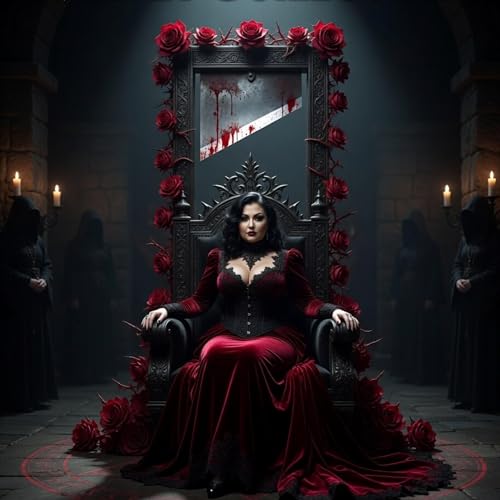
The Velvet Guillotine cover art

The Velvet Guillotine

The Velvet Guillotine

Written by: April Rain
Listen for free

About this listen

History didn't ask permission. Neither do we. Velvet Guillotine goes where the textbooks didn't — the atrocities, the forgotten bodies, the power structures, and the questions that don't have clean answers. Every episode follows the thread from the past to the modern mirror, because history isn't safely contained. It never was. Hosted by April Rain. Listener discretion advised.April Rain World
Episodes
  • The Countess Who Bathed in Blood — Elizabeth Báthory | Serial Killer, Political Target, or Both? | Dastardly Figures Ep. 1
    May 4 2026

    Six hundred and fifty victims. The most prolific female serial killer in recorded history. A noblewoman who tortured and murdered young women in her castle and bathed in their blood to preserve her youth.

    That's the story you know.

    Here's what the historical record actually says.

    In this episode of Dastardly Figures, host April Rain forensically dismantles one of history's most famous monster narratives — and finds something considerably more complicated underneath. Because the evidence against Elizabeth Báthory was extracted under torture, the man who prosecuted her stood to inherit her lands, the king who authorized the investigation owed her estate an enormous debt, and the detail that defines her legend — the blood bath — does not appear anywhere in the trial record.

    It first appears in a Jesuit history published 115 years after her death.

    What we cover:

    • Who the Báthorys actually were, and what noble power looked like in sixteenth-century Hungary
    • Elizabeth's marriage to Ferenc Nádasdy — the celebrated war hero who, by the same testimony used to convict her, was an enthusiastic participant in the abuse of servants
    • Why Elizabeth's widowhood made her politically dangerous, and who specifically had financial incentive to destroy her
    • The trial that never happened — why the most powerful noblewoman in Hungary was walled into her own rooms rather than put before a court
    • How testimony extracted under torture became the foundation of a four-century legend
    • Where the blood bath story actually came from — and when
    • What the Blood Countess legend does to our understanding of systemic aristocratic violence, and who it lets off the hook

    Maybe she was guilty of everything. Maybe the number was ten and not six hundred and fifty. Maybe the blood bath happened. Maybe it didn't.

    What is certain is that the story we've been telling about Elizabeth Báthory was built by people who needed her to be a monster. And we have been elaborating on their verdict ever since.

    Referenced in this episode: Tony Thorne, In the Footsteps of the Blood Countess | Kimberly Craft's primary document translations | László Turóczi's 1729 Jesuit history | Trial transcripts, January 1611


    Show More Show Less
    36 mins
  • They Danced Until They Died: The Dancing Plague of 1518 | Mass Hysteria, Medieval Suffering & the Body's Breaking Point
    May 4 2026

    In the summer of 1518, a woman named Frau Troffea walked into the streets of Strasbourg and started dancing. She didn't stop. Within a month, hundreds of people were dancing alongside her — through the August heat, until their feet were destroyed, until their hearts gave out, until some of them simply died.

    And no one could stop them.

    The Dancing Plague of 1518 is one of the most documented and least understood events in European history. In this episode, host April Rain goes beyond the "weird medieval history" headlines to examine what actually happened — and why it was never as strange as it sounds.

    What we cover:

    • The famine, plague, and feudal oppression that pushed Strasbourg to its breaking point
    • Who Frau Troffea was, and what we know (and don't know) about what happened to her
    • How the city's response — hiring musicians and building official dance floors — made everything catastrophically worse
    • The science of mass psychogenic illness: why the symptoms were real, the suffering was real, and "hysteria" is not the dismissal it sounds like
    • Why the Dancing Plague of 1518 was not the first — and what the 150-year pattern of Rhine Valley dancing plagues actually tells us
    • The direct line from 1518 Strasbourg to the German Peasants' War, the witch trials, and the present day
    • What it means that the dancers were exclusively poor

    This is not a story about superstitious medieval peasants doing something inexplicable. It is a story about what happens to human beings when the world becomes genuinely unlivable and no one in power acknowledges it.

    The body says what the mind cannot.

    Referenced in this episode: John Waller, A Time to Dance, A Time to Die | Dr. Paracelsus | The Strasbourg City Council records, 1518 | Sebastian Brant's Strasbourg Chronicle


    Show More Show Less
    43 mins
  • History Is a Crime Scene | Meet Velvet Guillotine
    May 3 2026

    What if everything you learned about history was the cleaned-up version?

    Velvet Guillotine is a dark history podcast that goes where textbooks don't — into the mechanisms of power, the bodies that paid for progress, and the stories that got buried so the wrong people could put their names on buildings.

    In this intro episode, host April Rain explains what Velvet Guillotine is, what it isn't, and why engaging seriously with dark history isn't morbid curiosity — it's a moral obligation.

    Coming up in Season One: the Dancing Plague of 1518, the body trade that built modern medicine, the witch trials as a tool of social control, medical experimentation on enslaved women, the Great Fire of London, and much more.

    This is not a murder podcast. Not a ghost story podcast. Not a conspiracy theory podcast. It's documented, sourced, deeply researched history — which is stranger and more disturbing than any of those things.

    New episodes drop three times a week.


    Show More Show Less
    24 mins
No reviews yet