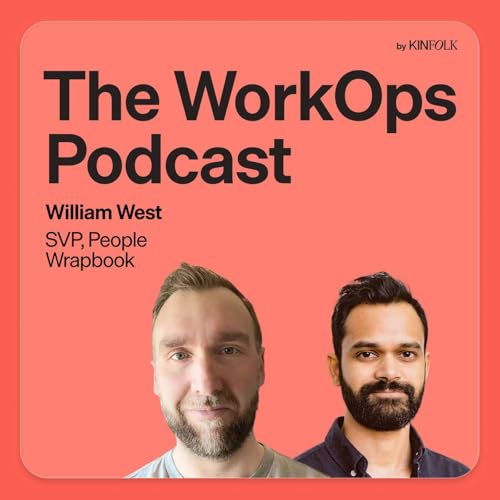
The WorkOps Podcast cover art

The WorkOps Podcast

The WorkOps Podcast

Written by: by Kinfolk
Listen for free

The WorkOps Podcast is your weekly conversation with HR leaders and People Ops practitioners doing the real work. In every episode we dig into one story. A process that went sideways, a system that just didn't work, and what someone actually did about it. Packed with practical lessons you'll want to bring back to your team. Whether you're supporting 500 employees or 5,000, this is how the best People leaders are building for what comes next.© 2026 by Kinfolk Economics Relationships Social Sciences
Episodes
  • What makes AI actually stick at a 750-person company
    Jun 4 2026

    Summary

    On The WorkOps Podcast, Jean Parchewsky, VP of People Operations at Vendasta, makes a case most AI conversations miss: whether AI takes hold in your company is decided at the hiring table, not in the tooling budget. She traces it back to a training binder that optimized for terminations over hiring, the "hire slow, fire fast" principle she built in response, and the behavior-first "ideal employee profile" her team uses today. Then she shows how that same hiring discipline is what made AI adoption stick, through a citizen developer program, a searchable build board, and a culture where sharing your failures out loud is the norm. Essential listening for any People leader who has been asked to "roll out AI."

    Chapters

    00:00 Why Jean never planned a career in HR

    03:50 The binder that optimized for firing, not hiring

    06:00 Hire slow, fire fast

    07:30 The bar raiser: never interview hungry

    11:00 The ideal employee profile: hiring for behavior

    13:20 Why AI adoption is a culture problem

    14:10 Citizen developers and the build board

    18:30 Putting AI enablement in People Ops, not IT

    23:00 Pepper and the rise of AI "employees"

    26:00 One piece of advice: just jump in

    Takeaways

    Optimizing HR for legal risk instead of the team can quietly cost you your best people.

    Hire slow and fire fast: spend your effort choosing the right person, and be honest quickly when it isn't working.

    Hiring for behaviors rather than skills builds the culture everything else depends on.

    Stalled AI adoption is usually a culture problem, not a tool problem.

    AI enablement belongs close to the work, in People Ops, where it becomes workflow change instead of better emails.


    Connect with the Guest
    LinkedIn: https://www.linkedin.com/in/jean-parchewsky/
    Website: https://www.vendasta.com/


    Sponsor
    This episode is brought to you by Kinfolk, the AI service desk built for HR.

    See more at kinfolkhq.com

    Show More Show Less
    29 mins
  • How to Separate the Why From the What in HR
    Jun 2 2026

    Summary
    On this episode of The WorkOps Podcast, Jeet sits down with William West, VP People at Wrapbook, to dig into what happens when HR leaders stop trying to do everything in one place. William shares how a 20-plus-hour calibration process became six hours by separating ratings conversations from development conversations entirely. He also makes the case that HR's distinct job in an AI transformation isn't governing tools — it's owning the human argument for why the change matters. And in his closing remarks, he offers a frame on vulnerability that redefines what effective People leadership looks like right now.


    Chapters
    00:00 William West's path from nonprofit HR to VP People at Wrapbook
    04:00 How HR changes across sectors: pace, complexity, and scale
    07:30 The calibration problem: 20-plus hours and still unclear
    12:30 The fix: reading instead of explaining
    16:30 Separating calibration from development, permanently
    21:00 AI and human connection: what the technology is actually for
    25:00 Who leads AI adoption, and why HR owns the why
    29:00 Vulnerability as a change management strategy


    Takeaways

    1. Calibration and development are two different conversations with different goals — combining them makes both worse.
    2. Switching from verbal summaries to a read-and-discuss format cut Wrapbook's calibration from 20-plus hours to around six.
    3. HR's distinct role in an AI transformation is owning the why, not governing the tooling; technical teams are better positioned for the what.
    4. Late adopters don't move without context-specific reasons; the leader closest to people in each function is best positioned to provide them.
    5. Naming openly that you feel behind on AI creates space for others to start learning instead of waiting for certainty.


    Connect with the Guest
    LinkedIn: https://www.linkedin.com/in/williamcwest/
    Website: https://www.wrapbook.com/


    Sponsor
    This episode is brought to you by Kinfolk, the AI service desk built for HR.

    See more at kinfolkhq.com

    Show More Show Less
    31 mins
  • Context is the new currency for HR
    May 26 2026

    Summary
    A top performer walks out the door at Qualtrics holding an outside offer for double their salary. Michael MacArthur, then Head of People, has a choice: pretend the market is wrong, or admit the comp process was. His read, years later from the COO seat at Recharge: the 2x counter-offer isn't a market signal. It's an audit finding.

    This is one of the cleanest diagnostics we've heard for whether a comp process is really working. And it's the same logic Michael applies to AI, engagement, and the build-versus-buy questions every HR leader is wrestling with right now. The unifying argument: context, not better tools, is the layer that separates the HR teams winning with AI from the ones spinning cycles.


    Timestamps
    01:00 Michael's path from sales comp to head of people at Qualtrics to COO at Recharge
    03:00 The Qualtrics dysfunction: forced curves and 18-month time-in-seat gates
    04:00 The "double their salary" diagnostic signal for a broken comp process
    06:30 Recharge's fix: 6-month cash cycle, no forced curve, multi-level calibration
    10:00 Process transparency versus salary transparency
    13:00 Nectar's anonymous follow-up and the context thesis for AI in HR
    14:30 Why Anthropic's engagement score doesn't matter to Recharge
    16:00 Build versus buy on the people side: when trust outweighs context
    21:30 The CEO move that put Recharge's exec team on terminals
    23:00 Audit the workflow before you prompt the model


    Takeaways
    - The fastest test that your comp process is broken: a leaving employee getting offered double their current salary at the next job.
    - Forced curves and time-in-seat promotion gates work at 250 employees. They quietly stop working at 2,500.
    - AI value in HR shows up in context-gathering, not dashboards. Anonymous follow-up conversations beat static survey scores.
    - Internal-historical engagement trends beat external benchmarks. Anthropic's engagement score doesn't tell you what's happening on your team.
    - Audit the workflow before you prompt the model. Most failed AI projects in HR are unmapped-workflow problems, not tooling problems.


    Connect with the Guest
    LinkedIn: https://www.linkedin.com/in/mimcarthur/
    Recharge: https://getrecharge.com/about/


    Sponsor
    This episode is brought to you by Kinfolk, the AI service desk built for HR.

    See more at kinfolkhq.com

    Show More Show Less
    26 mins
adbl_web_anon_alc_button_suppression_t1
No reviews yet