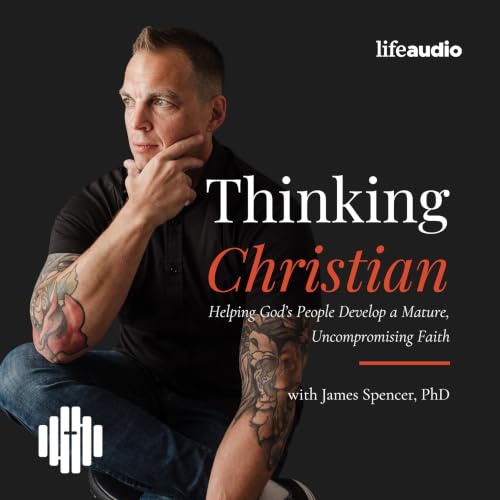
Thinking Christian: Clear Theology for a Confusing World cover art

Thinking Christian: Clear Theology for a Confusing World

Thinking Christian: Clear Theology for a Confusing World

Written by: James Spencer - Christian Theology Author and Speaker
Listen for free

Christians shouldn’t just think. They should think Christian. Join Dr. James Spencer and guests for calm, thoughtful, theological discussions about a variety of topics Christians face every day. The Thinking Christian Podcast will help you grow spiritually and learn theology as you seek to be faithful in a world that is becoming increasingly proficient at telling stories that deny Christ.

Find more from James at https://www.thinkingchristian.org/.

Christianity Ministry & Evangelism Spirituality
Episodes
  • Is "secular" really neutral? A historian reveals what the West forgot — and why it changes everything for Christians today.
    Jul 23 2026

    What if secularization isn't the decline of religion — but the replacement of one social order with another? In this episode, Dr. James Spencer and Dr. Ashish Varma sit down with Dr. Kevin Flatt, professor of history at Redeemer University and author of Secularization, Social Order, and World History, to unpack one of the most provocative frameworks in contemporary Christian thinking: Sacred Social Order.

    Kevin introduces the idea that every human culture — until the modern West — has organized its life around something higher than itself. He argues that what we call "religion" is actually a uniquely Western, uniquely modern compartment, while Sacred Social Order is the operating system beneath all of culture. From there, the conversation moves through Christian nationalism, the liberal firmware of Western democracy, Philip Reif's cultural warfare thesis, and why your children's public school is not religiously neutral.

    If you've ever sensed that something deeper than a culture war is unfolding — that the ground itself has shifted — this episode gives you the language to name it.

    Key Takeaways:

    • What "Sacred Social Order" means, and why it's a more accurate lens than "religion" for understanding culture
    • Why secular order isn't neutral — it has its own values, telos, and demands on individuals
    • How the Christian nationalism debate connects to identical movements in India, Iran, China, and the Muslim world
    • Why Philip Reif's "third culture" thesis is partly right — and where Kevin respectfully pushes back
    • Why public education is never neutral, and what Christians should really be asking about schools
    • Why the gym or the yoga studio may be shaping your theology more than Hinduism is
    • The Labubu doll illustration: how misidentifying spiritual threats reveals our blind spots

    Get early access and a bonus with a Patreon membership.

    Subscribe to our YouTube channel

    To read James's article on this topic, check out his author page on Christianity.com.

    📢 Stay Connected & Keep Growing!

    If you enjoyed this episode, be sure to subscribe to Thinking Christian, so you never miss an insightful conversation!

    Discover more Christian podcasts at lifeaudio.com and inquire about advertising opportunities at lifeaudio.com/contact-us.

    Show More Show Less
    1 hr and 3 mins
  • Can a nation be "Christian" without Christ?
    Jul 20 2026

    Is "Cultural Christianity" a bridge to the gospel — or a counterfeit that replaces it? In this episode, Dr. James Spencer (PhD, Trinity Evangelical Divinity School) and Dr. Ashish Varma respond to James Wood's widely-discussed First Things article, In Defense of Cultural Christianity. Together they unpack why calling a civilisation "Christian" when Christ is not its governing authority is not just imprecise — it's theologically catastrophic.

    From the Christendom narrative and American civil religion to the habituation of virtue, abortion statistics, and a profound meditation on Pentecost in Acts 2, this episode models what serious Christian thinking looks like when it refuses to foreclose on the full authority of Jesus Christ too soon.

    If you've wrestled with Christian nationalism, the "good, true, and beautiful" in culture, or what it means to vote as a follower of Jesus, this conversation is essential listening.

    Key Takeaways:

    • Why "a culture influenced by Christianity" is an insufficient — and potentially dangerous — definition of "Christian culture"
    • The concept of "inappropriate foreclosure": closing off our understanding of the good too soon and using that partial view as if it were complete
    • How Robert Bellah's concept of American civil religion explains why Christian language gets co-opted by government without actually conforming people to Christ
    • Why the Book of Acts — specifically Pentecost and the Gentile inclusion — fundamentally disrupts any vision of Christianity as a singular cultural program
    • The Light Bright metaphor: God is the light source; culture is the peg pattern. Christians must point people behind the pegs to the light itself
    • Why policy-driven virtue formation (habituation) has measurable real-world limits — and what the abortion statistics during different administrations actually reveal
    • How Dr. Varma's personal experiences — from campus life on 9/11 to being randomly selected in airports — illustrate why Wood's "civilisational benefit" narrative forecloses on the experiences of many believers

    Get early access and a bonus with a Patreon membership.

    Subscribe to our YouTube channel

    To read James's article on this topic, check out his author page on Christianity.com.

    📢 Stay Connected & Keep Growing!

    If you enjoyed this episode, be sure to subscribe to Thinking Christian, so you never miss an insightful conversation!

    Discover more Christian podcasts at lifeaudio.com and inquire about advertising opportunities at lifeaudio.com/contact-us.

    Show More Show Less
    1 hr and 7 mins
  • What does it actually mean to be human?
    Jul 16 2026

    What does it mean to be human — really? In an age of AI, transhumanism, and relentless technological "progress," Christians are making confident claims about humanity without a solid theological foundation underneath them. In this episode, Dr. James Spencer and Dr. Ashish Varma sit down with Dr. Marc Cortez, Dean of the Litvin School of Divinity at Wheaton College, to explore one of the most urgent and underdeveloped doctrines in Christian thought: theological anthropology.

    Dr. Cortez challenges the tendency to let the Image of God do all the heavy lifting — and makes a compelling case that the human body is not merely an instrument of the soul, but is fundamental to what it means to be made in God's

    image. Drawing from ancient idol language in Genesis 1, the resurrection, and modern cognitive science, this conversation reorients how Christians should think about embodiment, flourishing, technology, and even taking care of a tree.

    If you've ever wondered whether your theology can hold up in a world reshaped by AI, this is the episode to start with.

    KEY TAKEAWAYS

    • The Image of God (Imago Dei) uses ancient idol language — humans are the material means by which God manifests His divine presence in the world
    • We cannot think well about AI, transhumanism, sexuality, race, or disability without first building a robust theology of embodiment
    • The soul-body hierarchy in Christian history was never meant to devalue the body — but it almost always has
    • "Spiritual maturity" and "physical health" belong on the same list — our bifurcation of them reveals a modern, unbiblical blind spot
    • Before making confident claims about technology making us "less human," ask the prior question: what does it mean to be human in the first place?
    • Christian eschatology (resurrected, transformed bodies) gives us more theological complexity around human enhancement than most people realize
    • Dr. Cortez's shorthand for the Image of God: "We are the material means by which God is seeking to manifest His divine presence in a unique way in the world."

    Get early access and a bonus with a Patreon membership.

    Subscribe to our YouTube channel

    To read James's article on this topic, check out his author page on Christianity.com.

    📢 Stay Connected & Keep Growing!

    If you enjoyed this episode, be sure to subscribe to Thinking Christian, so you never miss an insightful conversation!

    Discover more Christian podcasts at lifeaudio.com and inquire about advertising opportunities at lifeaudio.com/contact-us.

    Show More Show Less
    57 mins
adbl_web_anon_alc_button_suppression_t1
No reviews yet