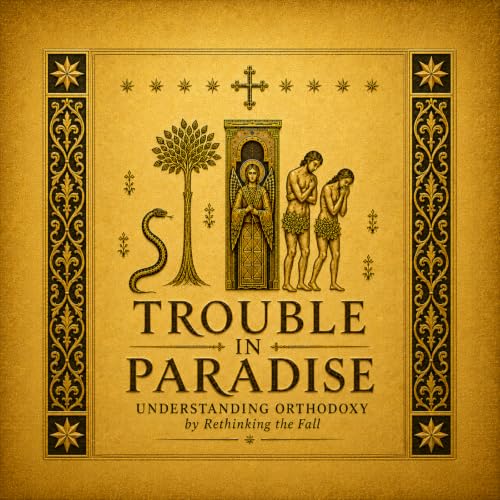
Trouble in Paradise - Understanding Orthodoxy by Rethinking the Fall cover art

Trouble in Paradise - Understanding Orthodoxy by Rethinking the Fall

Trouble in Paradise - Understanding Orthodoxy by Rethinking the Fall

Written by: Matthew Lyon
Listen for free

About this listen

Trouble in Paradise explores why Eastern Orthodoxy often seems confusing to other Christians — and how rethinking Original Sin reshapes the entire Christian story.

Through personal story, historical theology, and spiritual reflection, this podcast walks listeners through the crisis and discovery that can occur when those assumptions are challenged.

For Protestants, Catholics, and Orthodox Christians seeking a deeper understanding of the Christian story.

Matthew Lyon 2026
Christianity Ministry & Evangelism Philosophy Social Sciences Spirituality
Episodes
  • Frankenstein, Death, and Original Sin
    Apr 21 2026

    Episode 11 —

    Frankenstein, Death, and Original Sin

    This episode explores Frankenstein by Mary Shelley as more than a warning about science—it’s a story about death, the human will, and what happens when traditional theological frameworks collapse.

    🧭 Core Idea

    In earlier Christian thought—seen clearly in Paradise Lost—the pattern is:

    sin → death

    But in Frankenstein, that pattern is reversed:

    death → becomes the engine that drives human action

    The novel presents a world where death is no longer explained within a theological framework, but becomes the central problem shaping everything.

    ⚔️ Historical and Theological Background

    • John Milton writes within a world shaped by:
      • Reformation theology
      • divine sovereignty
      • human fallenness
    • John Calvin and later thinkers emphasize:
      • the brokenness of the human will
      • salvation as something given
    • By Shelley’s time:
      • these ideas are still present
      • but increasingly questioned and rejected
    • William Godwin (Shelley’s father):
      • raised in a Calvinist environment
      • rejects it in favor of reason and human perfectibility
    • Mary Wollstonecraft (her mother):
      • rejects the idea that humans are born ruined
      • retains belief in moral progress

    💀 Death as the Engine

    In Frankenstein:

    • The death of Victor’s mother becomes the turning point
    • Death is no longer a consequence—it becomes the driving force
    • Fear of death leads to:
      • control
      • technological intervention
      • desecration of the human body

    The grave becomes a resource. The body becomes material.

    🧠 The Will: Control vs. Trust

    Victor’s response to death reveals a deeper tension:

    • The will is active, but shaped by fear
    • Faced with death, there are two paths:
    1. Resurrection (received)
      • death is not final
      • not ours to overcome
    2. Control (attempted)
      • death must be defeated directly
      • leads to manipulation and violation

    Victor chooses control.

    🧩 The Creature and Belonging

    The Creature reads Paradise Lost and asks:

    Am I Adam… or a fallen angel?

    • He begins with longing and moral awareness
    • He seeks relationship and acceptance
    • He is consistently rejected

    His turning point comes when:

    he concludes he will never be received

    This leads to:

    • collapse of hope
    • emergence of rage

    ⚡ Key Question

    The novel leaves a central question unresolved:

    Are we corrupt because of how we are made… or do we become destructive because death is already at work?

    🔥 The Horror

    The real fear in Frankenstein is not the Creature itself—

    it is the recognition that his transformation makes sense

    Under the same conditions:

    • isolation
    • rejection
    • fear of death

    we would become him

    ✝️ Final Reflection

    The episode closes with a contrast:

    • If death is ultimate → fear drives everything
    • If resurrection is real → death is not the final authority

    The question is not whether we face death— but how we face it.

    🎯 Key Takeaway

    We don’t escape becoming the Creature by overcoming death— but by trusting that death has already been overcome.

    Show More Show Less
    15 mins
  • Energy, Synergy, and Union: How Salvation Actually Works — Death, Defilement, and the Restoration of Life — Part 2
    Apr 14 2026

    Episode 10 —

    This episode continues the exploration of salvation as union with God, not as an abstract idea, but as real participation in divine life. Building on Part 1, we turn to Scripture—especially Leviticus and the Gospels—to examine how the Bible consistently presents the human problem as death, corruption, and separation from life.

    Leviticus and the Problem of Death

    Leviticus is often misunderstood, but it provides a crucial foundation. Its central concern is not abstract guilt, but ritual defilement connected to death.

    What makes someone ritually defiled?

    • touching a dead body
    • loss of blood
    • bodily discharges
    • conditions associated with decay

    These are all signs of life leaving the body.

    Importantly, many of these states occur without sin. This shows that ritual defilement is not primarily about wrongdoing, but about contact with mortality—a kind of participation in death.

    Leviticus presents a world where:

    • death spreads
    • corruption spreads
    • defilement spreads

    The sacrificial system restores by reorienting the person toward life. As Leviticus teaches, “the life is in the blood.”

    Christ and the Reversal

    In the Gospels, Christ does not reject this framework—He reverses it.

    Under the law: contact with death → defilement spreads

    In Christ: contact with life → life spreads

    Examples:

    • A leper is touched and made clean
    • A woman losing blood is healed
    • The dead are raised

    In the case of prolonged illness, Scripture also connects suffering with spiritual bondage, as Christ speaks of those “bound” by Satan. This reinforces that corruption is not only physical, but also spiritual in nature.

    Christ does not become defiled. Instead, life overcomes death.

    Union and the Nature of Salvation

    This shifts the central question:

    Not just, “What have you done?” But, “What are you united to?”

    Salvation is not merely about forgiveness—it is about being freed from death and restored to union with the life of God.

    Morality as Participation in Life

    Christian morality flows from this reality.

    It is not simply a list of prohibitions. It is about aligning with life.

    Human beings bear the image of God, and that image is not erased. Every person is a life given by God and meant for union with Him.

    Love, then, is not just a feeling. It is the active support and honoring of life in another person.

    The Final Judgment (Matthew 25)

    Christ describes the final judgment in terms of love expressed through life-giving action:

    • feeding the hungry
    • giving drink to the thirsty
    • welcoming the stranger
    • caring for the sick

    The division is not framed as belief versus action, but as:

    love… and no love

    Where Is Merit?

    In this scene, there is no emphasis on earning or accumulation.

    The righteous are not calculating—they are surprised.

    They have become people who live in love, because they are participating in the life of Christ.

    As Christ says:

    “You did it to me.”

    Key Takeaway

    Salvation is union with life. Morality is living in that life. Love is the expression of that life.

    Show More Show Less
    20 mins
  • The Resurrection Changes Everything—Or Nothing
    Mar 30 2026

    Episode 9 —

    Why do many Christians spend months preparing for Christmas… but only hours reflecting on Easter?

    In this episode, we explore a quiet but significant shift in modern Christianity: the tendency to center the Cross while treating the Resurrection as secondary.

    Starting from a real conversation after an Easter service, this episode examines why the Passion is easier to relate to—and why the Resurrection is often reduced to little more than proof that Jesus is who He claimed to be.

    Drawing from the writings of Paul the Apostle, we ask what it really means to be “still in your sins,” and why forgiveness alone does not fully answer the human problem if death itself remains undefeated.

    We also explore how this imbalance can lead to a subtle dualism—where the soul is prioritized, the body is neglected, and salvation becomes more about escape than restoration.

    Finally, we contrast this with the lived rhythm of Pascha in the Orthodox Church, where the Resurrection is not just affirmed—but prepared for through Great Lent and celebrated as the central reality of the Christian life.

    If Christ is risen, then death is not normal—and Christianity is not just about being forgiven.

    It’s about being made alive.

    Show More Show Less
    10 mins
No reviews yet