• Why Real-Time Sensor Fusion Is CRITICAL for Autonomous Systems
    Jan 16 2026

    Modern autonomous vision systems rely on more than just powerful AI models—they depend on precise timing across sensors.

    In this episode of Vision Vitals, we break down why real-time sensor fusion is critical for autonomous systems and how timing misalignment between cameras, LiDAR, radar, and IMUs can lead to unstable perception, depth errors, and tracking failures.

    🎙️ Our vision intelligence expert explains:

    • What real-time sensor fusion really means in autonomous vision
    • How timing drift causes object instability and perception errors
    • Why NVIDIA Jetson platforms act as the central time authority
    • The role of GNSS, PPS, NMEA, and PTP in clock synchronization
    • How deterministic camera triggering improves fusion reliability
    • Why timing must be a day-one design decision, not a fix later

    We also explore how e-con Systems’ Darsi Pro Edge AI Vision Box, powered by NVIDIA Jetson Orin NX and Orin Nano, simplifies hardware-level synchronization for real-world autonomous, robotics, and industrial vision deployments.

    If you’re building systems for autonomous mobility, robotics, smart machines, or edge AI vision, this episode explains the foundation that keeps perception reliable under motion and complexity.

    🔗 Learn more about Darsi Pro on e-con Systems’ website

    Show More Show Less
    10 mins
  • Inside Darsi Pro: Features, Architecture & Why Edge AI Vision Matters
    Jan 9 2026

    In this episode of Vision Vitals by e-con Systems, we take a deep dive inside Darsi Pro — a production-ready Edge AI Vision Box built on the NVIDIA® Jetson Orin™ NX platform and launched at CES 2026.

    As robotics, autonomous mobility, and industrial vision systems scale, teams face growing challenges around multi-camera synchronization, sensor fusion, sustained AI workloads, and long-term deployment reliability. Darsi Pro is designed to address these real-world demands with a unified, industrial-grade vision compute platform.

    🎙️ In this episode, you’ll learn:

    • What Darsi Pro is and how it fits into modern edge AI vision stacks
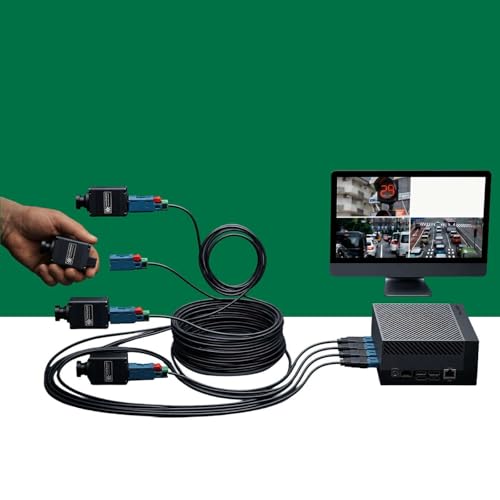
    • How it supports up to 8 synchronized GMSL2 cameras via FAKRA connectors
    • Why multi-sensor synchronization using PTP is critical for robotics and mobility
    • How NVIDIA Jetson Orin NX delivers up to 100 TOPS for sustained AI workloads
    • The importance of fanless, IP67-rated design for long-duty deployments
    • How CloVis Central™ enables remote device management, OTA updates, and fleet monitoring
    • Why unified AI vision boxes reduce integration risk compared to fragmented systems

    We also discuss camera flexibility, interface options (Ethernet, CAN, USB, GPIO), and e-con Systems’ roadmap toward future edge AI platforms, including PoE-driven models and NVIDIA Jetson Thor alignment.

    If you’re building AMRs, AGVs, autonomous vehicles, ITS platforms, or multi-camera vision systems, this episode explains how compute, cameras, sensors, and cloud management come together in a single, scalable vision platform.

    🔗 Learn more about Darsi Pro


    Show More Show Less
    7 mins
  • What Is an Edge AI Vision Compute Box and Why Do Industries Need It?
    Jan 2 2026

    What is an Edge AI Vision Compute Box — and why are industries moving away from traditional camera + compute architectures?

    In this episode of Vision Vitals by e-con Systems, we break down what an Edge AI Vision Compute Box is, the real-world challenges it solves, and why unified vision platforms are rapidly replacing fragmented camera and compute setups across robotics, mobility, and industrial automation.

    🎙️ In this episode, you’ll learn:

    • What defines an Edge AI Vision Compute Box and how it differs from traditional vision systems
    • Why camera + compute integrations often fail during scaling and real-world deployment
    • How edge AI compute enables real-time perception, low latency, and sensor fusion
    • The critical role of camera performance, ISP tuning, and multi-camera synchronization
    • Why sensor-ready architectures matter for robotics, ITS, and mobility platforms
    • How unified vision platforms reduce integration risk and speed up deployment

    We also discuss how e-con Systems’ Darsi Pro, powered by NVIDIA® Jetson Orin™ NX, brings compute, cameras, and sensor interfaces together in a production-ready Edge AI Vision Box — designed for real-world deployment conditions.

    🔗 Know more about Darsi Pro

    Show More Show Less
    8 mins
  • Multi-Path Interference in ToF Cameras: Causes, Effects & Mitigation
    Dec 26 2025

    Multi-path interference is a major challenge in Time-of-Flight (ToF) 3D imaging, especially in environments with reflective surfaces, corners, and complex geometry. When emitted light returns through multiple paths, depth measurements become distorted—leading to warped surfaces and unreliable perception.

    In this episode of Vision Vitals by e-con Systems, we explore:

    • What multi-path interference is in ToF cameras
    • How indirect light paths distort depth calculations
    • Why reflective materials, corners, and large incident angles make it worse
    • How multi-path interference appears in depth maps and 3D point clouds
    • Algorithmic mitigation techniques and spatial filtering
    • Multi-frequency depth strategies
    • Optical design and camera placement best practices
    • How real-world systems reduce interference in production deployments

    We also discuss how modern ToF camera architectures—including upcoming AF0130-based iToF solutions—address these challenges through on-camera depth computation and interference mitigation.

    If you’re building robotics, industrial automation, or 3D vision systems, this episode will help you design for more accurate and reliable depth sensing.

    🔗 Explore e-con Systems Depth Cameras

    Show More Show Less
    8 mins
  • Flying Pixels in ToF Cameras Explained: Causes, Impact & Solutions
    Dec 19 2025

    Flying pixels are one of the most common—and misunderstood—artifacts in Time-of-Flight (ToF) depth cameras. These false depth points appear near object edges and depth discontinuities, often leading to unreliable 3D perception in robotics, automation, and embedded vision systems.

    In this episode of Vision Vitals by e-con Systems, we break down:

    • What flying pixels are in ToF cameras
    • Why they occur near edges and depth transitions
    • The role of aperture size, integration time, pixel geometry, and IR interference
    • How flying pixels affect AMRs, AGVs, obstacle detection, and SLAM
    • Software filtering techniques like depth discontinuity and median filters
    • Hardware approaches such as Mask ToF and optical control
    • Best practices for reducing flying pixels in real-world deployments

    Whether you’re designing robotics perception systems, industrial automation, or 3D sensing applications, this episode will help you understand how to clean up depth data and avoid false obstacles.

    🔗 Explore e-con Systems Depth Cameras

    Show More Show Less
    9 mins
  • Where ToF Cameras Excel: AMRs, AGVs, Medical & Biometric Systems
    Dec 12 2025

    Unlock the real impact of Time-of-Flight (ToF) technology with DepthVista — e-con Systems’ powerful 3D sensing camera series.

    In this episode of Vision Vitals - e-con Systems Podcast, we break down the top real-world applications where DepthVista ToF cameras deliver unmatched value across robotics, healthcare, biometrics, and spatial intelligence.

    You’ll discover how DepthVista enables:

    🔹 Autonomous Mobile Robots (AMRs)

    • Robust object detection & obstacle avoidance
    • Stable depth sensing in mixed/low lighting
    • Real-time mapping & localization

    🔹 Pick & Place Robotics

    • Precise distance measurement
    • Reliable sensing on smooth or texture-less objects
    • Dense depth maps for fast cycle times

    🔹 AGVs (Automated Guided Vehicles)

    • Consistent depth in long corridors
    • Floor-level hazard detection
    • Reliable navigation on predefined routes

    🔹 Remote Patient Monitoring (RPM)

    • Privacy-preserving depth sensing
    • Non-contact fall detection & motion tracking
    • Accurate performance in fully dark rooms

    🔹 Biometric Security & Anti-Spoofing

    • 3D facial structure validation
    • Liveness detection
    • Low-light authentication with active NIR illumination

    We also explore upcoming opportunities for ToF cameras in:

    • Spatial analytics
    • Collaborative robots
    • Smart retail & gesture recognition
    • AR-assisted industrial workflows

    DepthVista continues to push what's possible in depth sensing — and this episode shows you why.

    🔗 Explore DepthVista & e-con Systems’ ToF Cameras

    Show More Show Less
    9 mins
  • ToF Cameras vs. Stereo Cameras — Which 3D Depth Technology Wins?
    Dec 5 2025

    ToF Cameras vs. Stereo Cameras — a comparison every robotics, autonomy, and computer-vision team asks sooner or later.

    In this episode of Vision Vitals by e-con Systems, we break down the real differences between these two popular depth-sensing technologies — beyond the usual textbook definitions.

    Whether you're building AMRs, AGVs, cobots, warehouse automation systems, industrial inspection tools, or navigation pipelines, choosing the right 3D sensing technology can make or break your deployment.

    🎧 In this episode, you’ll learn:

    How They Work

    • How Stereo derives depth through disparity & texture
    • How ToF measures distance using NIR reflection

    Where Each Technology Shines

    • Low-light & featureless environments
    • Texture-rich outdoor scenes
    • Smooth vs dark vs reflective surfaces
    • Indoor vs outdoor performance

    Accuracy & Range

    • Millimeter vs centimeter accuracy
    • How range scales in ToF vs Stereo systems
    • Why ToF excels in short-to-mid range robotics

    Compute & Integration

    • Processing load differences
    • Stereo’s dependency on GPU resources
    • Why ToF offers predictable compute paths

    Cost, Reliability & Real-World Deployment

    • Hardware vs software cost trade-offs
    • Challenges in shadows, bright sunlight, and mixed environments
    • Practical selection guidance for robotics teams

    🔗 Explore e-con Systems Depth Cameras

    Show More Show Less
    11 mins
  • Inside Time-of-Flight Cameras: Components & Architecture Explained
    Nov 28 2025

    How do Time-of-Flight (ToF) cameras actually work inside?

    In this episode of Vision Vitals — e-con Systems Podcast , we take you deeper into the core building blocks that make ToF cameras essential for AMRs, AGVs, warehouse robots, 3D mapping, and industrial automation.

    🎙 What We Cover in This Episode
    • The internal architecture of a ToF camera
    • Key components:
    — Illumination (VCSEL emitters, diffusers, drivers)
    — Optics + band-pass filters
    — NIR sensor and pixel architecture
    — Depth processing pipeline
    • Why modulation frequency matters for precision
    • How ambient light, reflectivity & dark surfaces affect depth accuracy
    • Choosing between 850 nm and 940 nm ToF illumination
    • Common ToF challenges — and how hardware + algorithms overcome them
    • Why ToF excels in dynamic environments vs stereo or structured light

    Ideal for engineers, robotics developers, and anyone building 3D vision systems.

    🔗 Explore e-con Systems’ ToF Cameras

    #TimeOfFlight #ToFCamera #DepthCamera #3DVision #Robotics #AMR #EmbeddedVision #econsystems

    Show More Show Less
    8 mins