

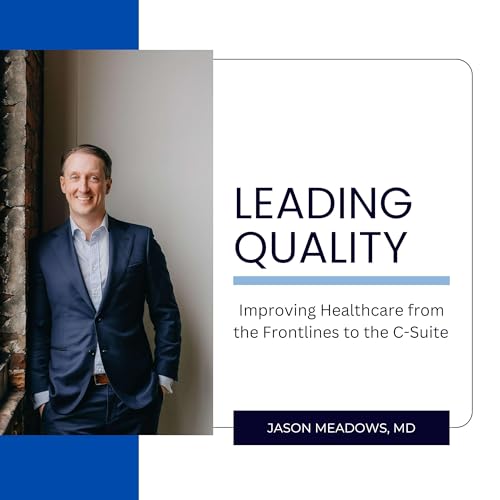
What Does a Chief Quality Officer Actually Do?
Failed to add items
Add to cart failed.
Add to wishlist failed.
Remove from wishlist failed.
Follow podcast failed
Unfollow podcast failed

What Does a Chief Quality Officer Actually Do?
-
Narrated by:
-
Written by:
About this listen
Episode Summary
What does the Chief Quality Officer role actually entail once you get past regulatory compliance and dashboards?
In this episode, Dr. Abraham Jacob draws on years as a system-level CQO to explain how quality leadership really works in practice: where to start, what to prioritize, and how culture, safety, and accountability interact over time. The conversation is grounded in lived experience, including successes, failures, and lessons learned during periods of workforce instability and change.
This episode is most useful for CQOs, CMOs, senior clinical leaders, and anyone building improvement capability at scale.
Core Ideas from the Conversation
- Patient safety is a leverage point
Reducing preventable harm creates alignment, urgency, and moral clarity in a way few other priorities do. - Quality assurance is necessary but insufficient
Meeting regulatory standards does not, by itself, produce better outcomes or learning systems. - Variation reveals system design problems
Unwarranted variation signals where workflows, standards, or training have failed the system. - Psychological safety enables performance, not comfort
Teams improve faster when speaking up is expected, acknowledged, and protected. - Turnover threatens reliability more than leaders expect
Standards erode quickly when onboarding, retraining, and reinforcement don’t keep pace. - The CQO role is shifting toward stewardship and value
Mature organizations expect CQOs to help lead system transformation, not just oversight.
Questions This Episode Raises for Leaders
- Where does your quality function spend most of its energy: assurance, improvement, or capability building?
- What forms of harm are still tolerated because they’ve become routine?
- How do new staff actually learn “how we do things here,” beyond policies?
- Where might turnover be quietly undoing prior improvement gains?
- When was the last time you publicly reinforced speaking up, especially when it was inconvenient?
Resources & References Mentioned
- “What Google Learned From Its Quest to Build the Perfect Team”
Charles Duhigg, New York Times Magazine
On psychological safety as the strongest predictor of team performance. - Institute for Healthcare Improvement (IHI)
Referenced as a formative influence on improvement science and leadership development. - IHI Chief Quality Officer Professional Development Program
A national program supporting CQOs in building system-level improvement capability. - High Reliability Organizations (HRO) in Healthcare
Principles focused on reducing harm and building reliable systems under pressure. - Intermountain Healthcare – Advanced Training Program
Cited as an early influence on variation reduction and outcomes-focused care. - Key Driver Diagrams
Discussed as a durable tool for linking strategy, drivers, and improvement work.
Continue the Conversation
You can connect with Dr. Abraham Jacob via email at akj@umn.edu or on LinkedIn.
Reflection and dialogue are central to improvement, so take a moment to notice where these ideas show up in your own system.
New episodes published every other Thursday at 7AM Eastern Time.