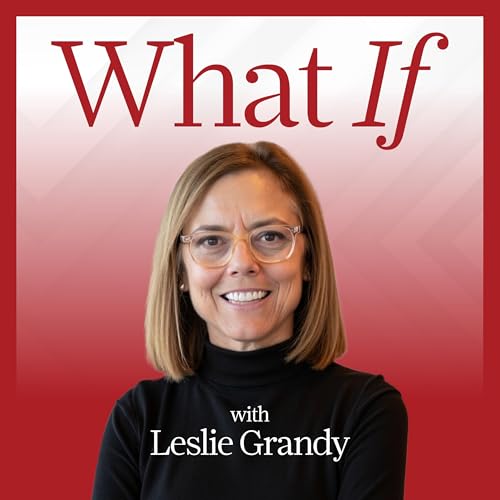
What If With Leslie Grandy cover art

What If With Leslie Grandy

What If With Leslie Grandy

Written by: Leslie Grandy
Listen for free

About this listen

This podcast is about curiosity, what it means to be creative, and why asking "What if?" can transform how things work and help you build a resilient future. We'll look at how asking better questions can unlock transformative thinking and what happens when you challenge assumptions and imagine what could be, rather than accepting what is.2026 Economics Management Management & Leadership
Episodes
  • Finding Leverage in Innovation Strategy with Scott Ehrlich | #12
    May 13 2026

    What if the biggest opportunity with AI isn't doing more with less—but doing what wasn't possible before?

    In this episode of What If?, Leslie Grandy sits down with Scott Ehrlich, Chief Innovation Officer and Head of Corporate Strategy at Sinclair Broadcast Group, to explore how media, technology, and business model innovation are changing as AI reshapes what can be created, personalized, distributed, and scaled.

    Scott has spent his career navigating major platform shifts—from early OTT subscription services at RealNetworks to digital-first studios, streaming platforms, FAST channels, and AI-enabled media strategy. His perspective is grounded in a simple but powerful idea:

    A strategy without leverage isn't really a strategy.

    Today, the mechanics of making things are no longer the biggest constraint. Production is faster. Distribution is broader. AI can generate, iterate, and adapt at speeds that would have been impossible just a few years ago.

    But that creates a new challenge.

    When everything can be made, the real question becomes: What should exist at all?

    Together, Leslie and Scott explore:

    • Why value is shifting from production capability to judgment, relevance, and timing
    • How AI changes the creative process by making iteration faster and less expensive
    • Why personalized storytelling may become a new frontier for media innovation
    • Why AI-native platforms may become the next operating systems for content discovery
    • How business models must evolve when audiences consume information inside AI interfaces
    • How leaders can drive adoption by focusing on one powerful promise: eliminating the toil of work

    Scott also offers a grounded view of where most organizations are in the AI adoption curve. Before companies can transform workflows, they often need to use AI to improve existing ones. The breakthrough, he argues, starts with helping people remove the frustrating, repetitive work that drains their time and attention.

    But the bigger opportunity is still ahead.

    Too much of the current AI conversation is focused on efficiency: fewer people, fewer steps, faster processes. Scott challenges leaders to look beyond that and ask a more expansive question:

    What new things can we do now that we could never do before?

    Because the future of innovation won't belong only to those who move faster.

    It will belong to those who can recognize where new leverage is forming—and use it to create something more meaningful.

    Reflection question:
    Are you using AI only to streamline what already exists—or to imagine what could exist next?

    Show More Show Less
    42 mins
  • Culture As The Real Corporate Operating System with Kelly Wright | #11
    May 6 2026

    What if culture isn't what your company says—but what your people actually experience when it matters most?

    In this episode of What If?, Leslie Grandy sits down with Kelly Breslin Wright, veteran executive, former President and COO of Gong, and founder of Culture Driven Sales, to explore a leadership challenge that becomes impossible to ignore as organizations scale:

    Misalignment.

    As companies grow, what once felt clear and shared begins to fragment. Leaders use the same words—innovation, customer obsession, growth—but mean different things. Teams move in parallel, not together. And the gap between stated values and lived experience quietly widens.

    Then AI enters the picture—and amplifies everything.

    AI doesn't just accelerate work. It exposes inconsistencies. It surfaces where culture is unclear, where leadership signals are mixed, and where organizations say one thing—but reward another.

    Together, Leslie and Kelly explore:

    • Why culture is defined by what happens when people take risks, not what's written on the wall

    • How to diagnose misalignment by asking a simple question: Does everyone describe our purpose the same way?

    • Why companies often lose sight of their "why" as they scale—and what that costs them

    • The critical role of leaders as "Chief Belief Officers" in aligning and inspiring teams

    • How AI is leveling the playing field, making people and leadership the true differentiators

    • Why psychological safety and honest conversations matter more in moments of disruption

    • How to build cultures where experimentation is expected—and failure is not punished

    • The risk of treating employees like outputs instead of humans—and how that erodes performance

    Kelly also shares lessons from her early experience running a door-to-door sales business—where resilience, adaptability, and emotional intelligence weren't theoretical concepts, but daily survival skills. Those same capabilities, she argues, are now essential for navigating modern organizations.

    Because while AI can increase speed, efficiency, and access to information, it cannot replace what great cultures create:

    Belief, trust, and the willingness to take risks together.

    This episode is a clear reminder that in a world where technology is advancing rapidly, the organizations that win won't just be the most technically capable.

    They'll be the most aligned.

    Reflection question:
    If you asked your leadership team to describe your company's purpose, would you hear one answer—or many?

    Show More Show Less
    53 mins
  • Maximizing Your Return On People with Cynthia Bentzen-Mercer | #10
    Apr 30 2026

    What if the biggest risk to your career isn't AI—but waiting for someone else to decide your future?

    In this episode of What If?, Leslie Grandy sits down with Dr. Cynthia Benson Mercer, human capital strategist, executive coach, and author of Human Capital Investment Strategy, to explore a fundamental shift happening inside organizations:

    Agency is no longer optional. It's required.

    As AI reshapes work—automating execution, accelerating analysis, and leveling access to information—the rules of value creation are changing. Effort alone is no longer enough. Titles are less stable. And the idea that "if I work hard, someone will notice" is quickly becoming outdated.

    Instead, both individuals and organizations are being forced to rethink what human contribution actually means.

    Together, Leslie and Cynthia explore:

    • Why human capital should be treated as a compounding investment, not a cost center
    • The critical difference between having value and articulating value
    • Why employees must take ownership of their careers—rather than outsourcing it to managers or companies
    • How to define your "aspirational next" and actively build toward it
    • The danger of reducing people to roles, titles, or "boxes"—instead of seeing them as adaptable "puzzle pieces"
    • What leaders get wrong about layoffs, talent mobility, and long-term workforce strategy
    • Why transparency, communication, and intentionality matter most during disruption
    • How AI is shifting value toward creativity, judgment, empathy, and complex problem-solving

    Cynthia also offers a powerful reframe: every individual carries their own human capital—their skills, knowledge, and potential—and they have the agency to deploy it wherever it can create the most value. Organizations don't own that value. They invest in it—and must continuously earn the right to keep it.

    This creates a new kind of tension.

    Companies say people are their greatest asset.
    But how they hire, develop, move, and sometimes let go of those people reveals what they actually believe.

    Because in a world where technology is advancing rapidly, the advantage doesn't go to those who simply adapt.

    It goes to those who take ownership.

    Show More Show Less
    56 mins
adbl_web_anon_alc_button_suppression_c
No reviews yet