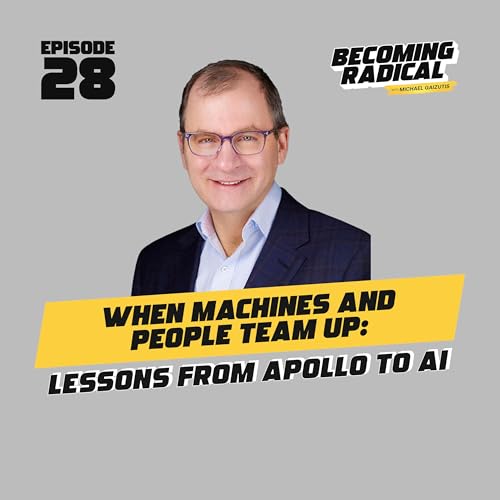
When Machines and People Team Up: Lessons from Apollo to AI cover art

When Machines and People Team Up: Lessons from Apollo to AI

When Machines and People Team Up: Lessons from Apollo to AI

Listen for free

View show details

About this listen

In this episode of Becoming Radical, Michael Gaizutis chats with David Mindell, a technologist, historian, entrepreneur, and co-founder of Humatics. David’s career has taken him from deep-sea robotics to MIT research and groundbreaking industrial innovation, and he’s got some fascinating insights on how precision navigation, human–robot collaboration, and bold investment choices are shaping the future of work.If you’re a technologist, founder, or leader trying to navigate the next industrial revolution, this episode will challenge the way you think about innovation and show why it’s industry, not just apps, that’s going to define the future. Key Takeaways Young engineers often overlook the intelligence embedded in human labor, a mistake companies cannot afford.Robots should complement workers, not replace them, creating worker-friendly AI and automation.Adoption is as critical as invention, scaling robotics requires trust and process innovation.Manufacturing and industrial work are powerful drivers of social change.Process innovation is just as transformative as product innovation, often more so.In This Episode [00:26] Introduction David Mindell[01:08] Humatics and spatial intelligence[03:15] Investment focus: transforming US industry[04:41] Industrial tech adoption and Silicon Valley’s software focus[06:05] Origins and inspiration for Humatics[07:26] Human-machine collaboration: Apollo program lessons[09:37] Defining spatial intelligence[10:49] Indoor positioning and subway applications[11:17] Rethinking autonomy and human-machine teaming[13:15] Real-world constraints and Waymo example[14:26] Collaborative robotics in industry[15:04] Designing worker-friendly AI and embedded intelligence[20:06] Training engineers for real-world context[21:14] Transition from academia to entrepreneurship[23:10] Evolving company leadership and founder transition[25:12] Commercializing deep tech and robotics adoption[30:22] Process innovation vs. product innovationOur GuestDavid Mindell is a technologist, historian, entrepreneur, and professor at MIT. He is co-founder and chairman of Humatics, a pioneer in high-precision navigation systems for robots and industrial environments, and co-founder of Unless, a venture firm investing in companies transforming U.S. industry. His latest book, The New Lunar Society, explores how industry, ethics, and innovation intersect to shape the next industrial revolution.Notable Quotes [03:34] “Less than 1% of venture capital in this country goes into industrial companies... we're all in a place where actually both parties in Washington agree we need to revitalize US Industry for a number of different reasons.” — David Mindell[11:50] “Every robot is made by people, right? So there's human intention built into the architecture, built into the software, built into which sensors are chosen depending on the task and the environment.” — David Mindell[24:02 “The statistics are that when founders step aside voluntarily, the companies overall do much better than when the founders are forced out.” — David Mindell[27:44] “I'm prepared for the idea that there is a moment when all of a sudden it'll seem like robots start popping up everywhere. Like we'll cross some usability threshold and then it'll kind of break free.” — David Mindell[28:29] “I do hope that you see a much more kind of fluid collaboration of robots and human environments instead of the kind of awkward, clunky things we see today. But that's hard.” — David Mindell[30:37] “We're very good in this country at product innovation. We've really dropped the ball on process innovation and that's really where the important stuff happens.”— David MindellResources and LinksDavid MindellLinkedInUnlessHumaticsBook: The New Lunar Society: An Enlightenment Guide to the Next Industrial RevolutionMichael GaizutisLinkedInWebsiteBecoming Radical LinkedInInstagramFacebook Twitter
No reviews yet