Episodes

  • Can Tigers Be Climate Refugees Too?
    Nov 17 2025

    In this episode of WildCats Pawcast, we ask: Can tigers be climate refugees too?

    We head to the Sundarbans, the world's largest mangrove forest and one of the most climate-vulnerable places on Earth, to explore how a warming world is reshaping life for both Bengal tigers and the people who live alongside them.

    We are joined first by Dr Sharif Mukul, Associate Professor of Environment and Development at United International University, Bangladesh. Dr Mukul explains his landmark study on how sea-level rise and rising temperatures could wipe out suitable tiger habitat in the Bangladesh Sundarbans by 2070, why key threats like salinity, sediment change and unplanned tourism may make things even worse, and why protecting the Sundarbans is not only about saving tigers, but about safeguarding one of our most important natural climate solutions.

    Then we speak with researcher Amrita DasGupta (University of London), whose work focuses on climate, migration and gender in Indian Ocean deltas. Amrita shares powerful insights from time spent in the Sundarbans, showing how climate change is driving people deeper into tiger territory, escalating human–tiger conflict, and disproportionately harming women through stigma, superstition, exploitation and displacement.

    Together, they reveal a stark reality: in the Sundarbans, some of the world's poorest communities, and the tigers they live beside, are already being pushed to move by a crisis they did little to cause, raising urgent questions about justice, responsibility and what it will take for both people and tigers to have a future there.

    Show More Show Less
    42 mins
  • Bridging the Digital Divide: World Wildlife Day 2024 Special
    Mar 3 2024

    Join us this World Wildlife Day as we delve into the cutting-edge realm of digital innovation in wildlife conservation! In this special episode, we are thrilled to be joined by Lydia Katsis, Senior Technical Specialist at the Zoological Society of London's Conservation Technology Programme.

    From advanced tracking technologies to innovative data analytics, we uncover the diverse digital solutions driving wildlife protection into the future. However, amidst the excitement of technological progress, a stark reality looms: an estimated 3.7 billion people, nearly half of the world's population, lack access to the Internet. This gaping digital divide disproportionately affects the least developed countries, which ironically harbor the richest biodiversity. This presents a formidable challenge in harnessing the full potential of digital technologies for collective conservation efforts. In our quest to safeguard species teetering on the brink of extinction, we must prioritize equal opportunities for all. Our mission extends beyond wildlife preservation; it encompasses fostering digital inclusion by 2030. Join us as we unravel the critical intersection of digital advancement and wildlife conservation, forging a path toward a more inclusive and sustainable future for all inhabitants of our planet.

    Show More Show Less
    13 mins
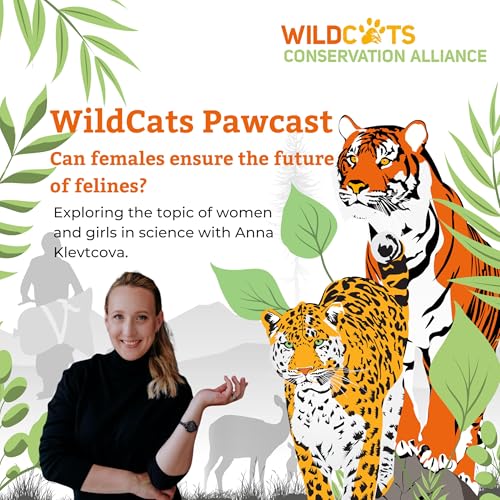
  • Can females ensure the future of felines?
    Feb 10 2024

    In this episode, we're celebrating Women and Girls in Science! Join us as we discuss how the exclusion of women from knowledge production hampers our ability to address global challenges like biodiversity loss effectively. We explore how one female mathematician exemplified the transformative insights women bring through her crochet-based solution to a problem that had stumped the world's leading minds for years. We also delve into the importance of valuing both social and natural sciences equally, explore the gender bias in academic disciplines, and speak with Anna Klevtcova, recipient of the WildCats Conservation Alliance's Professional Development Award. Anna shares insights on her interdisciplinary research, the challenges women face in academia, and the need for support in balancing research and family. Join us as we advocate for women in science.

    Show More Show Less
    19 mins
  • What can the ghosts of the Amur leopards past teach us about their future?
    May 3 2023

    In this episode, we will be discussing what historical records of Amur leopards in Seoul, Korea, at the end of the 19th century, can tell us about the future of large carnivores in major urban centers with a high human population density.

    We're joined by PhD Researcher Joshua Powell whose research investigates opportunities and challenges for the transboundary conservation of the Endangered Amur tiger, leopard, and other large carnivores in north-east Asia. Joshua is a visiting researcher with the Tiger and Leopard Conservation Fund in Korea (KTLCF) and has been a visiting research student in the College of Veterinary Medicine at Seoul National University. He is a National Geographic Explorer and one of the faces of WWF's Voices campaign on global biodiversity. In this episode, we will be focusing on his paper on the historical context of Urban Leopards in the Early Anthropocene From Seoul, Korea. His paper explored the socio-cultural, political, and ecological factors that may have facilitated human-leopard co-occurrence in an urban landscape and the factors that eventually led to the leopards' extirpation.

    Show More Show Less
    19 mins
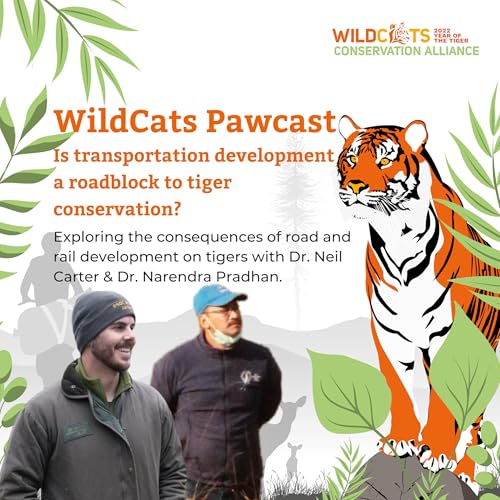
  • Is transportation development a roadblock to tiger conservation?
    Dec 8 2022

    The construction and expansion of roads and railways fragment wild spaces and have direct and indirect impacts on ecosystem integrity and the persistence of species, especially in areas of high biodiversity value.

    The length of legally sanctioned roads alone has increased by 12 million km worldwide since 2000, with a further 25 million km expected to be developed globally by 2050 — that's enough to circle the planet more than 600 times. Roughly 90% of these new roads will be built in developing nations, frequently in tropical and subtropical regions with high biodiversity and environmental value.

    Currently, it is known that 134,000 km of roads already exist within tiger habitats and 24,000 km of new roads will be built by 2050 within these tiger territories. So, in this episode of WildCats Pawcast, we are speaking with two of the authors from a recent paper that has forecasted the effects of transport infrastructure on endangered tigers.

    Join this episode to hear from Dr. Neil Carter, an Associate Professor from the School for Environment and Sustainability at the University of Michigan, and Dr. Narendra Pradhan, the Programme Coordinator at the International Union for Conservation of Nature (IUCN) in Nepal.

    Show More Show Less
    43 mins
  • Dam, are hydropower projects threatening wild tigers?
    Sep 20 2022

    While we are all too familiar with the catastrophic footprint fossil fuels have left on the environment and our health less is known about some of the impacts of renewables on our wild spaces and biodiversity.

    In this episode, we will be hearing more about how a low-carbon, renewable solution to rising global energy demands fails to fully consider impacts on biodiversity, freshwater connectivity and local communities.

    We are joined by Dr Ana Filipa Palmeirim, an Ecologist and Postdoctoral Researcher at the University of Porto. Filipa recently published a paper on the impacts of hydropower on the habitat of jaguars and tigers. This paper revealed more than one-fifth of the world's tigers had been affected by habitat loss linked to hydropower projects.

    Show More Show Less
    16 mins
  • How do you shoot a tiger? With a camera!
    Aug 19 2022

    This month we're bringing you a special episode of WildCats Pawcast in celebration of World Photography Day. If you're an aspiring wildlife photographer or just want to learn more from behind the lens this episode has the perfect mix of inspiration, creativity, and technical advice.

    Photography not only makes the world feel closer, but it also inspires people to care, making it an incredible tool for conservation. Tigers, specifically the Bengal tiger in India, have been extensively documented by photographers who have showcased the magnificence of these animals to a global audience. But beyond beautiful images, photos have also provided graphic evidence of our devastating impact on habitats and species which has helped to drive action in a worldwide community.

    Across the world, wildlife photographers are using the power of pictures to help save endangered species. In this episode, we are joined by an amazing photographer and longtime friend of WildCats Conservation Alliance, Tal Chohan.

    Tal is a UK-based photographer who specialises in big cat photography. He has been pursuing this passion for over a decade, first honing his skills in zoo settings before capturing wildlife in their natural habitats at home and abroad. For over a decade Tal has been supporting us at WildCats and you can explore more of his work over on Instagram or his website.

    Show More Show Less
    28 mins
  • Kids ask some of the most difficult questions, but can tiger experts answer them?
    Jul 29 2022

    Welcome back to episode 5 of WildCats Pawcast brought to you by the WildCats Conservation Alliance and hosted by Amy van Gelder.

    To celebrate Global Tiger Day on the 29th of July, we recruited some inquisitive kids to help record our Pawcast. Amid the who, what, where, why and how, children are often asking the most important and challenging questions. So, in the latest episode of WildCats Pawcast, we have handed the metaphorical podcasting microphone over to some of the world's most enquiring minds. But, can leading tiger experts withstand the interrogation? Join Dr. Dale Miquelle from the WCS, Debbie Martyr from FFI and Sashank Sharma from ZSL Nepal as they fearlessly take on these curious cubs.

    Show More Show Less
    18 mins