WorkTech Podcast cover art

WorkTech Podcast

WorkTech Podcast

Written by: WRKdefined
Listen for free

About this listen

The WorkTech Podcast explores the critical trends shaping the future of work and HR tech. George LaRocque of WorkTech, drawing from years of advising top innovators, investors, and enterprises, guides you through market deals, issues, opportunities, and trends—all through a strategic, actionable lens.All rights reserved by WRKdefined Careers Economics Leadership Management & Leadership Personal Success
Episodes
  • Goldman Sachs Validation: Einat Steklov on Kashable’s $60M Series C and the Future of Workplace Credit
    May 12 2026
    In this episode of the WorkTech Podcast, host George LaRocque sits down with Einat Steklov, co-founder and co-CEO of Kashable, to discuss their monumental $60 million Series C funding round led by the Goldman Sachs Impact Fund. At a time when middle-market funding has been scarce, this deal stands out not only for its size but for the powerful validation it provides for the financial wellness category. The "Action" Gap in Financial Wellness For years, employer-sponsored financial wellness was limited to advice and education. However, as Einat explains, "advice alone is just not enough" when 78% of Americans are living paycheck to paycheck. Kashable bridges this gap by combining expert financial coaching and credit monitoring with Socially Responsible Credit®, low-cost loans that serve as a lifeline for employees facing unexpected expenses like car repairs or medical bills. How It Works: The Employer Advantage Kashable’s unique model leverages the employer relationship to offer credit to those often shut out of traditional banking. By utilizing employment data for underwriting and payroll-linked repayment, Kashable can say "yes" more often while maintaining a resilient business model. This system creates a "win-win-win": For Employees: Access to credit that helps build or repair their credit scores—often by 45–50 points. For Employers: A reduction in 401(k) loan withdrawals (up to 30% in some cases) and improved employee retention and focus. For HR Teams: A seamless, tech-driven implementation that integrates with major HCM and payroll platforms like Workday and Business Solver. A Mission Validated by Goldman Sachs The partnership with Goldman Sachs’ Impact Fund brings with it a commitment to measurable social impact. Einat details how the $60M capital injection will be used to scale Kashable's reach from the 5 million lives currently covered to the 100 million+ American workers who still need these essential financial tools. Whether you are a CHRO looking to bolster your voluntary benefits package or a fintech enthusiast interested in impact investing, this conversation provides a blueprint for how technology can foster a more inclusive and resilient financial system. Key Takeaways Validation of the Category: A Series C led by Goldman Sachs signifies that financial wellness is no longer a "nice-to-have" but a durable, institution-grade business model. Moving Beyond Advice: Effective financial wellness requires an "action plan" that includes tangible tools, such as affordable credit, alongside education. The Power of Payroll: Using payroll integration for repayment provides the certainty needed to offer better terms than the open market, directly helping employees build credit files. Protecting Retirement Savings: Providing an alternative to 401(k) loans helps employees keep their retirement plans intact, addressing a major long-term problem for both workers and employers. Scalability via Tech: Seamless HCM integrations are critical for adoption, enabling HR teams to "flip a switch" and deliver high-impact benefits without a significant administrative burden. On this episode Einat and George discuss Series C Funding, Goldman Sachs Impact Fund, Financial Wellness, Socially Responsible Credit, Fintech, Employer Benefits, Payroll Integration, Credit Score Improvement, 401(k) Loans, Employee Retention, HR Technology. Learn more about your ad choices. Visit megaphone.fm/adchoices
    Show More Show Less
    27 mins
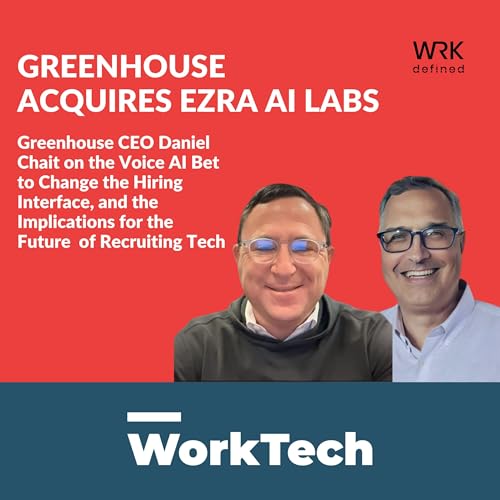
  • Greenhouse Acquires Ezra AI Labs: The Voice AI Bet Reshaping the Hiring Interface
    May 5 2026
    Why Greenhouse acquired Ezra AI Labs, what it signals for voice AI in HR tech, and how the hiring interface is about to change. In a WorkTech exclusive, George LaRocque sits down with Greenhouse CEO and founder Daniel Chait just after the announcement that Greenhouse has entered a definitive agreement to acquire Ezra AI Labs, a foundational voice AI interviewing platform built to deliver structured, naturalistic on-demand candidate conversations at scale. This breaking news episode goes beyond the press release, delivering analyst-led context on why this acquisition happened, why it happened now, and what it means for the HR technology market, talent acquisition leaders, and the future of the hiring interface. Greenhouse, the structured hiring platform used by 7,500 companies worldwide, is making a deliberate move to own a foundational AI capability before the market converges around it. Ezra AI Labs was purpose-built to solve the three core failures of first-generation AI interviewing: robotic voice quality, lack of structured methodology, and transparency gaps that eroded candidate trust. WorkTech's Q1 2026 M&A research flagged voice AI in talent acquisition as a strategic category to watch, tracking 41 acquisitions across 40 transactions in 10 countries driven by capability buying rather than consolidation. This deal is a direct expression of that thesis. In this episode, we look at: voice AI recruitment, AI-powered interviewing, HR technology M&A, talent acquisition innovation, structured hiring, the future of work, and agentic AI in enterprise software. Key Takeaways: Greenhouse acquired Ezra AI Labs because existing voice AI interview products were failing candidates on three measurable dimensions: experience quality, structured methodology, and transparency. Ezra was built from the ground up to solve all three. This is an infrastructure acquisition. Voice AI is the foundation for conversational interaction across the entire Greenhouse platform, not just a standalone interview feature. WorkTech's Q1 2026 M&A data shows capability buying as the dominant deal thesis across 41 work tech acquisitions. Greenhouse acquiring Ezra is the clearest expression of that pattern in talent acquisition. Candidate sentiment toward AI interviewing is shifting. Greenhouse's research shows acceptance is already growing as voice AI quality improves and companies lead with transparency and structured methodology. The deal signals to the broader market that voice AI in talent acquisition is no longer a watch list category. Competitors will respond. Expect significant M&A and product investment activity in this space over the next 12 months. For Greenhouse customers, Ezra continues to operate independently while integration work proceeds on the back end. Governance, reporting, and customer control are central to the rollout philosophy. The cultural fit between Greenhouse and Ezra runs deeper than technology. Both companies prioritize structured hiring practice, candidate experience, and compliance as foundational rather than add-on considerations. In this episode, George and Daniel discuss Greenhouse acquisition of Ezra AI Labs, voice AI interviewing, structured hiring methodology, candidate experience, HR technology M&A, agentic AI in recruiting, talent acquisition innovation, hiring platform strategy, AI adoption in enterprise software, and the future of the hiring interface. Learn more about your ad choices. Visit megaphone.fm/adchoices
    Show More Show Less
    21 mins
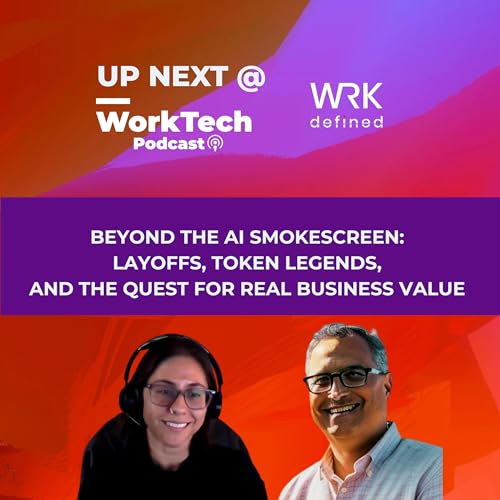
  • Beyond the AI Smokescreen
    May 3 2026
    In this comprehensive April 2026 edition of the Up Next @ WorkTech crosspod, George LaRocque (founder of WorkTech) and Kate Achille (The Devon Group) reunite after a season of travel and industry events to dissect the complex, often contradictory state of the modern workplace. The conversation strikes a balance between human-centric news, including Kate’s recognition as a Top Woman in PR and Communications, and the sobering reality of a tech sector undergoing a radical, AI-driven transformation. The episode dives deep into the late-April "layoff season," focusing on the divergent strategies employed by industry titans Meta and Microsoft. While Meta has announced significant cuts, slashing 8,000 positions and closing 6,000 open roles, the duo notes the "snarky" internal reality for those remaining: employees are reportedly being tasked as "AI training dummies," essentially training the models destined to replace their functions. In contrast, Microsoft is taking a more "human" approach through strategic buyouts aimed at its longest-tenured staff: those whose age and service years combined equal 70 or more. George and Kate discuss whether these layoffs are truly necessitated by AI or if the technology is serving as a "smokescreen" for companies to correct the over-hiring trends seen during the post-COVID boom. A provocative segment of the show explores the rise of "Office AI Leaderboards" at major corporations like JP Morgan and Disney. This trend, dubbed "token maxing," involves ranking white-collar workers based on their AI usage. George shares a striking anecdote of a Disney employee invoking the AI model Claude 460,000 times in just nine days. However, the hosts question the validity of these metrics. Citing observations from the CEO of Workable, George notes that while personal productivity (writing emails faster or generating 50-page briefs) has spiked, it has not yet translated into measurable business productivity, which still relies on human-centric alignment, communication, and leadership. They warn of the "AI slop" created when high usage is prioritized over competence. The episode also covers significant leadership changes at the Department of Labor (DOL). With Keith Sonderling stepping in as Acting Secretary of Labor, the hosts express cautious optimism. Known for his active engagement with the tech community to understand how AI is built and applied, Sonderling is viewed as a "steady" hand who may finally provide the federal regulatory guidance the workforce desperately needs. Finally, George provides an exclusive breakdown of the Q1 2026 WorkTech funding and M&A report. Key highlights include: $1.9 billion in capital raised across 58 deals, though "mega-deals" accounted for 68% of the total. An "hourglass" market effect, where early-stage startups and massive incumbents thrive while mid-market companies without AI-native models feel the squeeze. A surge in European consolidation, with Europe nearly matching the US in M&A transaction volume during the first quarter. The episode concludes with a "Rose and Thorn" segment, touching on the cultural impact of US policy abroad and Kate’s upcoming participation in a national athletic competition in Corpus Christi. On this episode Kate and George discuss AI Layoffs, Token Maxing, WorkTech M&A, Department of Labor, Keith Sonderling, Microsoft Buyouts, Meta AI Training, Human Capital Management (HCM), Business Productivity, HR Tech Trends, VC Funding 2026, Claude AI, Workforce Regulation, Employee Gamification, HR Brew Talent 2030. The Great Tech Reset: Layoffs and Strategic BuyoutsGamification vs. True ProductivityRegulatory Shifts and the M&A Landscape Learn more about your ad choices. Visit megaphone.fm/adchoices
    Show More Show Less
    44 mins
adbl_web_anon_alc_button_suppression_c
No reviews yet