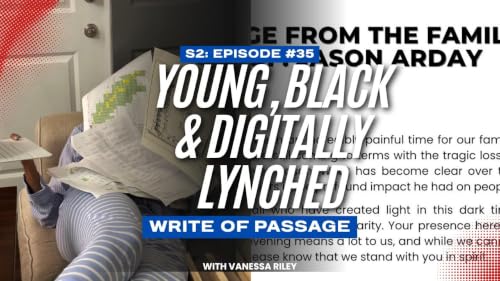
Write of Passage by Vanessa Riley cover art

Write of Passage by Vanessa Riley

Write of Passage by Vanessa Riley

Written by: Vanessa Riley
Listen for free

Join bestselling author Vanessa Riley as she delves into untold histories, reflects on current events through a historical lens, shares behind-the-scenes writing insights, and offers exclusive updates on her groundbreaking novels.

vanessariley.substack.comVanessa Riley
Social Sciences
Episodes
  • Young, Black, and Digitally Lynched
    Aug 18 2026
    I’ve done it.Last week, I told you I was on deadline, and now I am free. That is right—I have finished my 32nd book.I turned it in to my publisher. It will be my next historical fiction, coming in at 105,000 words, and I am so excited.I did something I’ve never done before. Multiple POVs. Caribbean history blended with American history. I have cars and horse-drawn carriages. Letters written and sealed under wax. Candlelight and electric lights.I can’t give you much more detail yet, but it is my brand—a powerful saga, women-centric, with women doing things we need to know about, finding rooms they weren’t supposed to be in and pushing forward questions we all should be asking and answering.So I should be coming out of deadline talking about nothing but joy.But at the same time, one of the most disconcerting things has been happening.There is always nonsense going on in the book sphere, the academic sphere, and the tech sphere—the three worlds I pay a lot of attention to.And this past week, it was academia.There was a young Black professor at Cambridge named Jason Arday. He was not a perfect person. None of us are. But he suddenly became the center of accusations of plagiarism and an enormous public storm.In a matter of days, it became a nightmare in the press.An investigation by NewsCord, which I will link her, counted every substantive and distinct article about Jason Arday from July 24 through August 14, 2026. Their count was:* 249 articles in 22 days* 188 articles in the final nine days—from his August 5 resignation through August 14* That’s an average of 20.9 articles per dayArticle after article. Imagine the tons of social-media impressions fueled by this much press. People attacked him, defending him, picked him apart. 9 days, his final 9 day, 188 articles.That looks like a digital lynching.It must feel like that.And it proves something I’ve talked about: when somebody has a grievance, when somebody needs a scapegoat, why so often a Black neck, a POC neck, or a woman’s neck becomes a doormat to step on.Today, I don’t want to use my words to talk about what happened to Jason Arday.I want you to hear his family’s words.While the rest of the world was debating a professor’s humanity, they watched someone they loved go through this storm.Now they are grieving him.This has been an incredibly painful time for our family, and we are still coming to terms with the tragic loss of our beloved Jason. What has become clear over the past 72 hours is the profound impact he had on people.We are grateful to all who have created light in this dark time through kindness, generosity and solidarity. Your presence here to remember him this evening means a lot to us, and while we cannot be there in person, please know that we stand with you in spirit.The public cruelty Jason was subjected to was too much for any man to bear. The outpouring of love, support and grief since his death means so much to us, although it is bittersweet. Kindness is needed in life, not just in death. We’ll never know what might have been different had he experienced more of it while he was still here.What we do know is how deeply he was loved, and we wish to especially thank those who knew Jason in life and tried to get through to him, who supported him in his darkest hour, and who saw the person in the middle of this awful storm.If you would like to share a message of condolence, memory, or support with Jason Arday’s family, please do so using this contact:TheArdayFamily@gmail.comNo book recs today. I want to publicize a legitimate Go Fund Me for his family.https://gofund.me/ce60c7ec0And if you are struggling with your mental health:In the United States:Call or text 988, the Suicide & Crisis Lifeline. It is available 24 hours a day.In the United Kingdom and Ireland:Call Samaritans at 116 123, free, 24 hours a day, 365 days a year.In England:For urgent mental-health help, call NHS 111 and select the mental-health option.If someone’s life is in immediate danger, call emergency services—911 in the United States or 999 in the United Kingdom.If you are worried about somebody, ask about them. Help them connect with professional support.Kindness is needed in life, not just in death.Let’s be better and have a better week.* Support your local bookstores, especially your indies.You can find my notes on Substack or on my website, VanessaRiley.com, under the podcast link in the About tab.Hey. Let’s keep building together. I need you. That is the truth. Like, share, subscribe, and stay connected to Write of Passage.Thank you for being here.I want you to come again. This is Vanessa Riley. This is a public episode. If you'd like to discuss this with other subscribers or get access to bonus episodes, visit vanessariley.substack.com/subscribe
    Show More Show Less
    9 mins
  • Deadline Hell Exposed
    Aug 11 2026
    That deadline you confidently agreed to because you were absolutely certain Future You would be organized, disciplined, and completely undistracted?Yeah. Future You lied.I’m exposing deadline hell. How writers get here—and how we get out.Deadline Hell Exposed: How Writers Get In—and How We Get OutNo, I haven’t disappeared.I’ve been in deadline hell.And since I’m currently working my way through it, I thought I’d take a moment to explain exactly what deadline hell is.Deadline hell does not necessarily mean you waited until the last minute to finish your book. Though, yes, sometimes that happens.Deadline hell is what happens when you have an unforgiving deadline—either one you set for yourself or one you agreed to—and suddenly the calendar and the manuscript are having two very different conversations.The problem begins when we agree to deadlines while imagining ourselves as completely different people.We imagine Future Writer Us.Future Writer Us is studious. Diligent. Disciplined. Future Writer Us wakes up every morning refreshed and inspired. Life is going perfectly. Nobody needs anything. Nothing breaks. There are no emergencies, unexpected trips, illnesses, distractions, family obligations, or days when our brains simply refuse to cooperate.Future Writer Us just writes.And because we know approximately how many words we can produce in a day, a week, or a month, we look at the deadline and think:Absolutely. I can deliver that.Welcome to the dreamworld.Here is something I’ve learned: until you really understand how you write and have developed the discipline to consistently produce, give yourself 1.5 times longer than you think you need.Trust me. You’ll be grateful for the padding.Of course, some of us know this and still let that beautifully padded time slip away.Hello. It’s me.Know How You WorkI’m an everyday writer.That means I’m going to write or research every single day until I get that bad boy done.Sometimes I have an actual word-count goal. I use Scrivener, which has a wonderful—and occasionally terrifying—feature that lets you enter your target word count and deadline. It calculates how many words you need to write each day to get there.In the beginning, maybe that number is five hundred words a day.Notice I didn’t say five hundred good words.I said five hundred words.Then life happens.Suddenly that daily target is 2,500 words.When you’ve been in the game for a while, that number doesn’t necessarily frighten you.It probably should.But fear isn’t going to finish the book.Right now, my deadline for my next book is August 15. This will be book number 32.With the exception of one book during COVID—and perhaps one or two deadlines that had to move by a couple of weeks—I’ve hit my deadlines.I don’t say that to brag.I say it because deadlines are about knowing yourself.As a writer, you get better by writing. There is no substitute for putting yourself in the chair and doing the work. There will always be something more interesting happening somewhere else.The book does not care.You still have to finish it.So, from someone currently residing somewhere around Dante’s fifth circle of Deadline Hell, here are the things that keep me moving.1. Limit Social MediaYou can scroll forever.What looks like a huge block of writing time can become a very small one frighteningly fast.But as an author, I also can’t simply tell you to abandon social media. Social media is one of the ways we get our stories into the world. Publishers expect authors to participate in promotion. As you develop readers, they’re going to want to know what you’re writing, what you’re thinking about, and what’s coming next.Connection matters.I’ve taken long social-media breaks before, and I’ve found that rebuilding that connection afterward can be difficult. Algorithms aren’t necessarily kind when you’ve been gone for a long time—particularly if you don’t already have an enormous following.So don’t disappear.Set boundaries.Do what you need to do, then get back to the book.2. Accept That You Don’t Have All the AnswersI have a decent outline.I have a plan.That’s it.I’ve mentioned before that I’m a plantser. I plan my books, but I deliberately leave room for inspiration and for the story to change based on how the characters begin speaking, behaving, and moving through scenes.An outline is a map, not a prison.Characters reveal things. Scenes develop differently than expected. Something you thought would be important becomes unnecessary.And something you barely noticed becomes the heart of the book.Leave yourself enough room to discover the story you’re actually writing.3. I Don’t Truly Know the Ending Until I Type “Done”I know.That sounds scary.I usually know where I’m heading. But because I allow the manuscript to change, I don’t know exactly how the book will end until I get there.I don’t completely know what will stay.I don’t completely know ...
    Show More Show Less
    18 mins
  • Receipts Please
    Aug 4 2026
    You wrote the book. You poured months, maybe years, into every page. But in today’s publishing landscape, that’s no longer enough. Can you prove you wrote it?Every author—and everyone who loves one—needs to know how to protect themselves.Receipts PleaseThe AI Witch Hunt And You’re Already GuiltyThe headlines are rough right now.Books are still being banned. Independent bookstores are struggling. Publishers are grappling with higher paper, printing, and shipping costs.We’re living in a political climate where books that tell fuller histories—or simply allow readers to imagine beyond rigid stereotypes—are increasingly treated as the problem.Now we’re all a part of the new witch hunt. We are watching as everyone from TikTok to the New York Times digs deeply into authorship and asks questions. The cross we now bear: “The author must have used AI.”As a writer who loves words and her job, I don’t fall into crab-in-a-barrel cynicism. I celebrate every book deal. I don’t care whether it’s a debut novelist who lands a six-figure contract or a veteran writer signing another multi-book deal. I want everyone’s story out there in the venue of their choosing, be it Indie or traditional, podcast, TV, film, or stage.The creative industry is hard enough without anyone rooting against another.Every contract or act of publishing represents years of sacrifice, rejection, revisions, and hope.And what I refuse to accept is the growing assumption that when certain authors succeed, they must have cheated.The New AI Witch HuntOver the past year, we’ve seen a troubling pattern emerge.Debut authors have found themselves publicly accused of using AI. Publishers have withdrawn books. Agents have pulled manuscripts and representation. Yet on what basis are these devastating actions being taken? AI detectors. Isn’t that sort of like the fox watching the hen house?Some of the most widely used AI detectors are:There are many more, each with opaque rules and algorithms and methodologies that are used to determine what is human and what is AI. Their judgement is being held up as a holy Grail. But it’s still just the fox guarding the henhouse.Influencers and bloggers have accused works of being AI-generated for having tropes, similar fantasy settings, etc. Newsflash: genre fiction like romance, thrillers, romantasy, is supposed to use tropes to meet reader expectations.The evidence- some screenshots and attitude is being treated as definitive.The result?Authors are increasingly expected to prove they wrote their own books. That should concern everyone.The Latest Targeted Authors: Is there a pattern?Following online accusations that BiPOC author Mia Ballard’s novel Shy Girl contained AI-generated text, Hachette investigated, didn’t stand by the author or the series of editors involved in acquisition, and canceled publication.BiPOC author Ballard has maintained that she did not use AI to write the novel, though she has acknowledged that an early edited version may have included AI-assisted edits introduced by someone else. But the buzz isn’t about editing; it’s about cheating to write the book.Black debut author Jerry Falade, whose thriller reportedly sparked a 14-publisher auction and a proposed $2 million deal, had his manuscript withdrawn after questions arose about its creation. Black author Falade has denied using AI to write the novel, while his agent, Marc Gerald of Europa Content, stated they could no longer authenticate the manuscript’s development.Meanwhile, Nobel Prize-winning Polish Woman author Olga Tokarczuk openly discussed using AI as part of her creative process—not to write her prose, but to explore character development, ask questions about fictional people, even what music they might listen to. The backlash was swift. She had to issue an apology and clarification, stating that her use was strictly for research.The latest banshee torches were raised to celebrated Black novelist H. M. Wolfe for her dark dystopian romance, Daggermouth. An Atlantic investigation questioned whether portions of the novel appeared AI-generated. Black author Wolfe denies using AI, and her publisher, Scarlett Press (an imprint of Simon & Schuster), stood behind the book.As an engineer with plenty of data training and modeling, there’s not enough here to say there is a trend, but if you are a Black author, a BiPOC author, or a woman author, be aware. We seem to be entering an environment where, if accused of AI Generation, we will be presumed guilty until proven innocent.Who Gets the Benefit of the Doubt?According to The Independent, Male Caucasian author Anthony Horowitz, a New York Times bestselling author, says ChatGPT has become part of his research process. He says, “I have absolutely no shame about using it at all. It would be crazy to give up an incredible resource.”He has also made clear that he does not use AI-generated prose in his novels and the Atlantic has not accused him of AI ...
    Show More Show Less
    24 mins
adbl_web_anon_alc_button_suppression_t1
No reviews yet