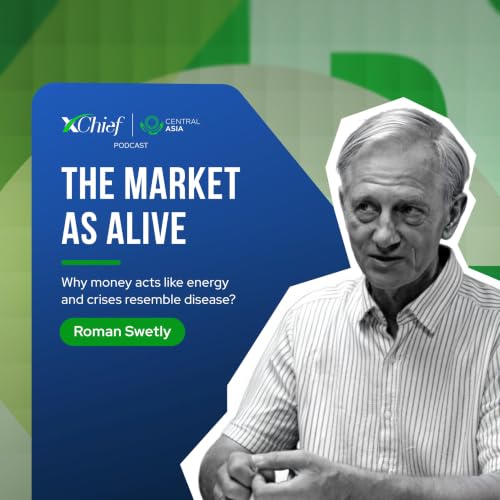
• The Market as Alive: Why Money Acts Like Energy and Crises Resemble Disease
    Jul 20 2026

    What if the financial market is not simply a mechanism that can be fully controlled, but a living organism?

    In this episode, engineer and developer Roman examines money, stocks, crises and market participants through the laws of nature.

    We discuss why financial markets would emerge again even if society had to start from zero, why economies depend on the constant movement of goods and capital, how human weaknesses support consumption, and why the modern human brain still follows many patterns formed in the savanna.

    Watch the full episode on YouTube — xChief Central Asia.

    Timestamps:

    00:00:00 — Teaser: money and markets as living systems

    00:00:30 — How Roman came to trading

    00:02:14 — Physics, models and the language of the market

    00:05:02 — The financial market as a living ecosystem

    00:07:39 — Predators, prey and long-term strategy

    00:08:48 — Why banks would emerge again

    00:10:16 — Stocks as populations of living organisms

    00:11:23 — Crises as market diseases

    00:12:06 — What if goods became eternal?

    00:14:45 — Capitalism and the savanna brain

    00:18:52 — Healthy stocks, weak stocks and market illusions

    00:20:08 — What is money?

    00:22:45 — Why a brokerage account is not money yet

    00:24:58 — Can we buy all the uranium on Earth?

    00:27:25 — Can the market be fully controlled?

    00:29:27 — Algorithms and competition between traders

    00:32:19 — Why long-term strategy is stronger

    00:34:14 — Nature-inspired models, robots and adaptive markets

    00:38:10 — Final: the market as a vast island

    Show More Show Less
    39 mins
  • Kazakhstan or Dubai: Business, Taxes, AI and the Rules of Growth
    Jul 10 2026

    Kazakhstan or Dubai — where should a business build its future?

    In this episode, we speak with Adlet Mazhitov about why Kazakhstani entrepreneurs increasingly look toward Dubai, how business works between two jurisdictions, and why moving a company abroad does not always solve old problems.

    We discuss why entrepreneurs open companies in the UAE, how Dubai differs from Kazakhstan as a business environment, what questions should be asked before relocating a business, and why tax optimization is not just an attractive phrase, but a complex legal structure.

    We also talk about English law, free economic zones, investors, startups, tax residency, dividends and the role of artificial intelligence in the work of lawyers, accountants and entrepreneurs.

    This is a conversation about business between Kazakhstan and Dubai, international ambition, legal details, mistakes, opportunities and why, even in a highly technological environment, it is still important to stay human.

    Timestamps:

    00:00:00 — Teaser: Kazakhstan or Dubai

    00:01:00 — Two countries, one business

    00:02:10 — Why entrepreneurs open companies abroad

    00:03:17 — Can any business move to another country?

    00:05:00 — What to ask before opening a company in Dubai

    00:06:57 — Taxes, relocation and hidden motives

    00:08:39 — Ambition or fear: why entrepreneurs choose the UAE

    00:11:30 — Why Dubai is a strong business environment

    00:14:31 — Business languages and international clients

    00:17:14 — English law and a different legal culture

    00:24:00 — Contracts, partners and global trade

    00:33:30 — Why Dubai reminds Adlet of Astana

    00:34:20 — AI as a business tool

    00:40:00 — Will AI replace lawyers and accountants?

    00:42:53 — Startups, expertise and market myths

    00:44:55 — Investors in Kazakhstan and abroad

    00:49:30 — Tax residency and international structures

    00:50:49 — Dividends, Dubai and taxes

    00:53:14 — Chinese language, DeepSeek and client trust

    00:55:35 — Final words

    Show More Show Less
    55 mins
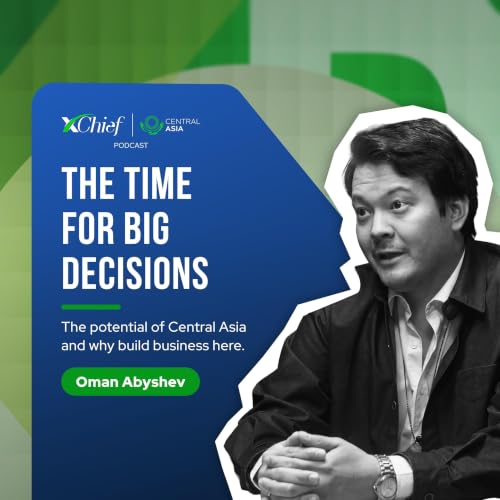
  • The Potential of Central Asia and Why Build Business Here
    Jun 15 2026

    Central Asia is often seen as a region people need to leave if they want to build a serious technology business. But what if one of the most underestimated markets is not somewhere far away — but right here?

    In this episode of xChief Central Asia Podcast, we speak with Oman Abyshev, CEO of Oscar and Sons, a deep-tech company from Bishkek.

    Oscar and Sons is developing Ozonix, a technology that helps extend the shelf life of agricultural products by 2–4 times and gives farmers in the region access to international markets without freezing their produce. But this conversation is not only about one technology.

    It is about the potential of Central Asia as a place for serious entrepreneurial decisions: a region with strong talent, overlooked markets, real problems, and room for companies that can build from within the region — not only outside of it.

    We discuss why you do not always need to leave to become someone, how to build in uncertainty, why regulation should act more like a gardener than a shepherd, how to grow in a difficult market, and why water may become one of the most important questions for the future of the region.

    The main question of the episode: what needs to happen for Central Asia to stop being only a source of talent — and become a place where that talent builds world-class companies?

    Chapters

    00:00:00 — Teaser: problems only a few people can solve

    00:00:28 — Central Asia: water, energy, crops and production

    00:00:49 — How Kyrgyzstan shapes entrepreneurial thinking

    00:03:02 — AI and Deep Tech: what is the difference?

    00:04:14 — Engineering, materials and decision-making theory

    00:08:01 — Family business and responsibility for Oscar and Sons

    00:11:01 — Why Kazakhstan became the first external market

    00:13:07 — Astana as a base camp for growth

    00:16:15 — Astana Hub or AIFC: where to start

    00:18:57 — Regional disadvantages as business opportunities

    00:20:27 — Regulation as a gardener, not a shepherd

    00:21:17 — Water crisis and Central Asian integration

    00:22:34 — AgriTech and Ozonix: what problem the technology solves

    00:24:47 — From technology to R&D, export and a bigger market

    00:28:13 — Digital Bridge and the first signs of demand

    00:30:53 — Food loss, storage and export barriers

    00:34:36 — Product logic and unit economics

    00:34:58 — Why Ozonix chose agriculture, not medicine

    00:37:28 — What the technology can and cannot change

    00:38:14 — Selling further, at higher value and to demanding markets

    00:39:45 — Why farmers adopt technology faster

    00:41:21 — Market, competitors and positioning

    00:43:49 — Building a Deep Tech company from Bishkek

    00:46:13 — Central Asia as an Eldorado for Deep Tech

    00:49:31 — Deep problems and the first million in Kazakhstan

    00:51:40 — Building business under uncertainty

    00:56:26 — Central Asia as a land of talent

    00:56:36 — The region’s main deficit: trust

    00:58:23 — Water as a key question for the future

    00:59:46 — Final thoughts: why the region needs to speak about its problems

    Show More Show Less
    1 hr and 1 min
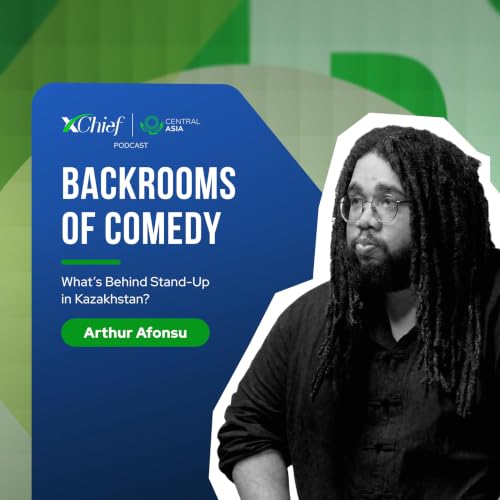
  • What’s Behind Stand-Up in Kazakhstan: Comedians, Venues, Audiences and the Events Business
    Jul 7 2026

    When people come to a stand-up show, they usually see the stage, the microphone, the comedian and a good night out.

    But behind it, there is much more: organization, venues, ticket sales, audience work, agreements, reputation, team management, stress and a clear understanding of why someone buys a ticket in the first place.

    In this episode of xChief Central Asia Podcast, we speak with Arthur Afonsu — stand-up comedian, producer, comedy event organizer and founder of the Comedy Point community.

    We discuss how stand-up works in Kazakhstan, how Astana and Almaty differ as comedy markets, why live events are becoming more valuable in the age of endless content, how comedy turns into a business and whether entertainment can become a sustainable part of Central Asia’s creative economy.

    The main question of the episode that we wanted to highlight today: what really stands behind a good stand-up night — and why comedy is no longer just about jokes?

    #xChiefCentralAsia #StandUp #Kazakhstan #Astana #Almaty #ComedyPoint #Comedy #CreativeIndustry #Business #Events #CentralAsia

    Timecodes:

    00:00:00 — Teaser: stand-up and the value of being real

    00:00:28 — Stand-up in Kazakhstan today

    00:00:59 — Arthur Afonso, Comedy Point and live events

    00:01:25 — Is the industry already formed?

    00:05:07 — What makes a stand-up scene?

    00:09:55 — Astana vs Almaty

    00:14:26 — A Kazakhstani style of humor

    00:19:29 — Why people pay for live comedy

    00:24:35 — Can anyone become a comedian?

    00:27:40 — How to hold an audience’s attention

    00:29:40 — When stand-up becomes a business

    00:33:35 — Why opening a comedy club is harder than it looks

    00:37:56 — Budgets, venues and unusual formats

    00:41:40 — What sells a show: name, venue or trust

    00:44:00 — Can comedians earn money systematically?

    00:47:41 — Akimat, permits and explaining the value of events

    00:49:53 — How to negotiate with venues

    00:52:57 — Can Astana become the center of comedy?

    00:57:29 — Final thoughts: stand-up and the creative industry

    Show More Show Less
    59 mins
  • Startups, Money and Trust: What Happens After Growth
    Jun 8 2026

    Every startup begins with an idea, speed, and the desire to grow fast. But at some point, a product alone is no longer enough.

    Banks start asking questions. Investors look at structure. Payments can get delayed. Documents, compliance, AML, KYC, reporting, partners, and internal responsibility become part of the business reality.

    In this episode of xChief Central Asia Podcast, we speak with Victoria Tsoy about how a startup moves from chaotic growth to becoming a real company, why money often becomes the first point of conflict, why structure matters before problems appear, and why trust is built not only through the product, but through the way the company operates inside the system.

    We discuss startups in Kazakhstan, Astana Hub, the AIFC, banking, international jurisdictions, accounting, MLRO, compliance, founder mistakes, and why growth without transparency can become a serious risk.

    The main question of the episode: are you building a business — or are you building access to the system where that business can actually exist?

    Chapters:

    00:00 — Intro: from startup speed to trust

    02:23 — Why startups ignore compliance

    04:32 — How long chaos can last

    06:18 — Working capital and transparent reporting 08:02 — When one chat is no longer enough

    09:30 — When a startup needs structure

    11:49 — Why money becomes the first conflict

    12:58 — Why accounting matters from day one

    14:36 — A strong product that failed to scale

    16:30 — Frozen payments and blocked accounts

    18:29 — Compliance: protection or control?

    20:16 — Financial chaos and red flags

    22:22 — Friends and relatives inside business

    24:40 — Traders, documents and regulatory questions

    25:32 — What an MLRO does

    26:01 — Currency operations and repatriation deadlines

    30:36 — Opening accounts for non-residents

    31:32 — Banking and digitalization in Central Asia

    32:43 — Astana Hub, AIFC and tougher requirements

    35:01 — Accounting policy as a sign of maturity

    37:09 — What investors see in financial reports

    39:24 — Suspicious transactions and expert responsibility

    42:28 — How to choose a trading platform

    48:16 — Accounting as the language of the company

    50:53 — Why Kazakh startups face trust barriers abroad

    52:38 — Why jurisdiction matters

    55:19 — AIFC, Astana Hub, Dubai and Delaware

    56:04 — Final thoughts: building trust, not only growth

    Show More Show Less
    57 mins
  • The Copyright Truth That Surprises Most People
    Jun 3 2026

    In this episode of xChief Central Asia Podcast, we speak with Sergey about why an idea itself has almost no legal value — and when it becomes something that can be protected, transferred to a company, and shown to investors.

    We discuss copyright, exclusive rights, software registration, founder agreements, IP transfer, risks for developers, startup investment in Kazakhstan, the AIFC, options, SAFE/KISS agreements, and the legal mistakes founders often make at the early stage.

    Can someone copy your idea without copying the code?

    Who owns the product — the person who came up with it, or the person who documented it?

    What should an investor check before entering a startup?

    And can you lose a business even if you created it yourself?

    This is a conversation about why a startup does not begin only with an idea. It also begins with rights, documents, structure, and responsibility.

    Partner of the episode: xChief Central Asia

    https://go.xchief.kz/EP9

    Chapters

    00:00:00 — Teaser: copying, paperwork and investment

    00:00:24 — Introduction: when an idea stops being just an idea

    00:00:49 — Does an idea have legal value?

    00:02:34 — Idea vs. intellectual property

    00:03:17 — Registration and proof of authorship

    00:07:00 — The first mistake founders make with ideas

    00:08:02 — Copyright claims in practice

    00:12:27 — IT law, fintech and startup disputes

    00:14:21 — The startup mistake: asking for investment with only an idea

    00:15:28 — When a company sells a product it doesn’t legally own

    00:16:50 — Teams, founders and handshake agreements

    00:20:15 — How rights work in practice: clients, developers and authors

    00:21:01 — Copyright vs. exclusive rights

    00:23:27 — How to transfer rights to a client or company

    00:24:32 — When a startup is ready to talk to investors

    00:25:12 — When a founder may not own the product they sell

    00:26:21 — Personal projects after work: who owns the code?

    00:31:39 — Investments in Kazakhstan: investment or debt?

    00:35:06 — Options, investment agreements and investor rights

    00:37:14 — AIFC, English law and transparent investment structures

    00:41:10 — Can you copy Spotify or Amazon if you wrote the code yourself?

    00:46:05 — Astana Hub and legal nihilism in startups

    00:47:49 — What an investor should check first

    00:49:25 — Why words are not enough: put agreements on paper

    00:51:33 — Why there are no “miracles” in law

    00:53:31 — Advice for someone registering their first startup

    00:54:33 — Final blitz: ideas, rights and losing a business

    00:56:07 — Image rights and commercial use

    Show More Show Less
    56 mins
  • Great Products Aren’t Built From Features
    May 24 2026

    Many companies see the problem, understand the risks and know that the solution already exists. But instead of buying the original product, they choose internal workarounds, pirated software, manual processes or delayed implementation.

    In this episode, Maxim Zverev explains why businesses do not always act rationally, how a product enters the market, and why “free” can end up costing more than a proper solution.

    A conversation about B2B products, licensed software, cybersecurity, market maturity, long sales cycles and product management across 8 countries.

    Timestaps:

    00:00 — Why companies don’t buy what they actually need

    01:17 — Original software, infrastructure and the cost of “saving”

    03:00 — What a product manager actually does

    06:00 — “We’ll manage as we are”: the main business objection

    07:45 — Need, risk and offer: how to convince a company

    09:00 — Why some clients refuse to be convinced

    10:10 — Building your own solution vs buying an existing product

    12:00 — Product managers as “preachers” of value

    13:00 — Money, value perception and market readiness

    15:00 — Long sales cycles and waiting years for a deal

    18:00 — When a deal finally lands

    20:00 — Pirated software and makeshift solutions in the CIS market

    22:00 — Market maturity, Kazakhstan and regional differences

    24:00 — “Pirate certificate” and understanding vulnerabilities

    26:00 — When original software still fails because of poor implementation

    28:00 — Mobile devices, personal phones and hidden corporate risks

    30:00 — Enterprise mobility management and large-scale infrastructure

    32:15 — What makes something a real product

    34:00 — Believing in the product before selling it

    35:00 — Features for the sake of features

    36:20 — When an idea becomes real value

    39:00 — Niche products, “exotics” and unclear demand

    41:30 — Unexpected competitors and old tools that still win

    43:00 — Kazakhstan, Uzbekistan, Armenia, Georgia and local market logic

    45:00 — Adapting the product without losing its core

    47:00 — Product promotion as a daily sport

    49:00 — Forecasts, faith and product success

    51:00 — Products that sell themselves vs products you have to explain

    52:30 — What happens when faith in a product starts to fade

    54:00 — What makes a strong product manager

    56:00 — Final thoughts: why people choose less-than-ideal solutions

    Show More Show Less
    57 mins
  • What Really Stands Between You & Global Capital
    May 19 2026

    Financial markets often look open to everyone: an app, a broker, a chart, and a buy or sell button. But real access to the market starts earlier — with infrastructure, licensing, jurisdiction, compliance, AML/KYC checks, regulation, and rules that define how safely a client can enter the market.

    In this episode of xChief Central Asia Podcast, we speak with Artem Kirilov about what stands between a trader and the financial market: brokers, liquidity providers, the AIFC, AFSA, AML checks, client categorization, aggressive “easy money” advertising, and the choice of trading platform.

    Why does a regulated company never promise profit?

    How can traders identify a legitimate broker?

    What are AML and KYC checks really for?

    Why is compliance not only control, but also client protection?

    And how is Kazakhstan developing financial infrastructure for Central Asia through the AIFC?

    This is not an episode about “getting rich quickly through trading.” It is a conversation about why financial markets begin with access, trust, and rules.

    00:00:00 — Teaser: charts, AML and market access

    00:00:42 — Introduction: market access, trust and compliance

    00:02:01 — One market, different access?

    00:04:03 — Why financial markets affect everyone

    00:08:01 — What is under the hood of market access

    00:09:56 — Why people reach the market but not the result

    00:12:09 — Aggressive ads and promises of easy money

    00:14:35 — “Overnight success” and the rise of regulation

    00:16:03 — Why trading ads often look like easy money

    00:19:51 — How to check a company: license, address and AIFC register

    00:23:10 — Regulation, categorization and professional clients

    00:29:18 — Where beginners should start

    00:31:54 — CFD trading explained simply

    00:33:59 — The main beginner mistake: going all in

    00:36:47 — Algorithmic trading and trading teams

    00:38:49 — Why infrastructure matters for serious accounts

    00:42:43 — Platform as the gateway to the market

    00:44:49 — Why your broker becomes your market partner

    00:46:53 — A-book model, liquidity and trust

    00:49:06 — Security, conditions and speed: the broker checklist

    00:51:39 — Deposits, withdrawals and regulatory limits

    00:55:02 — Compliance explained without jargon

    00:56:33 — AML checks and client onboarding

    00:57:34 — Compliance: control or protection?

    00:59:45 — Banking, Dubai and global compliance pressure

    01:01:15 — Scams, pyramids and shady brokers

    01:02:10 — Kazakhstan, AIFC and Central Asia

    01:04:42 — Competition, capital and trading conditions

    01:06:49 — Financial freedom within market rules

    01:08:38 — Bigger risk: price or market access?

    01:10:01 — News, geopolitics and market reactions

    01:11:10 — Final advice for traders

    01:12:27 — Access, trust and rules

    01:12:53 — Closing question and CTA

    Show More Show Less
    1 hr and 13 mins