

Jupiter: Cosmic Monarch of Our Solar System
Failed to add items
Add to cart failed.
Add to wishlist failed.
Remove from wishlist failed.
Follow podcast failed
Unfollow podcast failed

Jupiter: Cosmic Monarch of Our Solar System
-
Narrated by:
-
Written by:
Hey! I'd love to hear your thoughts, send me a voice note.
Jupiter: The Cosmic Monarch | Solar System Odyssey
Seven worlds behind us, and now we reach the one that almost wasn't a planet at all. Jupiter isn't just the largest world in our solar system — it's more massive than every other planet combined, twice over. If it had gathered just a little more mass during formation, it might have ignited into a second, smaller sun. Instead, it became something almost as commanding: a king that never quite claimed the throne.
Imagine a storm larger than Earth itself, raging continuously for at least 190 years, with winds tearing across it at 640 kilometers per hour — the Great Red Spot isn't weather in any sense we experience. It's a permanent scar of violence, older than most nations on this planet, still spinning.
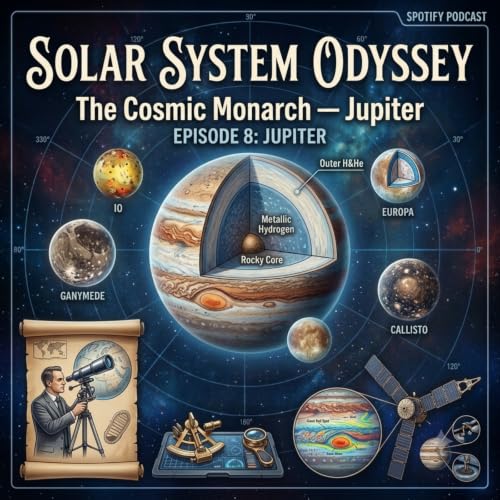
Think about it — every planet before this one, we could imagine standing on. Not this one. Jupiter has no true surface at all. Descend far enough and the atmosphere doesn't end, it just thickens into a churning ocean of metallic hydrogen, under pressure so extreme that hydrogen itself starts behaving like a liquid metal, generating the most powerful magnetic field of any planet in the solar system.
Jupiter doesn't just dominate through size — it dominates through gravity itself. It's the reason the asteroid belt never finished becoming a planet, the reason countless comets have been flung out of the solar system entirely, and the reason others, like Shoemaker-Levy 9 in 1994, were pulled in and torn apart on impact, live, in front of our own telescopes. That's not a metaphor for power. That's power, demonstrated.
And yet Jupiter's real treasures aren't the planet itself — they're the 95 known moons orbiting it. Europa, hiding a liquid ocean beneath its icy shell, possibly more water than every ocean on Earth combined. Io, the most volcanically active body in the entire solar system, its surface repainted by eruptions faster than any geologist can map it. This isn't a planet. It's practically a solar system of its own, held in orbit around one dominant king.
Here's what science still hasn't fully answered: what's actually happening at Jupiter's core. Does it even have a solid core at all, or does rock dissolve into that metallic hydrogen ocean entirely? NASA's Juno mission has been diving closer to Jupiter than any spacecraft before it specifically to find out — and every pass sends back data that complicates the picture further, rather than simplifying it.
Ancient skywatchers had no telescopes, no way to see the storms or moons — yet they still recognized something commanding in that steady, bright wanderer. Babylonian astronomers associated it with their king of gods, Marduk. Roman astronomers named it after the king of their own pantheon, Jupiter — a name that's outlasted the empire that gave it. And in 1610, Galileo pointed a primitive telescope at it and discovered four moons orbiting another world for the first time in human history — a single observation that helped dismantle the idea that everything in the universe circled Earth.
Here's the part worth sitting with: Jupiter never became a star, never had the mass to ignite. It spent 4.6 billion years as close to that threshold as any planet ever gets, and stayed a planet anyway. Sometimes the most powerful thing in a system isn't the one that burns brightest — it's the one whose gravity quietly shapes everything else without needing to.
Researched and written by me. Voice and visuals produced with AI, so I can go deeper on every world in this series.
🎧 Episode 8 of Solar System Odyssey — a Fall in Cosmos series. Subscribe, and let's fall in cosmos, together.
Keywords: Jupiter planet explained, Solar System Odyssey podcast, Great Red Spot, Jupiter moons Europa Io, Juno mission NASA, largest planet solar system, Jupiter magnetic field, gas giant explained.