• Having the Conversation: Talking About AI Anxiety at Work
    Jul 9 2026

    Episode 7: "Having the Conversation: Talking About AI Anxiety at Work"


    Afraid to admit you're struggling with AI at work? You're not alone—but silence won't protect you. This episode teaches you how to advocate for yourself constructively without seeming resistant or incompetent. Learn the "Prepare, Frame, Ask, Commit" framework for productive conversations with your manager, complete with word-for-word scripts you can adapt. Discover how to request support, set boundaries around learning expectations, and communicate concerns in ways that position you as solution-oriented rather than problem-focused. For managers, we explore how to create psychological safety, normalize struggle, and structure learning so teams can be honest without fear. Featuring candid interviews with an HR director and a department manager who successfully guided his team through AI implementation, plus ready-to-use scripts for five common workplace scenarios. Because speaking up strategically isn't just about getting support—it often opens the door for your entire team to have honest conversations too.

    Show More Show Less
    25 mins
  • The Learning Spiral: How to Upskill Without Burning Out
    Jul 9 2026

    Episode 6: "The Learning Spiral: How to Upskill Without Burning Out"


    Feeling crushed by the pressure to master every AI tool and trend? You're not alone. This episode tackles the overwhelming burden of constant upskilling by introducing the AIMS Framework—a strategic approach to learning that prioritizes depth over breadth. Discover why the "learn everything" mindset backfires, how to identify the critical 20% of skills that deliver 80% of value, and how to integrate learning into your daily work instead of treating it as a separate burden.

    Featuring insights from a learning science expert and a marketing professional who successfully adopted AI without burning out, this episode offers a practical roadmap for sustainable growth. Learn to distinguish anxiety-driven learning from goal-driven learning, and give yourself permission to focus on what actually matters for your specific role. Because you don't need to know everything—you just need to know what counts.

    Show More Show Less
    26 mins
  • Building AI-Era Resilience: Mental Habits of People Who Thrive Through Change
    Jul 9 2026

    Episode 5: Building AI-Era Resilience - Mental Habits of People Who Thrive Through Change

    In 2008, two analysts lost their jobs the same day. One spiraled into bitterness and stayed unemployed for three years. The other got strategic, adapted, and within 18 months earned more than before. The difference? Resilience.

    Resilience isn't something you're born with—it's a learnable skillset of mental habits. This episode teaches you five core practices proven to help people thrive through disruption:

    Learning agility: Getting comfortable in beginner mode (add "yet," celebrate confusion)

    Anti-fragile thinking: Growing stronger from stress, not just bouncing back

    Growth mindset about technology: Challenging "I'm not a tech person"

    Psychological flexibility: Taking action alongside fear, not waiting for it to pass

    Community and support: Building your resilience network


    Featuring Richard, 58, who navigated three major tech disruptions over 35 years by staying curious, not competing with machines, and learning from younger colleagues.

    You'll create your personalized resilience plan with specific weekly actions.

    Show More Show Less
    26 mins
  • Rewriting Your Career Story: From 'Threatened' to 'Evolving'
    Jul 9 2026

    Episode 4: Rewriting Your Career Story - From 'Threatened' to 'Evolving'

    Two developers. Same AI announcement. Developer A thinks "I'm being phased out" and spirals. Developer B thinks "This could free me up for strategy" and thrives. Same situation—two completely different outcomes.


    The stories you tell yourself aren't just reflections of reality. They create reality. Your brain doesn't distinguish between thought and fact when triggering behavior. If you tell yourself "I'm falling behind," you'll act like someone falling behind.

    This episode teaches you how to consciously rewrite your career narrative:

    • Five common limiting stories ("I'm being replaced," "I'm too old," "My experience doesn't matter")

    • Why your brain created these protective stories

    • The four-step reframing framework (name it, find contradictory evidence, write alternative, practice)

    • Interview with career coach Amanda Torres on breaking self-fulfilling prophecies

    • Janet's transformation from "AI is doing my job" to People Experience Strategist

    You'll create your new story using evidence-based reframing—not toxic positivity, but intentional narrative shift that changes outcomes.

    Show More Show Less
    26 mins
  • The Grief of Obsolescence: Processing Career Identity Loss
    Jul 8 2026

    Episode 3: The Grief of Obsolescence - Processing Career Identity Loss

    Tom smiled when his manager said "we'll find new responsibilities." Then he went to his car and cried for an hour.

    At 47, after 20 years building his legal expertise, AI was automating his core work. "I felt like I was losing myself. Like who I was didn't matter anymore."

    If this AI transition feels like more than just a career change—if you're experiencing a loss so deep it surprises you—you might be grieving. And that's not only normal, it's necessary.

    Career grief is real because your professional identity is deeply intertwined with your sense of self. You're not just worried about money. You're grieving three things: your competence and mastery, your sense of purpose, and your professional community.

    The Five Stages of Tech Grief:

    Denial → Anger → Bargaining → Depression → Acceptance

    We explore how each shows up with AI disruption, and why people who try to "toughen up and skip the grief" get stuck—while those who process it eventually move through.

    Dr. Lisa Chen shares five practices: Name it as grief. Create a grief ritual. Talk about it. Feel it in your body. Take small actions alongside the grief.

    Maria's story: From paralegal to strategic liaison. It took a year—but she came through stronger.

    Grief is not weakness. It's love with nowhere to go. Honor it, process it, and move forward.

    Show More Show Less
    30 mins
  • What Makes You Irreplaceable: The 7 Human Skills AI Can't Replicate
    Jul 8 2026

    Episode 2: What Makes You Irreplaceable - The 7 Human Skills AI Can't Replicate


    Think AI will replace you? Think again.


    Marcus was a data analyst whose company adopted AI that did his work in 30 seconds. He thought he was done. Instead? He got promoted. Why? Because AI handled the data—Marcus handled everything AI couldn't: judgment, context, relationships, and strategy.


    This episode reveals the 7 core human skills that AI fundamentally cannot replicate:


    1. Contextual Creativity - Creating what's emotionally right, not just technically correct

    2. Emotional Intelligence - Reading between the lines, building genuine trust

    3. Ethical Judgment - Navigating gray areas where values conflict

    4. Relationship Building - The trust AI will never earn

    5. Adaptive Problem-Solving - Innovating when standard solutions fail

    6. Meaning-Making - Connecting work to purpose beyond tasks

    7. Intuitive Pattern Recognition - Reading rooms, sensing dynamics, knowing without data


    You'll hear real stories: Rachel the project manager who saved an employee AI flagged as "underperforming." The editor who shifted from grammar to strategic vision.


    The Human Advantage Audit: Identify YOUR superpowers and reframe your value proposition so you're not competing with AI—you're directing it.

    You're not becoming obsolete. You're becoming essential in a different way.

    Show More Show Less
    33 mins
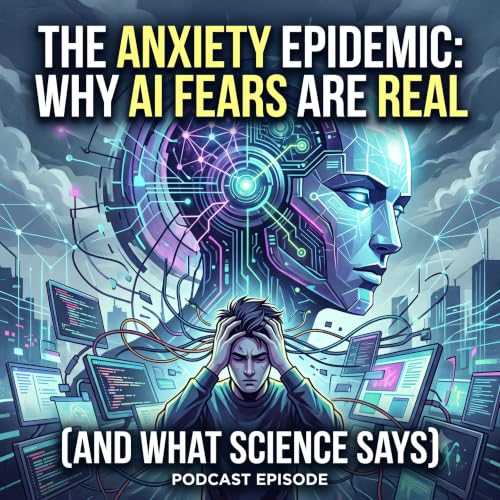
  • The Anxiety Epidemic: Why AI Fears Are Real (And What Science Says)
    Jul 8 2026

    Episode 1: The Anxiety Epidemic - Why AI Fears Are Real (And What Science Says)


    Can't sleep because you're worried about AI taking your job? You're not alone.


    Meet Sarah—a marketing manager with 12 years of experience who spent weeks unable to eat or sleep after her company announced AI integration. Her panic wasn't about losing a paycheck. It was deeper: "Who am I if AI can do what I do?"


    If you've felt anything like Sarah, this episode is for you.

    What We Cover:

    🧠 Why Your Anxiety Makes Sense

    Your brain literally can't tell the difference between "I need to learn new skills" and "I'm about to be eaten by a predator." We'll explain the neuroscience behind why AI disruption triggers the same fight-or-flight response as mortal danger—and why that's completely normal.


    📊 What the Data Actually Shows (Beyond the Headlines)

    Yes, Goldman Sachs says AI could impact 300 million jobs. But the World Economic Forum also projects 97 million NEW roles emerging. We break down what's really happening beyond the fear-mongering headlines.


    🎯 Which Jobs Are Actually at Risk

    Not all jobs are equally threatened. We reveal which roles are most vulnerable (routine, repetitive tasks) and which are least at risk (work requiring human judgment, creativity, and emotional intelligence).


    🧬 The Three Psychological Patterns Making This Worse

    - Loss Aversion: Why you fixate on what you might lose instead of what you might gain

    - Ambiguity Aversion: Why uncertainty feels worse than a bad outcome

    - Social Comparison: Why watching younger colleagues adapt effortlessly amplifies your shame

    💡 Expert Insights from Dr. Jennifer Martinez

    A clinical psychologist shares three evidence-based techniques for managing technological displacement anxiety:

    1. Name it - How simply labeling your emotion calms your amygdala

    2. Separate facts from stories - Why "My company is implementing AI tools" is manageable, but "I'll lose everything" is a catastrophic prediction

    3. Find your sphere of control - Action within your control is the antidote to helplessness

    The Five Realities That Should Ground You

    - Most jobs won't disappear; they'll transform

    - Humans have adapted to every technological revolution

    - The most valuable skills are the hardest to automate

    - You have time to adapt (but you need to start now)

    - You're not alone, and support systems exist


    🎯 The Awareness Audit (Your First Action Step)

    We guide you through four questions that shift you from overwhelming, abstract fear to specific, manageable awareness. Ten minutes of your time that could change everything.


    Who This Episode Is For:

    - Professionals feeling anxious about AI disruption

    - Anyone lying awake worried about career relevance

    - People feeling behind or too old to adapt

    - Those experiencing imposter syndrome in a rapidly changing field

    - Anyone who needs validation that their fears are legitimate

    What Makes This Different:

    We don't offer toxic positivity or pretend AI won't disrupt careers. We provide honest, realistic guidance grounded in psychology, neuroscience, and the lived experiences of people navigating this transition right now.


    The Bottom Line:

    Your anxiety is valid. Your fear is rational. And understanding it is the first step to managing it. This episode won't fix everything, but it will help you understand why you feel the way you do—and that's where change begins.

    This is Episode 1 of a 10-part series that takes you from anxiety to empowerment, from feeling threatened to feeling irreplaceable.


    Ready to stop panicking and start understanding? Press play.

    Show More Show Less
    26 mins