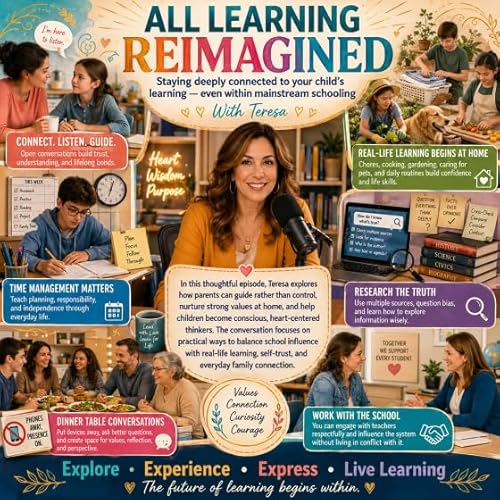
All Learning Reimagined with Teresa cover art

All Learning Reimagined with Teresa

All Learning Reimagined with Teresa

Written by: BBS Radio BBS Network Inc.
Listen for free

About this listen

All Learning Reimagined, where passion meets possibility, one story at a time. All Learning Reimagined is a global gathering place for parents, educators, and lifelong learners who are ready to question—and transform—the outdated systems of education. This podcast dares to reimagine learning by placing heart, intuition, and creativity at its core. Grounded in common sense, connection to nature, community, and the wisdom of indigenous traditions, each episode offers practical, intuitive, and self-directed approaches that inspire confidence and awaken self-mastery in both mentor and learner. Through heartfelt conversations, reflections, and skill-sharing from around the world, we spotlight real-life stories and ideas that break free from rigid educational models. From early childhood through every stage of life, we explore what it means to learn in alignment with our inner knowing and natural curiosity. Our guests include parents, educators and changemakers who are living examples of heart-centered, life-honoring approaches to education. Together, we build a bridge between traditional pedagogy and more flexible, holistic, and skill-based learning pathways. Whether you're a parent seeking new ways forward or an educator ready to evolve, All Learning Re-imagined offers inspiration, tools, and an optimistic vision for the future of learning—one that begins with the heart. "Learning is not a system to fix — it’s a living journey to nurture."Copyright 2026 Teresa
Episodes
  • All Learning Reimagined, February 13, 2026
    Feb 14 2026
    All Learning Reimagined with Teresa Songbird Questions to awaken inquiry, curiosity and deep learning The Portal of Inquiry: Reimagining Education Through the Power of Questions The Power of Questions Awakening inquiry, curiosity, and deep learning in a complex world. PODCAST SUMMARY The Core Philosophy "Questions are one of the oldest technologies of learning... they act as a portal to unlock information and the thirst to seek." The Cognitive Danger Zone The statement "I already know that" is a terminal switch. It signals the brain to stop searching, shuts down curiosity, and prevents the updating of outdated beliefs. 🧠 Neuroscience Curiosity triggers dopamine, making learning "stickier" and more joyful. ⚖️ Sovereignty Questioning builds autonomy and prevents passive consumption of info. The Question Taxonomy Closed Questions Retrieve facts (e.g., 1+1). Efficient for foundations but non-transformative. Open-Ended Inquiry Invites imagination and multiple perspectives. "What if?" and "How might we?" Reflective & Generative Inward-looking. "What surprised me?" or "How would a future elder see this?" Key Skill: Discernment The ability to pull apart information, perceive clearly using all senses, and distinguish between True (perception) vs. Truth (universal). #Inquiry #Curiosity #Discernment #LifelongLearning Host: Teresa • 28 min read/listen • Part 1 of Series In this episode of All Learning Reimagined, host Teresa explores the transformative potential of high-quality questions as the "oldest technology of learning." She challenges the traditional educational focus on "what to think" and advocates for a return to our natural state of curiosity, discernment, and intellectual sovereignty. By shifting from seeking fixed answers to embracing powerful inquiry, we can unlock deeper learning and adapt to a rapidly changing world. The Cognitive Impact of Inquiry Questions serve as "portals" that unlock information and a thirst for seeking, often jolting individuals out of the dangerous cognitive state of "I already know that." This phrase is described as a "closed statement" that signals the brain to stop searching and thinking, effectively shutting down curiosity. In contrast, neuroscience shows that curiosity activates dopamine pathways, making learning "stickier," more joyful, and more memorable. By fostering wonder and exploration, we align with our biological priming for learning, which has often been suppressed by modern educational systems focused on rote memorization and obedience. The "I Already Know" Trap When we claim to already know something, we create a cognitive dead end. Here is how inquiry flips the script: Closed State: "I already know that" → Signals the brain to stop searching. Open State: "What if?" → Activates dopamine and deepens neural connections. The Goal: Moving from passive consumption to active meaning construction. Building Sovereignty and Discernment Learning to ask questions is a foundational step toward reclaiming personal autonomy and sovereignty. This process involves "discernment"—the ability to distinguish differences and perceive information clearly using not just the mind, but the whole body and its senses. Teresa emphasizes the distinction between "true" (a person's subjective perception based on experience) and "truth" (objective reality). By teaching children to question, we help them navigate a complex world with confidence, allowing them to construct their own meaning rather than accepting handed-down narratives. A Framework for Powerful Questions Effective inquiry requires moving beyond simple "closed questions" (which check for facts) toward more transformative categories. These include: Open-ended Questions: Invite research, multiple perspectives, and ethical reasoning. Reflective Questions: Encourage looking inward at personal growth and shifts in perception. Perspective-shifting Questions: Ask how a situation looks through the eyes of others, such as an elder, a scientist, or someone from the future. Generative Questions: Lead to entirely new inquiries and deeper understanding before making decisions. By utilizing these various types, educators and parents can foster empathy, pattern recognition, and higher-order thinking skills. Types of Inquiry Portals Reflective "How did I grow through this?" Perspective "How would an elder see this?" Generative "What else do we need to know?" Imaginative "What if this were possible?" Key Data & Context Experience Base: The host brings over 30 years of teaching experience to the discussion. Timeline of Change: Significant personal and global shifts observed over the last 5 years have influenced this focus on discernment. Historical Context: Critique of an education system that has prioritized fact-memorization for approximately the last 100 years. To-Do / Next Steps Observe your own daily habits to identify if you are asking deep, open-ended questions or merely closed ones. Carve out 5 to 10 minutes each day to...
    Show More Show Less
    29 mins
  • All Learning Reimagined, February 6, 2026
    Feb 7 2026
    All Learning Reimagined with Teresa Songbird Topic: Using Senses in Everyday Life - Part 2 Beyond the Five Senses: Reimagining Human Perception and Connection All Learning Reimagined: Beyond the Five Senses Redefining education through intuitive perception and the wisdom of nature. EPISODE SUMMARY The Sensory Spectrum Mental Senses (The Head Space) Imagination Memory Intuition Reasoning Willpower Subtle/Spiritual Senses Clairvoyance: Inner seeing, visions, and symbols. Clairsentience: Sensing vibrations and emotions. Clair cognizance: The "Gut Knowing" or instant truth. Clairaudience: Perceiving internal sounds/music. The Animal Mirror DOGS 300M scent receptors EAGLES 8x human vision HORSES Heart-rate synchronization CATS Whiskers sense air/elements The Story: Children of the Whale Song "Humans are not limited. You were born with many senses, and when you awaken them, the whole world becomes whole again." The 5 Gifts of the Listeners: 1Inner Seeing: Heart speaking in pictures. 2Clairsentience: Feeling truth beneath words. 3Heart Telepathy: True connection from the heart. 4Timeline Listening: Sensing harmony vs. struggle. 5Energetic Creation: Intent shaping the subtle world. Core Practice: Contemplation Moving beyond mindfulness to "pondering" in nature. Dropping out of the mind-space to listen to trees, wind, and stones. #HolisticLearning #Intuition #NatureWisdom ⏱ 31 min listen • Host: Teresa This episode of All Learning Reimagined explores the expansive spectrum of human and animal perception, moving far beyond the traditional five senses. Host Teresa discusses the integration of mental, emotional, and spiritual awareness, using nature and storytelling to illustrate how we can reconnect with a more intuitive and humane approach to education and life. The Multi-Layered Human Experience True education involves recognizing that humans possess multiple "bodies"—physical, mental, emotional, and etheric. While mainstream schooling focuses heavily on the five physical senses, ignoring our more subtle faculties blocks our ability to navigate everyday life effectively. Modern society often traps individuals in a "mental loop" of intellect and neuroscience, frequently at the expense of the "heart space" and willpower. Reclaiming self-discipline and self-governance is essential to breaking the cycle of instant gratification that has dominated the last few decades. The "subtle" or spiritual senses are often misrepresented in popular media as overt "bells and whistles," but in reality, they are gentle and require attunement to nature. These include clairvoyance (inner seeing), clairaudience (inner hearing), clairsentience (sensing vibrations and emotions), and Clair cognizance (an innate gut knowing). Developing these allows for a deeper perception of reality that exists beneath the surface of physical interaction. The Spectrum of Subtle Perception # Beyond the Five Senses: Reimagining Human Perception and Connection Introduction This episode of All Learning Reimagined challenges the traditional boundaries of education by exploring the full spectrum of human perception. Host Teresa discusses how moving beyond the five basic physical senses to embrace mental, spiritual, and intuitive "bodies" allows for a more humane and connected way of navigating everyday life. Detailed Summary of Key Themes The Multi-Layered Human Experience Traditional education often limits the study of human perception to the five physical senses: sight, sound, smell, taste, and touch. However, humans possess multiple "bodies"—physical, mental, emotional, and etheric—each with its own set of senses. By focusing solely on the physical, society often blocks out subtle intuitive and mental faculties such as imagination, memory, reasoning, and willpower. There is a growing concern that willpower and self-discipline have declined over the last 30 years due to a societal "programming loop" that prioritizes instant gratification over self-governance. To break this loop, individuals are encouraged to drop from the "head space" into the "heart space" to access deeper levels of awareness. The Spectrum of Human Senses Physical The Basic 5 Mental Willpower, Intuition Spiritual Clairvoyance, Sensing True education involves integrating all layers of the human field to perceive the world accurately. Lessons from the Animal Kingdom Animals often exhibit sensory capabilities that far exceed human limits, largely because they are not trapped in mental loops or belief-based programming. For instance, eagles possess sight four to eight times more powerful than humans, while dogs navigate the world through 300 million scent receptors. Beyond the physical, animals demonstrate profound emotional and intuitive intelligence; elephants mourn their dead for decades, and horses have the unique ability to synchronize their heart rates with humans, offering a form of intuitive healing. These examples suggest that the natural world is constantly communicating ...
    Show More Show Less
    31 mins
  • All Learning Reimagined, January 30, 2026
    Jan 31 2026
    All Learning Reimagined with Teresa Songbird Topic: Human Senses and how to awaken them Awakening the 15 Human Senses: A Holistic Approach to Learning Podcast Summary • All Learning Reimagined Awakening the 15 Human Senses Moving education beyond the physical: From passive intake to embodied sovereignty. Editorial Mode The Educational Shift Old Way (Pisces)Passive Intake New Way (Aquarius)Deep Embodiment "Education starts with yourself. You are the one that has to live with yourself for the rest of your life. Trust your own inner signals." — Teresa, Host Ultimate Goal To foster Sovereignty & Self-Regulation by tuning into the body's natural communication systems. 🧠 Mental Senses (Mind Tools) Imagination Activity: Story Seeds Memory Activity: Path Walk Reasoning Activity: The 5 Whys Willpower Activity: Micro Habits ✨ Spiritual Senses (The Clairs) ClairvoyanceInner Seeing (Cloud messages, Symbols) ClairaudienceHeart Hearing (Listening within) ClairsentienceEnergetic Feeling (Hand Energy Ball) ClaircognizanceKnowing (Quick-answer games) #HolisticEducation #Intuition #SelfTrust Source: bbsradio.com/alllearningreimagined Introduction This episode of All Learning Reimagined explores the concept of expanding education beyond the traditional five physical senses to include mental and spiritual perceptions. Host Teresa argues that to foster self-sovereignty and deep embodiment in the "Age of Aquarius," educators and parents must nurture innate human capacities like intuition, imagination, and energetic sensitivity. The discussion provides practical activities to awaken these dormant senses, transforming learners from passive consumers into creative, grounded beings. Detailed Summary The Shift to Multidimensional Learning The current educational landscape often relies heavily on the five physical senses (sight, sound, smell, taste, touch), which limits human potential. While these physical senses are fundamental, relying on them exclusively ignores the multidimensional nature of human beings. The host suggests a shift away from the "Age of Pisces" model of passive information intake toward an "Age of Aquarius" approach that prioritizes deep awareness, embodiment, and direct experience. By acknowledging ancient knowledge and subtle perceptions, learners can navigate reality as creators rather than just consumers. The Inner Senses of the Mind Beyond physical perception, the "mental senses" serve as essential tools for creativity, self-governance, and meaning-making. These are distinct from the "overthinking" mind that is easily programmed; instead, they represent the mind as a constructive tool for focus and discipline. Key mental senses include Imagination (divergent thinking), Memory (reconstructing experiences), Reasoning (deep inquiry), and Willpower (micro-commitments rather than force). Intuition also bridges the mental and physical, acting as a body compass to guide decision-making through subtle internal signals. 🧠 The 5 Mental Senses & Activation Imagination Using "Story Seeds" (objects) to imagineer narratives. Memory Reconstructing a path walk via drawing or storytelling. Intuition Using the "Body Compass" to feel choices physically. Reasoning Applying the "5 Whys" for critical unpacking. Willpower Micro-commitments (small, immediate successes). The Spiritual and Subtle Senses (The "Clairs") The discussion introduces the "sixth sense" not as a single ability, but as a suite of natural human capacities often grouped under the French prefix clair (meaning clear or bright). These abilities are frequently more visible in children before societal conditioning dampens them. Clairvoyance (Inner Seeing): Perceiving symbols and patterns, which helps in reading the "big picture" story. Clairaudience (Inner Hearing): Distinct from physical hearing, this is described as "heart-listening" or internal guidance. Clairsentience (Energetic Feeling): The ability to perceive emotional vibrations or atmospheric shifts in a room. Claircognizance (Inner Knowing): Spontaneous, gut-level knowledge that arises without logical processing. Clairalience & Clairgustance: The ability to access memory through subtle smells or phantom tastes without physical stimulus. ✨ Decoding the "Clairs" (Subtle Senses) 👁️ ClairvoyanceInner Seeing / Symbolic Imagery 👂 ClairaudienceHeart Listening / Inner Guidance 🤲 ClairsentienceEnergetic Feeling / Vibration 💡 ClaircognizanceInstant Knowing / "The Download" Educational Relevance and Application Integrating these senses into education helps learners regulate their nervous systems and develop emotional intelligence. By tuning into subtle cues, students can better navigate social harmony and identify when they feel unsafe or triggered. Ultimately, this approach reframes the learner not as an empty vessel to be filled, but as a multi-sensory, energetic being capable of self-trust and sovereign decision-making. Implementation Activities (To-Do) Imagination Exercise: Present ...
    Show More Show Less
    31 mins
No reviews yet