• All Learning Reimagined, May 1, 2026
    May 2 2026
    All Learning Reimagined with Teresa Songbird Intergenerational learning Bridging the Generational Gap: Reimagining Education through Ancient Wisdom All Learning Reimagined Redefining education through intergenerational wisdom and natural connection. Editorial Abstract Core Vision "Learning and living are one and the same. It’s time to move from age-segregated 'factories' back to ancient, community-rooted wisdom." Ancient Roots of Learning Play As Best Medicine Key Perspectives ✦Lived Experience: Valuing "PhDs in Life" over mere paper degrees and doctrines. ✦Natural Lore: Reconnecting with soil, nature, and the "is-ness" of our environment. ✦The Shift: Moving from digital distraction to presence and yarning circles. Cultural Blueprints Aboriginal Storytelling Maori Whānau Apprenticeship Models Elders as Guides Practical Re-emergence • Shared Meals: One meal a day for connection. • Community Bridges: Mentoring across ages. • Skill Exchange: Knitting, gardening, tinkering. • Presence: Awareness as the first step to shift. #EducationReform #Intergenerational #Wisdom Host: Teresa | Episode: 2026-05-01 Explore, Experience, Express — Reimagining the architecture of tomorrow's world. In this episode of All Learning Reimagined, host Teresa explores the fading yet essential practice of intergenerational learning, contrasting modern age-segregated systems with the natural, community-based wisdom of indigenous cultures. The discussion highlights how reconnecting youth with elders fosters empathy, practical skills, and a deeper sense of belonging in an increasingly digital world. The Essence of Intergenerational Learning Intergenerational learning is an ancient, natural process that has quietly faded from modern formal education. It values lived experience and direct knowledge over labels, degrees, or institutional doctrines. This type of learning often happens spontaneously in everyday life—such as a grandparent teaching a child how to select ripe fruit at a supermarket—where knowledge, stories, and skills are shared fluidly across ages. Historically, before the advent of structured classrooms, children learned by observing and participating alongside community members of all ages, allowing them to discover their passions and achieve mastery through real-world contribution. Traditional vs. Modern Learning Models Natural / Ancient Community-based Mixed-age interaction Storytelling & Observation Lived experience as authority Modern / Industrial Institutional boundaries Strict age-segregation Academic & Label-driven Technology-mediated Cultural Blueprints and the Modern Disconnect Indigenous cultures, such as the Aboriginal Australians and the Māori, provide profound examples of intergenerational success. These communities utilize "yarning circles," storytelling, and song to pass down cultural wisdom and "connection to country." In these frameworks, children function almost like apprentices, contributing alongside adults and earning self-worth through participation. However, the Industrial Revolution introduced a "factory model" of education that separated learners by age, a shift exacerbated today by the isolation of elders in care homes and the intrusive nature of technology. This disconnect is visible in restaurants where families sit together but remain isolated on individual devices, losing the art of eye contact and presence. The Practical Power of Reconnection Returning to intergenerational roots is a practical necessity rather than mere nostalgia. When wisdom meets curiosity, it creates a "win-win-win" scenario: elders feel valued and purposeful, children gain patience and empathy, and the community benefits from a ripple effect of shared humanity. This model shifts learning from purely academic metrics to grounded life skills—ranging from cooking and storytelling to mechanical repairs and gardening. By fostering conversational and relational learning, society can move away from stagnant, linear systems toward a more "Fibonacci-like" growth pattern that is wavy, swirling, and inherently natural. The Generational Synergy 🌱 The Young Curiosity, fresh thinking, creativity, and playfulness. ⇄ 🌳 The Elders Perspective, calm, lived experience, and mentorship. "Learning becomes conversational, observational, and relational." To-Do / Next Steps Visit the BBS Radio website to access the free guide and archived articles on reintroducing intergenerational learning. Practice presence by sitting in nature—whether at a beach, park, or even with a balcony plant—to reconnect with the environment. Actively seek the opinions of individuals from different generations to sharpen personal clarity and perspective. Create regular "connection points" within the family or local community, such as shared meals or storytelling sessions. Share the podcast and its resources to inspire others to reflect on their own learning alignment. Conclusion Intergenerational learning is not a new invention to be...
    Show More Show Less
    31 mins
  • All Learning Reimagined, April 24, 2026
    Apr 25 2026
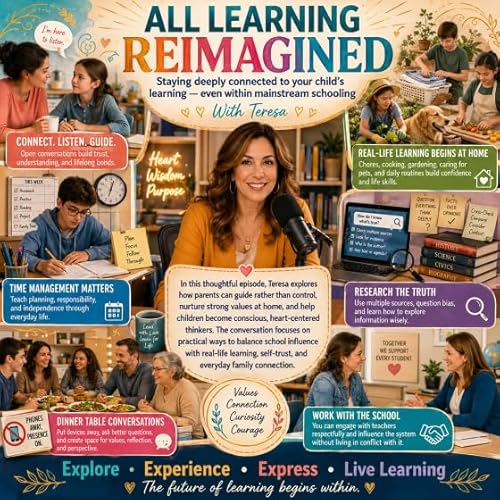
    All Learning Reimagined with Teresa Songbird Raising conscious thinkers within the system Beyond the Classroom: Cultivating Conscious Thinkers at Home All Learning Reimagined Nurturing sovereign thinkers within the mainstream schooling system. Editorial Mode Core Philosophy "You don't have to remove your child from the schooling system to remain deeply connected to their learning. You can do both." Influence vs. Control Shift from managing actions to guiding values. Stewardship replaces indoctrination through conscious response. The "Resonance" Metric Teaching children to listen to their "inner knowing" or "Spidey-senses" to discern truth from external propaganda. Practical Integration ✦Real-Life Mastery: Use household chores (cooking, cleaning, time management) as empowerment tools, not burdens. ✦Storytelling Influence: Use bedtime stories or family history to embed values and shape subconscious patterns. ✦Research Literacy: Teach cross-referencing (Brave/DuckDuckGo) and identifying bias in documentaries and AI. ✦The Dinner Table: Play "What If" or "Would You Rather" to challenge paradigms and celebrate "spectacular failures." #Sovereignty #CriticalThinking #Parenting #Resonance Host: Teresa | All Learning Reimagined39 min read/listen This episode of All Learning Reimagined explores how parents can deeply influence their children's values and life skills while remaining within the mainstream schooling system. Host Teresa emphasizes shifting from a mindset of control to one of conscious stewardship, raising children who possess the "sovereignty" to think for themselves . The Shift from Control to Influence The conversation begins with the realization that many parents feel trapped between the necessity of mainstream schooling and the desire to protect their children from misaligned values. The solution is not necessarily to withdraw from school, but to "equal the equation" by raising conscious thinkers at home. This requires a fundamental shift in the parental role: moving from trying to control every external exposure to influencing the child’s "inner knowing." By fostering strong home values and personal discernment, children can maintain their sovereignty regardless of the setting they are in. The Stewardship Framework From Control Fear-based reaction, trashing the house, managing indoctrination. ➔ To Influence Conscious response, nurturing discernment, modeling sovereignty. Real-Life Learning and Responsibility Empowerment begins with practical life skills that schools often overlook. Teresa argues that "real-life learning begins in the home" through chores like vacuuming, gardening, and meal preparation, which build a child's sense of self-worth and contribution. A critical component of this is time management; teaching children to manage their own schedules, social lives, and deadlines from a young age creates independent adults. Furthermore, parents should allow children to fail in low-stakes environments—like baking or tree climbing—to build the grit and physical efficacy that worksheets cannot provide. Nurturing Intuition and Critical Thinking To counter "groupthink," parents can use bedtime stories and "imagineering" games to subtly embed family values and fables that shape a child's inner voice. Teresa introduces the concept of "resonance"—teaching children to listen to their bodies to determine if information feels true. This "Spidey-Sense" allows them to question authority figures or peers respectfully when something feels "off." In an era of AI and media bias, children must also be taught to cross-reference multiple search engines and identify the underlying narratives in documentaries or curriculum content. The "Resonance Check" Technique A simple somatic exercise to help children (and adults) tap into their intuition when facing a decision or new information: ✅ Lean Forward: The body's natural "Yes" or attraction to truth/alignment. ❌ Lean Backward: The body's natural "No" or signal of discomfort/misalignment. 🔍 The Pin: If it's "off," put a pin in it and research further. Collaborative Engagement with the System Finally, the podcast advocates for direct, respectful engagement with schools. Rather than demonizing teachers, parents should use "honey over vinegar" to communicate their family values and request that specific life skills be reinforced in the classroom. Establishing home traditions, such as device-free dinners or the "What did you fail at today?" game, creates a safe space for children to share perspectives and challenge paradigms, ensuring they grow into authentic individuals rather than "clones" of the system. To-Do Integrate children into household chores (vacuuming, laundry, yard work) to build self-worth and life skills. Teach children time management by having them backward-map their own commitments and exercise routines. Establish a "responsibilities before play" rule for technology use to prevent addiction and promote accountability. Use ...
    Show More Show Less
    39 mins
  • All Learning Reimagined, April 17, 2026
    Apr 18 2026
    All Learning Reimagined with Teresa Songbird Embodying learning - Wisdom through the body Embodied Learning: Reimagining Education Through the Wisdom of the Body Episode 08 • Final Series📅 April 17, 2026 Embodying Learning: Wisdom Through the Body Redefining education as a whole-being experience where movement, sensation, and safety drive deep intelligence. The Core Thesis "Thinking alone does not create deep learning. Experience does. We remember what we live." Biological Safety A dysregulated nervous system prioritizes survival over cognition. Safety is the prerequisite for deep learning. Somatic Memory The body holds memory in every cell. Physical repetition (like handwriting) deepens neural pathways. Practical Toolkit ✔Walking & Talking ✔Sensory Integration ✔Grounding (Barefoot) ✔Failure Experiments The 8-Part Framework 1. Language & Awareness✓ 2. Relational Learning✓ 3. The Learning Field✓ 4. Passion-led Learning✓ 5. Nature as Teacher✓ 6. Community/Contribution✓ 7. Redefining Intelligence✓ 8. Embodied Learning• Key Insights #Neuroplasticity #SomaticWisdom #HolisticEd #SelfRegulation Host: Teresa | Duration: ~31 mins Explore • Experience • Express This episode explores the concept of "Embodied Learning," shifting the educational focus from purely mental processes to the holistic intelligence of the human body. Host Teresa concludes her eight-part series by examining how movement, the nervous system, and physical experience are not just supplements to learning, but its very foundation. By integrating the body’s wisdom, educators and parents can foster deeper comprehension and more resilient learners. The Body as an Instrument of Intelligence Learning is often mistakenly viewed as a purely mental exercise, yet the body and brain work in tandem to shape how we process information. Movement has been shown to significantly improve memory, comprehension, and retention, with verbal and motor parts of the brain accounting for a vast majority of our cognitive engagement. Physical experiences—such as using a skipping rope while reciting times tables—deepen the understanding of abstract concepts by anchoring them in the physical realm. The body is not merely a vehicle for the brain; it is an active participant in the thinking process, constantly communicating through sensations and "muscle memory". The 8 Pillars of Learning Reimagined A journey through the framework of intuitive education 1. Language & Awareness 2. Relational Learning 3. The Learning Field 4. Passion-led Learning 5. Nature as Teacher 6. Contribution & Community 7. Redefining Intelligence 8. Embodied Learning Safety, the Nervous System, and Sensory Integration A regulated nervous system is a prerequisite for curiosity and deep learning. When a learner feels stressed or psychologically unsafe, the body enters a survival mode that prioritizes safety over cognition, effectively shutting down the parts of the brain responsible for complex thought. Creating an environment that supports emotional safety and sensory regulation—such as allowing movement, grounding through bare feet, or providing fidget tools—enables students to move from surface-level "cramming" to genuine comprehension. Sensory-rich environments that move beyond just auditory or visual stimuli help prevent the "scattered focus" often seen in the digital age, allowing learners to engage their internal sensations and spatial awareness. Experience as the "Glue" of Memory Deep learning is created through experience rather than thinking alone. The body holds memory in every cell, and physical repetition forms patterns that integrate knowledge more effectively than digital "copy-pasting." For example, the act of handwriting creates a unique connection between the hand and the heart, lighting up different cognitive pathways than typing. By "living the learning"—much like the repetitive physical training seen in the Karate Kid’s "wax on, wax off" method—skills become second nature. When students are encouraged to fail through hands-on experiments, they build character and resilience, learning that mistakes are simply different perspectives on a problem. Practical Embodied Strategies 🚶 Walk & Talk: Conduct discussions while moving to increase blood flow and focus. 🌱 Natural Materials: Use rocks, leaves, or pebbles for tactile math and counting. 🧘 Body Pause: Stop to ask, "What is my body trying to tell me right now?" 🎭 Concept Acting: Use drama and movement to make abstract ideas memorable. Key Data Brain Engagement: Approximately 75% of the brain is involved in verbal and movement-related processing. Biological Composition: The human body is composed of 70%+ water, which acts as a medium for storing physical and emotional memory. Series Scope: This discussion marks the conclusion of an 8-part framework for reimagining education. To-Do / Next Steps Implement "Walk and Talk" sessions for group discussions to improve focus and mood. ...
    Show More Show Less
    31 mins
  • All Learning Reimagined, April 10, 2026
    Apr 11 2026
    All Learning Reimagined with Teresa Songbird Redefining Intelligence Redefining Intelligence: From Cognitive Metrics to Multidimensional Knowing All Learning Reimagined: Redefining Intelligence Moving from narrow institutional metrics to a multidimensional symphony of knowing. Podcast Summary "Education is not just preparing someone for a career... it is life itself. We are not separate from the system; we are its evolution." The Dimensions of Intelligence Somatic (Body)Nervous system regulation & physical awareness. Heart (Emotional)Compassion, empathy, and heart-brain coherence. Intuitive (Inner)Rapid pattern recognition beyond logic. RelationalCollaboration, community, and interspecies attunement. The Paradigm Shift ✕Traditional: IQ, Math, Recall, Testing. ✓Reimagined: Embodiment, Wisdom, Trust. ✓AI Context: Human "Heart" as the final frontier. Key Themes #HolisticEducation #SomaticLearning #HeartMath #SelfSovereignty #EcologicalWisdom Host: Teresa | Duration: 31 min | Next Episode: Embodied Learning Explore • Express • Experience This episode of All Learning Reimagined challenges the narrow, traditional focus on literacy and logic as the sole measures of human intelligence. Host Teresa explores a broader spectrum of "knowing," advocating for an educational shift that honors somatic, intuitive, and heart-based wisdom. By expanding our definition of intelligence, we can foster deeper inclusion and help learners align with their authentic selves. Detailed Key Points The traditional education system has long prioritized a narrow set of skills—primarily linguistic and mathematical recall—often overlooking the vast "symphony" of human potential. While Howard Gardner’s theory of multiple intelligences (including musical, spatial, and naturalistic traits) laid the groundwork for a more inclusive view, there is a growing need to move beyond these mental frameworks. Recognizing that every individual possesses a unique "constellation" of strengths allows educators to support those who may not thrive under mandatory testing but express their intelligence through diverse, non-traditional channels. The Evolution of Intelligence TRADITIONAL Linguistic Mathematical Recall-Based → REIMAGINED Somatic & Intuitive Heart-Centered Relational Wisdom Moving from "How smart are you?" to "How are you smart?" A critical dimension of this reimagined intelligence is the "intelligence of the heart," which encompasses empathy, compassion, and emotional coherence. As AI and technology increasingly automate cognitive tasks, these uniquely human qualities are becoming the forefront of leadership and connection. Children are naturally heart-led, yet traditional systems often "indoctrinate" them into purely head-based thinking. Reclaiming heart intelligence is not merely an accessory to learning; it is the foundational key to effective communication and genuine self-alignment. Somatic and intuitive intelligences further expand the boundaries of how we process information. Somatic intelligence recognizes the body as central to learning, emphasizing that movement and nervous system regulation are essential for deep cognition and memory retention. Meanwhile, intuitive intelligence—often dismissed as illogical—serves as a "quiet voice" that precedes logic, guiding creativity and innovation. By cultivating stillness and trust, learners can tap into a "gut instinct" that provides rapid pattern recognition and a sense of self-sovereignty that cannot be programmed. The Somatic Learning Foundation Safety First The nervous system must feel safe to unlock deeper learning and healing. Movement Activating the physical body engages up to 75% of the brain's capacity. Key Data Brain Activation: Incorporating movement into learning activates approximately 75% of the brain. Historical Context: Howard Gardner’s Multiple Intelligences theory gained significant awareness in the 1980s. Human Potential: Intelligence is categorized into at least 12+ dimensions in this expanded model, including linguistic, logical, spatial, musical, kinesthetic, interpersonal, intrapersonal, naturalistic, somatic, intuitive, relational, and spiritual. To-Do / Next Steps Visit the podcast landing page at bbsradio.com/alllearningreimagined to access archived shows and articles. Download the reflection guide to identify your personal "ways of knowing" and learning preferences. Practice stillness and reflection to distinguish your intuitive "quiet voice" from external programming or fear. Educators should evaluate their teaching styles to ensure they aren't only catering to their own dominant intelligences. Tune in to next week’s episode focusing specifically on "Embodied Learning." Conclusion True intelligence is not a single score but a multidimensional constellation of the head, heart, and body. By embracing somatic awareness, intuitive trust, and emotional coherence, we can move beyond "cookie-cutter" education toward a future where learning is a ...
    Show More Show Less
    31 mins
  • All Learning Reimagined, April 3, 2026
    Apr 4 2026
    All Learning Reimagined with Teresa Songbird Contribution and Community Learning Through Giving: Reimagining Education as Community Contribution Episode 06 of 08⏱ 30 Min Listen All Learning Reimagined: Contribution & Community Shifting education from passive consumption to active, heart-centered contribution. Core Philosophy "There is a quiet shift that happens when learning moves from 'What can I get from this?' to 'What can I give through this?'" 1 The Avengers Effect: Every learner brings a unique "superpower." Education should nurture individual lanes rather than forcing "all-rounders." 2 Wellbeing Catalyst: Research shows contribution reduces anxiety and depression by replacing "dis-ease" with a sense of purpose and belonging. 3 Beyond AI: While technology can deliver information, it cannot replace the human touch of applying knowledge to real community needs. The Garden Project (Case Study) Success Story Learners transformed a patch of land into an organic garden. They mastered math (measurements), science (pesticide-free growth), and social skills (sharing abundance with neighbors). Practical Pathways 🌱 Seed Saving 📦 Care Packs 🏠 Shelter Building 📻 Community Podcasts 🤝 Bartering Barns 🎨 Handmade Crafts Keywords:#ActiveLearning #Intergenerational #ServiceLearning #Wellbeing #CreatorBeing In this episode of All Learning Reimagined, host Teresa explores the sixth pillar of her educational framework: the vital shift from passive consumption to active contribution within a community. By moving beyond institutional boundaries, learners of all ages can discover their unique "superpowers" and foster a sense of belonging that enhances both personal wellbeing and societal health. The Philosophical Shift: From "Get" to "Give" The core of this approach lies in changing the lens through which we view education. Rather than asking what a qualification or a piece of paper can provide, learners are encouraged to ask how their knowledge can improve their family, their environment, and their community. This transition from a "take" mentality to a "give and take" flow creates an energetic balance that is often missing in modern, consumption-based educational settings. When learning taps into the "heart space" and answers the question of "why," it deepens significantly, transforming information into meaningful action. The Learning Paradigm Shift Traditional Passive Consumption Information Delivery Seeking Grades/Labels → Reimagined Active Contribution Purposeful Application Community Impact The Psychology of Purpose and Wellbeing There is a profound connection between contribution and mental health. Research and observation suggest that when learners—particularly teenagers—shift from "doomscrolling" and passive observation to active creation, their sense of hopelessness diminishes. By becoming "creator beings" who bring value to others, individuals experience increased happiness and reduced anxiety. This sense of purpose acts as an internal validation, removing the need for external labels or the constant questioning of whether one is "good enough". Real-World Application: The Garden Project The power of this model is best illustrated through practical experience rather than theory. A notable example involved a group of learners transforming an unused patch of land into an organic community garden. This project integrated mathematics, research, and problem-solving naturally as the children calculated fertilizer needs and studied plant biology. The result was not just an abundance of food shared with neighbors, but a visible "glow" of confidence in the participants. This "learning through doing" creates skills that cannot be unlearned and fosters a reciprocal relationship with the local community. Community Contribution Ideas 🌱 Environment: Community garden beds, seed saving, or local waterway cleanup. 🛠️ Infrastructure: Building park seating, animal shelters, or repurposing items. 📢 Communication: Starting a local podcast, newsletter, or awareness campaign. 🤝 Service: Creating care packs for the elderly or volunteering at animal shelters. 🔄 Exchange: Setting up "Bartering Barns" for skill-sharing and goods exchange. Intergenerational Growth and the "Avengers" Model True community learning is intergenerational and recognizes that everyone has a unique "superpower." Much like the Avengers in popular culture, a community thrives when individuals bring their specific skill sets—whether in music, communication, gardening, or listening—to create a whole that is more
    Show More Show Less
    30 mins
  • All Learning Reimagined, March 27, 2026
    Mar 28 2026
    All Learning Reimagined with Teresa Songbird Nature as Teacher Nature as the Original Classroom: Reimagining Education through the Natural World Nature as Teacher: The Original Classroom Reimagining education through the Biophilia Hypothesis and embodied learning. Series Ep. 05 The Biophilia Hypothesis Humans possess an innate affinity for life. Nature exposure isn't just "nice"—it's a biological necessity that regulates the nervous system, sharpens attention, and fuels creativity. The "Forest" Effect ✔For-Rest: The word "forest" implies a space for rest and energetic healing. ✔Nervous System: Direct contact (barefoot/grounding) lowers cortisol and primes the brain for learning. ✔Sensory Clarity: Natural light and fresh air move us from "headspace" to "heartspace." "Nature doesn't rush, yet everything is accomplished. Grass doesn't strain to grow; it just unfolds." 🌿The Learning Shift Traditional Four Walls Compliance "Zombie" State Nature-Based Infinite Space Curiosity "Alive" & Embodied Experiential Activities 📏 Garden Math🏗️ Self-Governance Building🚜 Farm Stays🐚 Ecosystem Observation👣 Barefoot Reflection Weekly Invitation: Step outside for 10 minutes without technology. Observe what draws your attention. Let the environment be your guide. ⏱️ 35 Min Listen👤 Host: Teresa📍 Global (Steiner/Forest Schools) #AllLearningReimagined This episode of All Learning Reimagined explores the "Nature as Teacher" framework, advocating for a shift from indoor, compliance-based schooling to outdoor, experiential learning. Host Teresa discusses how reconnecting with the environment regulates the nervous system, sparks innate creativity, and transforms abstract theory into embodied wisdom. Detailed Summary The Biophilia Hypothesis and Human Vitality Human beings possess an innate affinity for the natural world, a concept known as the biophilia hypothesis. Exposure to nature is not merely a "break" from productivity but a fundamental requirement for wellbeing, improving attention, creativity, and sensory sharpness. While modern society often programs us to remain in a "headspace," nature allows for a transition into the "heart space," where deep learning and emotional regulation occur naturally. 🌿 The Impact of Nature on Learning 🧠 Nervous System: Regulates voltage and reduces stress through grounding and oxygenation. 🎨 Creativity: Encourages "out-of-the-box" thinking by quieting the analytical mind. 👁️ Focus: Widens attention and primes the brain for complex information absorption. ❤️ Emotional Regulation: Provides a calming environment that supports sensory processing. From Compliance to Embodied Experience Traditional Western education often fosters a "zombie-like" compliance where students are conditioned to follow instructions in isolation. In contrast, taking learning outdoors—whether for math measurements in a garden or observing creek ecosystems—activates a child's energy and curiosity. This "embodied learning" ensures that knowledge is not just abstract theory but is anchored in reality through movement, social interaction, and sensory engagement. Global Models and Ancient Wisdom The concept of nature-based education is both ancient and globally resurgent. From indigenous cultures where nature was the primary home and classroom to modern Scandinavian Forest schools and Steiner education, the focus remains on rhythm, imagination, and the natural development of the child. These models emphasize that life and learning are inseparable, a symbiosis reflected in modern cultural narratives like the movie Avatar. The "Return to Nature" Protocol 👣 Ground Barefoot contact 📵 Disconnect No technology 🧘 Observe Silent presence 🌬️ Breathe Deep oxygenation Integrating Nature into Daily Practice Reclaiming nature as a teacher does not always require "moving mountains"; it can begin with simple shifts in location. Moving a reading session outdoors or using natural objects like sticks and stones for mathematics helps bridge the gap between isolated subjects and the integrated reality of the world. By observing the same outdoor spot over time, learners develop an awareness of rhythm, change, and the interconnectedness of all living systems. To-Do / Next Steps Practice the "Return to Nature" Invitation: Step outside barefoot, without technology, and sit or walk in silence for 5 to 30 minutes to reconnect with your body and environment. Shift the Learning Location: Move at least one daily activity (reading, conversation, or work) from an indoor setting to an outdoor one to build environmental awareness. Utilize Natural Manipulatives: Use real objects like sticks, stones, or your own feet for measurements and mathematical exploration instead of man-made tools. Engage in Sensory Observation: Visit the same outdoor place multiple times a week to notice changes in light, sound, and internal emotional states. Explore Recommended Resources: Research Steiner education...
    Show More Show Less
    35 mins
  • All Learning Reimagined, March 20, 2026
    Mar 21 2026
    All Learning Reimagined with Teresa Songbird Passion Led Learning The Heart of Education: Reimagining Learning Through Passion All Learning Reimagined Passion-Led Learning: Moving from the "Push" of Curriculum to the "Pull" of Curiosity PART 4 OF 8 The Core Philosophy "The brain remembers what it cares about. When a learner is lit from within, learning becomes a magnetic pull rather than a forced push." Self-Determination Theory (The 3 Pillars) ⚖️ Autonomy Sense of Choice 💪 Competence Feeling Capable 🤝 Connection Being Seen The "Conveyor Belt" Problem External Rewards: Over-reliance on grades/carrots creates compliance, not mastery. Rigid Timetabling: "Next, next, next" mentality extinguishes the spark of inquiry. Logic vs. Heart: Society trains us to lead with the head, ignoring the heart's magnetic field. Practical Activities 📍Curiosity Mapping: Using "Why" threads to find what interests a child right now. ✨Follow the Spark: Observing moments of natural engagement during daily life. 🚀Passion Projects: Self-directed research that often links to future career paths. Neurological Impact Intrinsic Dopamine+ High Focus Unlike tech "hits," passion-led dopamine strengthens memory and persistence. #IntrinsicMotivation#Curiosity#EducationReform#Homeschooling#FlowState 🎙️ Host: Teresa⏱️ Duration: 32 mins Target: Parents, Educators, Lifelong Learners This episode of All Learning Reimagined explores the transformative power of passion-led learning, moving beyond the rigid "conveyor belt" of traditional schooling. Host Teresa discusses how shifting from external rewards to internal curiosity can foster deeper engagement, better memory retention, and a more humane approach to personal growth. The Spark of Curiosity: From "Push" to "Pull" Learning is most effective when it is driven by an internal "pull" rather than an external "push." In early childhood, curiosity is a natural, magnetic drive characterized by a fascination with small details and a constant desire to ask "why". However, traditional educational environments often stifle this spark through rigid timetables, standardized assessments, and a focus on government-mandated curricula. To counter this, educators and parents must create environments that allow for open-ended exploration and honor the learner's "highest excitement". The Learning Shift 📉 The "Push"External rewards, grades, compliance, and rigid schedules. ➔ 📈 The "Pull"Internal curiosity, autonomy, and passion-led exploration. The Science of Motivation: Self-Determination Theory The podcast highlights Self-Determination Theory, which posits that human motivation flourishes when three core needs are met: Autonomy (having a sense of choice), Competence (feeling capable and growing), and Connection (feeling seen and supported). While many schools manage connection well, autonomy and competence are often neglected, leading to forced learning and increased anxiety among students. Biologically, genuine interest triggers the release of dopamine, which is distinct from the superficial "hits" provided by social media. This internal dopamine release enhances focus, strengthens memory, and increases persistence. Ultimately, the brain is wired to remember what it truly cares about; deep learning occurs only when there is an emotional and passionate connection to the subject matter. The SDT Motivation Triad 🔑 Autonomy: The power to choose the "what" and "how" of learning. 💪 Competence: The confidence gained from mastering tasks independently. 🤝 Connection: The feeling of being supported in a relational learning field. When these three intersect, motivation becomes natural and effortless. Reclaiming the Heart in a Logic-Driven World Modern society and secondary education systems often function like a "conveyor belt," pushing students toward certificates and degrees while stripping away individual choice. This trains people to lead with logic and the "head" rather than the "heart". To break this cycle, individuals of all ages are encouraged to "follow the spark." Whether it is a grandparent taking a grandchild fishing or an adult discovering a new hobby like weightlifting in their 70s, following one's heart has a ripple effect that can raise collective consciousness and even aid in trauma recovery. Practical Strategies for Educators and Parents To integrate passion into learning, the host suggests several actionable methods: Curiosity Mapping: Using visual tools or nature-based materials to help learners identify and "thread" their interests. Passion Projects: Allowing learners to build or research something entirely of their own choosing, which often informs their future career paths. Reframing Questions: Shifting the focus from task completion to personal interest (e.g., "What part of this task interests you most?"). Environment Design: Taking learning outside the classroom and providing "learning center tables" with diverse, interesting materials. To-Do / Next ...
    Show More Show Less
    32 mins
  • All Learning Reimagined, March 13, 2026
    Mar 14 2026
    All Learning Reimagined with Teresa Songbird The Learning Field The Learning Field: Reimagining Education as a Relational Space The Learning Field: Reimagining Education Episode 3: Shifting from "Content Delivery" to "Relational Emergence" EDITORIAL MODE The Core Concept "Learning isn't just inside the child or the teacher; it lives in the space between them—the relational field." Theoretical Scaffolding •Vygotsky’s ZPD: The "Zone of Proximal Development" where guidance turns the impossible into the achievable. •Social Constructivism: Knowledge is co-created through interaction and shared meaning-making, not just "downloaded." •Indigenous Wisdom: Learning as a communal, life-integrated process rather than an institutionalized, fenced-off event. The Educator as "Field Stabilizer" Presence Intention Tone Regulation Environmental Anchors #NaturalLight #Soundscapes #Scent(Coconut) #PsychologicalSafety #Flow Pop-Culture Bridges Star Wars (The Force), Avatar (I See You), The Matrix (Perception vs. Reality). #Education #Pedagogy #Holistic Duration: ~33 min | Target: Educators & Parents In this episode of All Learning Reimagined, host Tariza explores the "Learning Field," a concept where education is viewed not as a top-down delivery of content, but as an emergent process living in the space between people. By integrating social constructivism, environmental design, and indigenous wisdom, the discussion shifts the focus from what we teach to how we co-create the conditions for flourishing. Detailed Insights into the Learning Field Learning is fundamentally a relational and energetic phenomenon that exists in the "field" between the learner and the guide. Rather than information being a simple "download" or transfer from one brain to another, it is co-created through shared consciousness and connection. This perspective suggests that every environment—from a sterile shopping center to a vibrant rainforest—carries a specific frequency that either hinders or facilitates the body’s ability to absorb new knowledge. Some may describe this inter-connected space as "quantum" or even akin to "The Force," emphasizing that knowledge is a living system rather than a static commodity. The Learning Paradigm Shift Old Model Content Delivery Instructional Control Isolated Learning → New Model Field Emergence Relational Connection Co-created Space Drawing on Vygotsky’s "Zone of Proximal Development" (ZPD), the podcast highlights that the most effective learning occurs when a student is guided through tasks they cannot yet do alone. This "scaffolding"—much like a parent holding the handles of a bicycle—relies on collaboration and peer interaction to enhance retention and comprehension. By working together to solve problems, learners tap into a shared space that makes the acquisition of skills a social and supportive journey rather than a solitary struggle. The physical and emotional environment acts as a primary driver of the learning field, directly impacting the learner's nervous system. A classroom is not merely a backdrop; it is a participant in the education process. Factors such as natural lighting, textures, subtle scents (like coconut oil to trigger relaxation), and even the arrangement of furniture to improve "flow" can shift a room from a place of high-stress compliance to one of creative engagement. When students feel psychologically safe and have ownership over their physical space, their curiosity is naturally liberated. Environmental Design Elements ✨ Lighting: Natural & soft frequencies 🌿 Senses: Calming scents & textures 🌀 Flow: Energy-conscious layout 🛡️ Safety: Psychological & emotional security The educator serves as a "field stabilizer," anchoring the emotional tone of the environment through their own presence and intention. Because learners—especially children—are highly sensitive to the energy of the adults around them, a teacher’s stress or passion can instantly recalibrate the entire room's dynamic. This "invisible layer" of education suggests that who the educator is in the space matters as much as the curriculum they deliver. By showing up with regulated emotions and a clear intention to "see" the learner, the guide creates a "garden bed" where seeds of knowledge can actually take root. Finally, the discussion contrasts modern Western schooling—often characterized by rigid schedules and physical barriers like fences—with indigenous and community-based models where learning is inseparable from life. Traditional cultures emphasize observation, storytelling, and real-world participation within the community and the land. To truly evolve, education must move away from the "babysitting service" mentality and return to designing conditions where learning happens naturally through life experience and communal contribution. To-Do / Next Steps Visit the BBS Radio website to access the full archive of articles and resources associated with this framework. Listen to...
    Show More Show Less
    34 mins