• Episode 7- They Loved Me Until I Started Doing Better.
    Oct 13 2026
    Thanks for reading Spirandi Ombrevôtre! This post is public so feel free to share it.They Loved Me Until I Started Doing BetterI have been thinking about a kitchen table.Not a particular one.Just a table.The sort where people sit down without arranging themselves first.Someone puts the kettle on.Someone has brought biscuits.Someone is telling a story they said they weren't going to tell.Someone else is laughing too loudly.There is usually something left on a plate.A cup nobody knows whose it is.This is where I think women have always done some of their best thinking.Not in the meeting room.Not necessarily in the places where important decisions are supposed to happen.At the table.Someone says, “Right. Let's work this out.”And everybody leans in.I have always liked making those tables.Making room.Introducing people.Listening.Connecting things.Sometimes just sitting with someone until they can hear themselves again.There is a particular pleasure in watching a person arrive at the table carrying something they have never quite said aloud.A ridiculous dream.An impossible idea.A plan they are embarrassed to admit they want.You listen.You say, “Go on.”And for a while, that is enough.I have been thinking about what happens afterwards.When the dream stops being a dream.Because it is easy to encourage someone when they are still sitting beside you saying,“One day I'd like to…”You can smile.You can say, “You should.”You can tell them how brilliant they are.Nothing has happened yet.Then one day something does.She gets the job.She starts the business.She finishes the book.She makes the money.People begin to notice her.She changes her clothes.Changes her voice.Changes her mind.She stops asking whether she is allowed.She starts taking up the space she used to leave empty.And suddenly the room feels different.I have noticed this.Not with everyone.There are women in my life who have stayed.Women who have clapped without looking around first.Women who have recommended me in rooms I wasn't in.Women who have remembered what I said I wanted before I had done anything about it.I treasure those women.But there have been other moments.A conversation that used to happen every week becomes once a month.Then occasionally.Messages become shorter.The enthusiasm changes.You mention something you are doing and there is a little silence before the subject moves elsewhere.Nothing dramatic.Nobody says:“I don't want you to succeed.”People rarely announce themselves so clearly.You simply begin to notice the empty chair.And there is a temptation to explain it.She's jealous.They don't like women who change.People don't want you to do better than them.Perhaps.Perhaps not.I don't know what is happening inside another person's head.I only know what happens in the room.And sometimes that is enough.There is another kind of table, too.The one where everyone comes because you are useful.You listen.You organise.You remember.You know what to say.You know who to call.You make things happen.You are the strong one.The capable one.The one who always has time.People can love this version of you very easily.She is convenient.Then one day she says,“I need you.”Or:“I can't do that this time.”Or:“I've got something of my own to deal with.”And suddenly the chair seems to have moved.I have wondered about that.The difference between being loved and being useful.The two can look very similar from the kitchen table.Someone calls.You answer.Someone needs something.You help.Someone is struggling.You stay late.It can feel like intimacy.Sometimes it is.But sometimes you are not being held.You are being relied upon.There is a difference.I think we learn it when we stop giving.That is when the room tells you something.I have also had to look at myself.Because it is easy to talk about other people's discomfort with success while ignoring our own.Can I watch another woman get the thing I wanted and remain at the table?Can I hear her talk about her success without immediately measuring my life against hers?Can I say:I'm happy for you.And mean it.Can I recommend her?Can I say her name when she isn't there?Can I open a door?Can I clap without wondering who is watching?I want to be that woman.Not because I have mastered jealousy.I haven't.Not because comparison has disappeared.It hasn't.But because I don't want another woman's becoming to become a threat to my own.Her chair isn't mine.Her money isn't mine.Her beauty isn't an accusation.Her opportunity isn't evidence that I have been rejected.There is room.And if there isn't, perhaps we have been sitting at the wrong table.Pull up another chair.Or make another table.I am beginning to think this is what growth does.It changes the furniture.You become different, and suddenly the old arrangement doesn't quite work.The person who was always available becomes busy.The person who never asked for anything begins asking.The person who listened to everyone begins speaking.The person who used to ...
    Show More Show Less
    20 mins
  • Episode 6.1-What do you remember? Write more
    Oct 10 2026
    What Do You Remember? Write MoreI thought about Mrs. Oxford today.I don't know why.Perhaps it was the weather. Perhaps it was nothing at all.She had been an old woman when I knew her, although now, when I think of her, I realise that she must once have been young.This seems obvious.But it wasn't, when I was five.When I was five, she was simply Mrs. Oxford.Sometimes my grandmother left me with her.There was no discussion about it. Adults said things like, “You're going to Mrs. Oxford,” and you went.Her house had a veranda.There were lizards everywhere.They made a sound I found disgusting.I can still hear it.She didn't seem to mind.She had beautiful teeth. Hazel eyes. Long silver hair that she kept carefully.I remember her hands.I remember the radio.Six o'clock.The news.Then seven.Then eight.The news went on while we were there, the world coming into the house through that little radio while I sat somewhere nearby.Sometimes she gave me jam.Guava.Cherry.There was sorrel.There were things she cooked that I cannot make now.This annoys me.She had shown me.I had watched.At the time I must have thought there would always be another day when I could ask her how she did it.There wasn't.That is one of the peculiar things about being young.You don't know which moments are the last time.You don't know that you are collecting them.You think you are simply sitting on a veranda.There are photo albums in my memory.She had many of them.She would turn the pages and tell me about people.Her children.Relatives.People who had gone somewhere.Canada, I think.There were faces I didn't know.Names that meant nothing to me.She knew them.She would tell me who they were.I listened in the way children listen.Not carefully.Not carelessly either.Just without knowing that one day the story would matter.I think that was when I first understood, without having the words for it, that people had lives I couldn't see.Mrs. Oxford had a life before I knew her.Of course she did.She had been a girl.She had friends.She had fallen in love, perhaps.She had quarrelled with people.She had been frightened.She had wanted things.There must have been things she was proud of.Things she regretted.Things she had never told anyone.But I didn't ask.I knew Mrs. Oxford.I did not know the girl she had been.I did not know the young woman.I knew the old woman who gave me jam.When you're five, this is enough.Later, it isn't.Years passed.Then Alzheimer's came.By then I was old enough to understand what it meant, although understanding did not make it less strange.She didn't recognise me.I remember being hurt by this.It was an unreasonable hurt.She wasn't choosing not to remember me.But some stubborn part of me thought:How can you not know me?I knew her.I remembered the veranda.The radio.The lizards.Her hair.The jam.The photographs.The sound of her voice.All these things were still inside me.And yet she could no longer reach them.That was the strange part.Something had happened between us.I knew it had.I carried the evidence.She couldn't.Perhaps this is what we mean when we say someone has disappeared.Not that they have gone somewhere.They are still sitting there.Still breathing.Still themselves, somehow.But parts of the person you knew have become inaccessible.And then, eventually, there is no one left who remembers those parts.That thought has stayed with me.Because people disappear in pieces.A recipe goes.A saying goes.A story.A name.The reason your family always did something in a particular way.The song your grandmother sang.The smell of a kitchen.The person who lived at the end of the road.Nobody thinks these things are important enough to record.Until the person who knew them is gone.Then someone asks:“Why did we used to do that?”And nobody knows.So lately I have been writing things down.Not properly.Not beautifully.Just enough.A sentence.A memory.Something somebody said.The ridiculous thing your child did when they were six.The story your father always told.Your grandmother's expression.The smell of the kitchen where you grew up.The song they always played at church.Write it down.You think you will remember.You will remember some of it.That's the trouble.Memory is selective.It keeps the strangest things.You may forget the recipe and remember the taste.Forget the conversation and remember someone's hands.Forget the year and remember the light coming through a window.You may forget what happened and remember how it felt.I think about Mrs. Oxford sometimes and wonder what I would ask her now.Not about church.Not about being a good woman.Not about the things I thought were important when I was five.I would ask:Who were you?What were you like at twenty?Who was your best friend?What did you think your life would become?What frightened you?What made you laugh until you couldn't breathe?Who broke your heart?What did you regret?What did you never tell anyone?But she isn't here to answer.So I am left with the veranda.The radio.The lizards.The jam.A handful of ...
    Show More Show Less
    11 mins
  • Episode 5 On friending
    Oct 4 2026

    Thanks for reading Spirandi Ombrevôtre! This post is public so feel free to share it.


    This is a public episode. If you'd like to discuss this with other subscribers or get access to bonus episodes, visit spirandiombrevtre.substack.com/subscribe
    Show More Show Less
    11 mins
  • Episode 4: One hand can't clap- BHM special edition- Be Walking with Nicky
    Oct 1 2026

    One Hand Can't Clap

    Black History Month Special Edition

    Honouring Our Communities

    Some places make you before you know you are becoming.

    For me, one of those places was Vineyard Town, Kingston, Jamaica.

    There was noise. Food. Arguments. Dominoes. Aunties who weren't always your aunties. Somebody calling you inside. Somebody knowing your mother, your grandmother and probably something about you that you hadn't yet worked out yourself.

    At the time, it was just life.

    Now, I understand it was education.

    This episode is a walk back into that community, and into a question I don't think we ask often enough:

    Who helped make me?

    And once we ask that, perhaps we have to ask another:

    What am I putting into somebody else's basket?

    Thanks for reading Spirandi Ombrevôtre! This post is public so feel free to share it.

    In this episode

    00:00 | The community that made me

    Black History Month brings me back to Vineyard Town, Kingston, and the community that was shaping me before I knew what I was becoming.

    01:35 | I thought it was just Tuesday

    The market. Scallion. Callaloo. Big white buses. Voices from the yard. The smells and sounds that seemed ordinary then, but don't feel ordinary anymore.

    03:20 | Too many aunties, not enough parents

    The women who weren't necessarily related to you, but somehow belonged to the business of raising you.

    04:50 | Everybody knew everybody

    The neighbour who knew your name, your mother and your family history. Community as something you lived inside rather than something you had to define.

    06:20 | The education nobody put on a curriculum

    Learning to read people. Knowing when someone needed feeding. Hearing what wasn't being said. Knowing when “I'm alright” didn't mean alright.

    07:15 | “Every finger nuh have same length”

    We aren't all the same. We don't have the same circumstances, opportunities or strengths. Difference isn't a defect. There is room for different people to have different roles.

    08:30 | Everybody had a role

    The nurse. The gardener. The person who fixed the fan. The prayer warrior. The person who could make everyone laugh. And, inevitably, somebody with absolutely no sense whatsoever.

    10:00 | Who helped make me?

    Before the five-year plan, before the career, before we knew our strengths, there were people responding to us, teaching us and showing us what survival looked like.

    11:40 | “One one cocoa full basket”

    The small things people leave with us. A meal. A story. A correction. A laugh. An act of kindness. One thing at a time, the basket becomes full.

    13:20 | Community doesn't have to be perfect

    Some people shape us through love. Others through disappointment. Some teach us things they never intended to teach us. We don't have to pretend everything was good to acknowledge that it shaped us.

    14:40 | Turn your hand make fashion

    Making something out of what you've got. Finding possibility in very little. Turning leftovers into something. Turning community into opportunity.

    15:40 | What are you putting into someone else's basket?

    Eventually, we stop being the child shaped by the community and begin shaping somebody else's world.

    16:20 | The people history doesn't always name

    The mothers, aunties, neighbours, teachers and ordinary people whose names may never appear in a textbook, but whose hands are all over the lives we eventually build.

    16:50 | To the people who made me

    A thank you to Vineyard Town, to the people who fed me, corrected me, loved me, annoyed me and gave me things to carry.

    17:00 | One hand can't clap

    We become ourselves, but rarely by ourselves.

    Take this with you

    Who helped make you?

    Who gave you your humour?

    Your courage?

    Your way of surviving?

    And perhaps the question that matters just as much:

    What are you putting into somebody else's basket?

    Because one one cocoa, full basket.

    And one hand can't clap.

    Walk good.


    This is a public episode. If you'd like to discuss this with other subscribers or get access to bonus episodes, visit spirandiombrevtre.substack.com/subscribe
    Show More Show Less
    17 mins
  • Episode 2 : Good or bad it's hard to say
    Sep 26 2026
    Thanks for reading Spirandi Ombrevôtre! This post is public so feel free to share it.Spirandi Ombrevôtre is a reader-supported publication. To receive new posts and support my work, consider becoming a free or paid subscriber.Good or Bad, It’s Hard to SayThere are things we become very good at without ever deciding that we wanted them.This is an awkward discovery to make.Nobody had forced me, exactly. There had been no sinister figure standing behind me, moving the pieces of my life across some enormous board. No Matrix. Nothing so dramatic.It was much quieter than that.People had simply been talking.When I was young, they told me what a good life looked like. Do well at school. Get a proper job. Make sensible choices. Find someone nice. Buy a house. Have children. Work hard.The instructions were not unreasonable.That was the difficulty.They were good instructions, mostly. Respectable ones. The kind that made adults nod approvingly.And so I followed them.I became good at things.I became useful.I became independent.I became, in the eyes of the world, an adult.And then, somewhere along the way, I discovered something nobody had mentioned.Everyone was improvising.Some people were simply improvising with better stationery.I found this strangely comforting.Because I had spent years imagining that adulthood was the point at which you finally knew what you were doing. You arrived at a certain age and the fog lifted. You understood money and marriage and work and children and yourself.But the fog doesn't lift.You just learn to walk through it while carrying a handbag.And lately I have been wondering about the things I call ambition.How much of it belongs to me?Ambition does not appear from nowhere. It has a history. Someone praised you for something. Someone else told you what was realistic. Someone laughed at an idea. Someone you loved believed something about the world, and because you loved them, you carried it with you.Eventually you forget who said what.You simply call it me.I have begun to wonder about that.Who decided what was respectable for me?Who decided what was possible?Who decided what sort of woman I was supposed to become?And, more importantly, which of those decisions did I actually make?I think this is partly why I became interested in coaching.Not because I have discovered the answers.Quite the opposite.I like giving people room to discover their own questions.Someone might say, “I want a promotion.”Fine.But what does the promotion mean?Money?Security?Recognition?Escape?Perhaps they are frightened about money. Perhaps they have spent years feeling that they are one unexpected bill away from vulnerability. Perhaps what they call ambition is actually a desire to feel safe.The promotion is only the door.There is something behind it.A good question opens the door.And once you begin asking these questions, identities become less solid.Manager.Mother.Creative.Entrepreneur.Good daughter.Successful woman.The person who always copes.You begin to wonder who made these categories, and when you entered them, and whether you remember agreeing to stay.There is something dangerous about this kind of thinking.It can change your life.Not dramatically, necessarily.Sometimes it is much quieter.You stop explaining yourself.You make the thing.You take yourself seriously.You admit, perhaps for the first time:I actually want this.Or the more frightening sentence:I actually don't want this.That second one can be harder.Because what happens when nobody is watching?If nobody saw the house, would you still want it?If nobody knew about the holiday, would you still go?If nobody congratulated you on the money, would the money still matter?If nobody thought you were impressive, what would remain?I don't think we should become suspicious of every desire we have. That would be exhausting. There are a million thoughts passing through a human mind, and sometimes you just like the shoes.You buy the shoes.You wear them.Life continues.But there are some desires worth sitting beside for a while.Not judging them.Not deciding whether they are good or bad.Just looking at them.Turning them over.Peeling them back, layer by layer.Perhaps you discover that what you really want is freedom.Then another question appears.What else could give me freedom?Perhaps you discover that you are exhausted.Perhaps the thing you thought you wanted was simply the thing you thought would finally make the exhaustion stop.Perhaps you don't know yet.And perhaps I don't know yet is a perfectly respectable answer.I think about the things I believed at twenty.Some were unfair.Some were inherited.Some belonged to people I loved.Some were based on what I had actually experienced.And some, strangely enough, were mine.I am interested in knowing the difference.Not because I want to dismantle my entire life.I don't.I simply want to know which parts of it I chose.What do I say I want?And why?There is something liberating about not knowing the answer ...
    Show More Show Less
    7 mins
  • Episode 1.2: We’re not walking for fitness sake
    Sep 25 2026
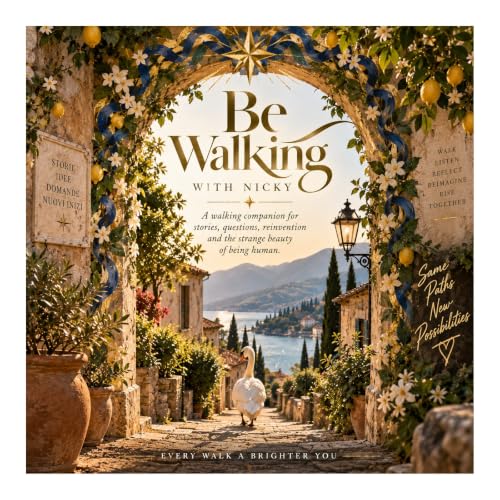
    Contents00:00 | Walking Is Not Fitness I challenge the modern obsession with walking as exercise, arguing that walking is less about fitness and more about presence.01:10 | When Everything Becomes a Performance From runs to gym sessions to daily walks, we’ve turned ordinary human activities into metrics, targets and achievements.02:15 | The Problem with 10,000 Steps A humorous look at how arbitrary numbers have transformed simple movement into a daily box-ticking exercise.03:10 | The Lost Art of Noticing Walking allows us to reconnect with our surroundings, seeing the details, characters and quirks of everyday life that would otherwise go unnoticed.04:20 | Walking Is Life Walking is not something humans invented for health benefits. It’s simply what humans do. We walk to think, connect, travel, process and live.05:00 | The 4,000 Angry Steps Walking as emotional regulation. The universal experience of pacing, stomping and striding through frustration rather than saying something you’ll regret.05:50 | It’s Never Too Late A reflection on ageing, movement and the misconception that if fitness wasn’t prioritised earlier in life, there’s little point starting now.07:10 | The Anti-Fitness Walk No pace. No targets. No guilt. No optimisation. Just permission to walk in whatever way feels right.08:15 | The Wellness Culture Trap How the self-improvement industry can leave us feeling perpetually unfinished and constantly in need of fixing.09:05 | Maybe You Don’t Need Fixing A powerful reminder that sometimes the answer isn’t another programme, challenge or productivity hack. Sometimes it’s a walk and some fresh air.10:00 | Presence Is Enough The achievement is not the step count. The achievement is that you showed up, experienced something and were present.10:35 | Final Thoughts Walking doesn’t need justification. Sometimes walking is simply walking, and that’s enough.The IdeaWe’ve mistaken walking for exercise.Not because walking can’t improve health.But because we’ve become so obsessed with measuring outcomes that we’ve forgotten how to experience the act itself.This episode argues that walking isn’t primarily about burning calories, tracking progress or reaching a target.It’s about being present.What’s Really Going On?Modern culture struggles with things that don’t produce measurable results.If we run, we want the pace.If we train, we want the numbers.If we walk, we want the steps.What was once a natural part of being human has become another performance metric.The irony?The more we focus on measuring the walk, the less likely we are to experience it.Three Ideas Worth Thinking About1. Presence Cannot Be MeasuredThe most valuable part of a walk might not be the distance covered.It’s noticing.The neighbour’s eccentric garden ornament.The smell of dinner from an open window.The dog enthusiastically dragging its owner down the street.These small moments remind us that we’re participating in life rather than rushing through it.2. Movement Doesn’t Need a JustificationNot every walk has to improve something.You don’t have to earn your walk.You don’t need a fitness goal.You don’t need to optimise the experience.Sometimes movement is enough.3. You Can Start Where You AreMany people believe they missed their chance to be active.I challenge this idea directly.Whether you’re 30, 50, 70 or older, movement continues to matter.The best time to start may have passed.The second-best time is now.The Anti-Fitness Walk Manifesto* Walk slowly.* Walk quickly.* Stop for coffee.* Get distracted.* Take the long route.* Turn around halfway.* Look at things.* Think about nothing.Most importantly:Don’t turn it into another thing to succeed or fail at.Memorable Quotes“Walking is not fitness. It’s presence.”“You don’t need fixing. Just some fresh air.”“Walking is life.”“Sometimes walking is just walking.”What This Episode Is Really AboutOn the surface, this episode is about walking.Underneath, it’s about permission.Permission to stop optimising.Permission to stop measuring.Permission to stop treating yourself like a project.And permission to remember that being human doesn’t always require an improvement plan.Reflection QuestionWhat would change if, for one walk this week, you left the targets behind and simply paid attention to where your feet were taking you?The value of a walk isn’t found in the distance you cover, but in your willingness to be fully present while taking it. This is a public episode. If you'd like to discuss this with other subscribers or get access to bonus episodes, visit spirandiombrevtre.substack.com/subscribe
    Show More Show Less
    11 mins
  • What I am tired of being able to do.
    Sep 20 2026

    Be Walking with Nicky

    What I am tired of being able to do.

    Come for a walk. Today, I want to talk about the things we’re tired of being good at. Available, agreeable, useful, and endlessly giving. We’re taught to listen to every voice asking something from us. But when generosity becomes an invitation to be emptied, maybe we need to be asking, who benefits from me never saying no?

    There are some things you don’t realize you’re carrying until you put them down. I’ve spent a lot of my life listening to people at work, in friendships, in families, in rooms where people said one thing while their face was saying something completely different. And I’ve always been interested in that gap,

    the space between what we say and what we actually mean. I think I’ve become slightly obsessed with the story we tell ourselves. Not because stories are bad. The problem is sometimes we forget they’re just stories. You can tell yourself, I’m just tired. I’m just busy. This is how relationships are. I’m not really ambitious.

    I don’t really know what I want. It’s too late. I’m fine. I’m fine. I’m fine. I’m fine. And sometimes, I’m fine is the most complicated sentence in the room. I used to have a dog called Brutus. He was a part of my life in the ordinary ways animals become parts of our lives.

    You don’t necessarily notice all the times when they’re living around them. The sitting on the feet, the lying around, the walking, the noise, the scratches, the ridiculous little routines, their presence, and then one day, they’re gone. And suddenly, the ordinary becomes so precious.

    You miss that little tail wagging and the sound of the bark that comes only for you when you’re just coming through the door. There’s an empty space where he might have been. Grief has a way of editing your memory. And it takes things you thought were insignificant and puts them in bold.

    Something you didn’t know you would miss until you did. I think people are a bit like that too. We don’t always notice ourselves while we’re living. Some of us become parents. Some of us have partners. We get promotions. Maybe we’re carers. Some of us Like to be reliable, while others prefer to be difficult. The strong one.

    The one who can cope. And somewhere underneath all those different roles, still just a person. Sometimes that person starts asking questions. Questions you don’t necessarily say out loud. Like, what if I don’t want this anymore? I want more. I’m not actually happy. What if the version of me everyone knows isn’t the whole me? What if I’ve changed?

    Who am I when nobody needs anything from me? Those questions can be uncomfortable. Because once you hear them, it’s difficult to pretend you didn’t. And that’s where my interest in coaching comes from. Not having all the answers. Actually quite the opposite. I don’t think most people need another person telling them what to do.

    There’s loads of advice you can drown in. You’ve got books, podcasts, TikToks, Instagram, experts. Everybody seems to have an answer but you. Sometimes we just need somewhere to think. Somewhere to say the thing we haven’t been saying. And then ask, is that actually true? That’s what I mean when I talk about creating room. Not escaping your life.

    Not becoming completely different from who you are. Just having enough space to hear yourself underneath all that noise. Sometimes you need to meet the person you’ve been leaving behind. I think there’s something interesting about this particular point in life that I’m in. This stage for me is about having enough history to know what certain choices cost.

    Enough life left to make certain ones. And that’s what I’m interested in exploring. Identity. Work. Money. Creativity. The things we inherit. The things we repeat. And the things we finally decide to question. The strange, wasabi, beautiful business of becoming yourself. So that’s what this podcast is about. Not me telling you who to become.

    Not me handling you or giving you a perfect five step life plan. I’m not about that life. I think you should be asking, what do I already know? The things we don’t say out loud. Maybe you don’t need to become better at anything. Maybe it’s what’s draining you. Maybe you need permission to stop. Take what you thought on your next walk and decide and notice which voice is yours and which ones you’ve been carrying.


    This is a public episode. If you'd like to discuss this with other subscribers or get access to bonus episodes, visit spirandiombrevtre.substack.com/subscribe
    Show More Show Less
    6 mins