Becoming Radical cover art

Becoming Radical

Becoming Radical

Written by: Michael Gaizutis
Listen for free

About this listen

Inspire, challenge, and transform. “Becoming Radical” is a podcast for visionaries, innovators, and bold thinkers who refuse to settle for the status quo. Hosted by Michael Gaizutis, each episode dives into the untold stories of companies, brands, and leaders radically reshaping their markets. From groundbreaking strategies to hard lessons learned, this is your go-to guide for redefining success in a rapidly changing world.Michael Gaizutis Economics
Episodes
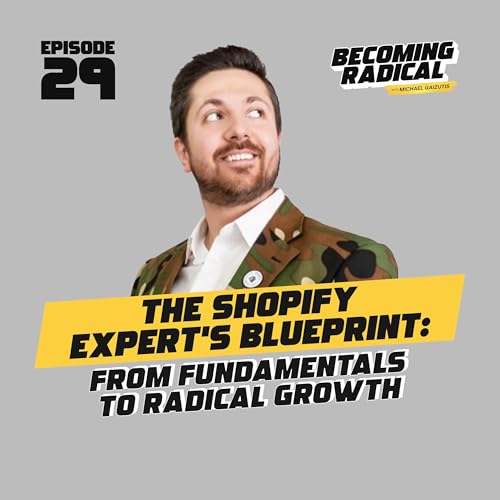
  • The Shopify Expert’s Blueprint: From Fundamentals to Radical Growth
    Sep 16 2025
    In this episode of Becoming Radical, Michael Gaizutis sits down with Kurt Elster—host of The Unofficial Shopify Podcast and one of the most trusted independent Shopify experts in the world. With over 500 episodes under his belt and a career working with some of the most successful Shopify brands, Kurt has built his reputation on cutting through the noise and focusing on what really drives growth.From navigation mistakes that kill conversions to the overlooked power of newsletters, Kurt lays out a no-fluff, fundamentals-first approach for entrepreneurs who want to thrive in e-commerce. He shares lessons from running his agency, building a leading Shopify podcast, and helping brands increase their average order value with small but radical tweaks.Together, Michael and Kurt explore what separates stores that scale from those that stall, the future of headless commerce and AI agents, and why storytelling and copywriting remain timeless drivers of trust and differentiation.If you’re building a brand in 2025—or wondering how to radically improve your Shopify store—this conversation is a masterclass you don’t want to miss. Key Takeaways The two fundamentals every e-commerce brand must master: a strong product and the discipline to stay focused.Most Shopify stores fail on the basics—like navigation and product pages—before chasing shiny tools and apps.Small tweaks, like adding a “best value” badge, can boost average order value by 10% without more traffic.Copywriting still outperforms design changes—focus on clarity, legibility, and customer-focused messaging.Balancing automation with personalization is essential—customers can smell generic AI content.Podcasting consistency built Kurt’s brand: 500+ weekly episodes over 10 years.The future of Shopify includes AI-driven catalog search, global cart, and cleaner product taxonomies.Bootstrap founders should start simple: build a newsletter to stay top of mind.In This Episode [00:51] What separates successful Shopify stores from those that stall[04:10] Common mistakes brands make with navigation and product pages[08:39] The fundamentals of a high-converting product page in 2025[12:15] Why copywriting changes beat design tweaks[15:42] How one small badge boosted AOV by 10%[19:11] Balancing automation, AI, and personalization[22:34] The art of storytelling in e-commerce[26:18] Kurt’s process for working with brands[30:45] The origins and growth of The Unofficial Shopify Podcast[34:09] Shopify apps Kurt swears by (and why less is more)[38:42] Headless commerce and the Shopify horizon[43:27] E-commerce in the next 3–5 years[47:11] How AI and Shopify’s catalog API will reshape shopping[52:03] What Kurt would do differently starting from scratch[55:14] His advice to bootstrap founders launching in 2025[58:21] Where to find Kurt Elster onlineOur GuestKurt Elster is a senior e-commerce strategist and host of The Unofficial Shopify Podcast. Recognized as one of the most trusted independent Shopify experts, Kurt has advised hundreds of brands and produced over 500 podcast episodes exploring the world of Shopify, conversion optimization, and digital entrepreneurship.Notable Quotes [02:12] “Anyone can build a beautiful store. But if you don’t have focus and a good product, it won’t work.” — Kurt Elster[25:36] “Hold up a mirror for your customer—help them see themselves in your product.” — Kurt Elster[31:29] “The key to podcast success is consistency. We’ve published every Tuesday, unrelentingly, for 10 years.” — Kurt Elster[54:45] “Start a newsletter. Just being in someone’s inbox keeps you top of mind.” — Kurt ElsterResources and LinksKurt ElsterWebsiteThe Unofficial Shopify PodcastLinkedInTwitter/XMichael GaizutisLinkedInWebsiteBecoming Radical LinkedInInstagramFacebook Twitter
    Show More Show Less
    38 mins
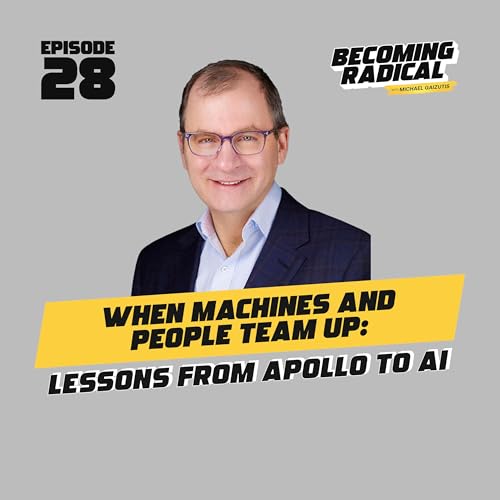
  • When Machines and People Team Up: Lessons from Apollo to AI
    Sep 9 2025
    In this episode of Becoming Radical, Michael Gaizutis chats with David Mindell, a technologist, historian, entrepreneur, and co-founder of Humatics. David’s career has taken him from deep-sea robotics to MIT research and groundbreaking industrial innovation, and he’s got some fascinating insights on how precision navigation, human–robot collaboration, and bold investment choices are shaping the future of work.If you’re a technologist, founder, or leader trying to navigate the next industrial revolution, this episode will challenge the way you think about innovation and show why it’s industry, not just apps, that’s going to define the future. Key Takeaways Young engineers often overlook the intelligence embedded in human labor, a mistake companies cannot afford.Robots should complement workers, not replace them, creating worker-friendly AI and automation.Adoption is as critical as invention, scaling robotics requires trust and process innovation.Manufacturing and industrial work are powerful drivers of social change.Process innovation is just as transformative as product innovation, often more so.In This Episode [00:26] Introduction David Mindell[01:08] Humatics and spatial intelligence[03:15] Investment focus: transforming US industry[04:41] Industrial tech adoption and Silicon Valley’s software focus[06:05] Origins and inspiration for Humatics[07:26] Human-machine collaboration: Apollo program lessons[09:37] Defining spatial intelligence[10:49] Indoor positioning and subway applications[11:17] Rethinking autonomy and human-machine teaming[13:15] Real-world constraints and Waymo example[14:26] Collaborative robotics in industry[15:04] Designing worker-friendly AI and embedded intelligence[20:06] Training engineers for real-world context[21:14] Transition from academia to entrepreneurship[23:10] Evolving company leadership and founder transition[25:12] Commercializing deep tech and robotics adoption[30:22] Process innovation vs. product innovationOur GuestDavid Mindell is a technologist, historian, entrepreneur, and professor at MIT. He is co-founder and chairman of Humatics, a pioneer in high-precision navigation systems for robots and industrial environments, and co-founder of Unless, a venture firm investing in companies transforming U.S. industry. His latest book, The New Lunar Society, explores how industry, ethics, and innovation intersect to shape the next industrial revolution.Notable Quotes [03:34] “Less than 1% of venture capital in this country goes into industrial companies... we're all in a place where actually both parties in Washington agree we need to revitalize US Industry for a number of different reasons.” — David Mindell[11:50] “Every robot is made by people, right? So there's human intention built into the architecture, built into the software, built into which sensors are chosen depending on the task and the environment.” — David Mindell[24:02 “The statistics are that when founders step aside voluntarily, the companies overall do much better than when the founders are forced out.” — David Mindell[27:44] “I'm prepared for the idea that there is a moment when all of a sudden it'll seem like robots start popping up everywhere. Like we'll cross some usability threshold and then it'll kind of break free.” — David Mindell[28:29] “I do hope that you see a much more kind of fluid collaboration of robots and human environments instead of the kind of awkward, clunky things we see today. But that's hard.” — David Mindell[30:37] “We're very good in this country at product innovation. We've really dropped the ball on process innovation and that's really where the important stuff happens.”— David MindellResources and LinksDavid MindellLinkedInUnlessHumaticsBook: The New Lunar Society: An Enlightenment Guide to the Next Industrial RevolutionMichael GaizutisLinkedInWebsiteBecoming Radical LinkedInInstagramFacebook Twitter
    Show More Show Less
    35 mins
  • Unlocking the Magic of Customer Experience with Shep Hyken
    Sep 2 2025
    In this episode of Becoming Radical, Michael Gaizutis sits down with Shep Hyken, world-renowned customer experience expert, keynote speaker, and Chief Amazement Officer of Shepard Presentations. Together, they dive into what it really takes to create unforgettable customer experiences, experiences that turn customers into loyal fans.Shep shares his journey from a 12-year-old magician writing thank you notes to becoming one of the leading voices in customer service strategy. He unpacks the philosophy of “moments of magic” versus “moments of misery,” why consistency is the true key to amazement, and how culture, not just initiatives, defines a company’s long-term success.They also explore how AI is reshaping customer support, where automation and personalization meet, and why the best brands find a balance between digital tools and the human touch. Along the way, Shep drops practical insights for leaders, startup founders, and enterprise executives alike on building companies that last by obsessing over the customer.Whether you are a founder, CX leader, or builder chasing radical growth, this episode will inspire you to rethink how you serve the people who matter most, your customers. Key Takeaways Customer service is not a department, it is a philosophy woven into company culture.Consistency, not over the top gestures, is what makes customers say “I’ll be back.”Leaders must defend and model company culture from the top down.Training is not something you did, it is something you do continuously.Mapping every customer touchpoint reveals where magic or misery happens.AI is improving fast, but personalization and human empathy remain irreplaceable.Companies that blend automation with humanity avoid becoming commodities.The future of customer experience is about balance: digital efficiency plus human trust.In This Episode [00:02] Introduction to Becoming Radical[05:00] Defining “amazement” and moments of magic[08:34] Why customer service training must be ongoing[10:14] Shifting from reactive to proactive customer experience[13:52] Real life stories of radical customer care[20:00] Retail brilliance and lessons from a jewelry store owner[30:00] The duality of automation and humanity[31:35] What CEOs must understand: defending culture as job #1[32:27] Where to find Shep and his resourcesOur GuestShep Hyken is a globally recognized customer service and experience expert, New York Times bestselling author, and Chief Amazement Officer at Shepard Presentations. With over 40 years of experience, Shep helps companies of all sizes, from startups to Fortune 500s, create customer loyalty through consistent, memorable experiences. His philosophy: treat employees as well as you want customers treated, and amazement will follow.Notable Quotes [01:16] “Have you ever walked away from a business and thought, wow, that was amazing? That's what I help my clients achieve.” — Shep Hyken[06:38] “If you want to be seen as amazing, just do what people expect all the time. It's not that difficult.” — Shep Hyken[30:30] “The companies that are going to really survive are the ones that are able to say, we're going to give you all the digital automation, AI type of support and an experience you want. But guess what, we're human too.” — Shep Hyken[32:12] “I defend the culture. That is the most important thing I do.” — Shep HykenResources and LinksShep HykenWebsiteYouTubeArticles and PodcastMichael GaizutisLinkedInWebsiteBecoming Radical LinkedInInstagramFacebook Twitter
    Show More Show Less
    37 mins
No reviews yet