Bootie and Bossy Eat, Drink, Knit cover art

Bootie and Bossy Eat, Drink, Knit

Bootie and Bossy Eat, Drink, Knit

Written by: Bootie and Bossy
Listen for free

Bootie and Bossy are two sisters who share a love of cooking and crafting. Please join us in our adventures and misadventures! We'll share our best recipes and make you feel better about your craft projects. Whatever you do, don't knit like my sister! For show notes and more, please visit Bootieandbossy.comAll rights reserved Art Cooking Food & Wine
Episodes
  • We will always love Dolly Parton
    Oct 9 2026

    In this time of doom and discord, there's one bright, pink sparkling light that can bring us all together: Dolly Parton. When she died on August 25th, we lost a great spirit, and the whole world mourned her passing with flags hanging at half staff in every American embassy throughout the globe. So we felt it was only fitting to dedicate this episode to all the things we love about Dolly Parton. What does she have to do with eating, drinking and knitting, you ask? Full disclosure: she was not a knitter as far as we know, though the lovely white hand-crocheted shawl she's wearing here attests to her appreciation of the handmade. But she and her sister Rachel Parton George did collaborate on a best-selling cookbook, Good Lookin’ Cookin’: A Year of Meals—a Lifetime of Family, Friends and Food. Make her Country Ham and Biscuits, and let that flaky warmth melt in your mouth while you listen to the five songs that best capture Dolly's spirit.

    "9 to 5" is the anthem for all working women. When we learned she wrote "I Will Always Love You" to explain to Porter Wagoner why she had to leave his show and strike out on her own, we loved it even more. But it's how she champions embracing who you are that we find the most inspirational. A moment alone, singing in an old abandoned church, surrounded by crude "dirty pictures," Dolly describes her own spiritual awakening:

    “I didn't hear it like a voice, it came to me as a feeling that was as strong as a voice, though, and I felt like I found God that day. And I felt like I knew who I was that day . . . In this place of confusing images . . . I found God, music and sex. My fascination was complete. I sang with a strengthened conviction that only God could have understood the joy of the truth I found there. It is with me to this day. I found God, and I had found Dolly Parton.”

    (Quoted from the wonderful podcast, Dolly Parton's America, episode 9)

    Dolly's revelation that God loves her for being herself gave her the faith and confidence to embrace everyone--men and women, young and old, from the cowboy to the drag queen. This is why Nelson Mandela asked the guards to play "Jolene" in prison. For Dolly, when you accept who you are, you find the Godly within, and that's always worth fighting for. So thank you for all you gave to us, Dolly--the great embrace of your music and your divine spirit. We will always love you.

    Show More Show Less
    36 mins
  • We're back and Mom's OK!
    Aug 31 2026

    Okay, it's been a while since our last episode, but don't worry--we were not fighting. There were no fisticuffs. Most importantly, Mom's okay! But it was a grueling couple of months for all of us as Mom fought her way back from a significant health setback. Who knew that you could get a burst fracture in two vertebrae from violent coughing? Put this in the category of things we would rather not learn through experience. And when life gives you burst vertebrae, we recommend a good drink and talking about a great book, in this case Roz Chast's graphic memoir, Can't We Talk About Something More Pleasant?

    Simply put, everyone needs to read this book. Whether you are a child caring for an aging parent, or a middle-aged parent contemplating the fate of your child wading through decades of your accumulated "treasures," or a child who thinks his parents are bad now (just wait!), this book is for you. It is poignant, funny and profound, and says out loud many of the things you might have been thinking but could not find the words for, or perhaps did not feel you could say out loud. As Chast describes her realization so aptly,

    "The piles of newspapers, magazines, and junk mail had grown larger . . . and they themselves had grown frailer. I could see that they were slowly leaving the sphere of TV commercial old age--Spry! Totally Independent! Just like a normal adult, but with silver hair!--and moving into the part of old age that was scarier, harder to talk about, and not a part of this culture. Something was coming down the pike (p. 20).

    Chast's book gives us a way to starting talking about the thing we can't name that's coming down the pike. While we would love to include the fantastic drawings she has created to accompany the profound truth that she distills into a caption, we suspect her work is copyrighted. So instead here's a pic of the drinks we got at Skein & Tipple, our favorite speakeasy/yarn store in Clinton, on Whidbey Island in Washington (note the crocheted coasters--simply divine). Inspired by their Hornet Murder libation, we offer up this drink recipe with deep gratitude for all the people who helped us through this, and most of all for Mom, for being okay. We love you, Mom.

    Show More Show Less
    38 mins
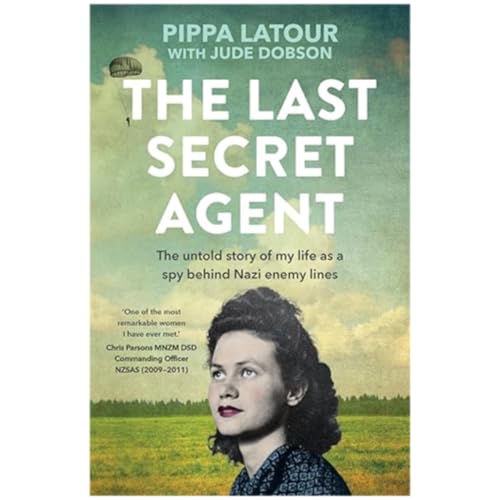
  • Pippa Latour, a Portrait in "Cool and Lonely Courage"
    May 4 2026

    We are back for our second installment on knitting and espionage with Pippa Latour's memoir, The Last Secret Agent: My Life as a Spy Behind Nazi Lines. First a disclaimer: knitting stands out only as the most normal, ordinary thing in the extraordinary life of Pippa Latour, and it plays a critical, albeit small, part in her life as an Special Operations Executive (SOE) agent. Pippa Latour is above all a survivor--when she died in 2023 at the age of 102, she literally was the last surviving secret agent who served during World War II.

    What's perhaps most surprising is how her life before the war perfectly prepared her for being a spy. With a French father and English mother, she grew up in Africa speaking many languages (Swahili, French and English). She was also used to hardship, loss and violence--her father died when she was four months old, killed in an uprising against Western doctors lead by local healers. Her mother died when she was four. Raised by various relatives and friends of her parents, she was shuttled from one home to another, so she constantly had to adapt to new situations. She was used to living in the bush and sleeping outside in a hammock. She knew how to shoot a gun and pilot a plane before her spy training. Those years playing with monkeys in the trees meant she killed it on the ropes courses too. All this prepared her to parachute behind enemy lines, adopt the cover of a 14-year-old French girl selling goat-milk soap for her "grandparents," while she gathered intelligence and transmitted it by Morse code through radios hidden in 27 locations across her territory in France. Yeah. She did that. Most radio transmitters survived six weeks behind enemy lines. Not Pippa Latour.

    Major Selwyn Jepson was the British commander who advocated for recruiting women as spies because

    "Women have a greater capacity for cool and lonely courage than men, who usually want a mate with them. Men don't work alone; their lives tend to be always in company with other men. Women are mostly on their own" (p. 66).

    We decided a World War II era cocktail would be a great accompaniment to discussing Pippa's story, so try the delicious "Three Dots and a Dash," which is "V" in Morse code for Victory. It is because of the sacrifices of so many and the "cool and lonely courage" of women like Pippa Latour that we enjoy the lives we have today, and we are profoundly inspired and deeply grateful.

    Show More Show Less
    40 mins
adbl_web_anon_alc_button_suppression_t1
No reviews yet