• Following Gurus Is Worse Than Taking Random Trades
    May 8 2026

    This debate explores whether social media trading gurus and finfluencers genuinely help retail traders find better market ideas, or whether the whole ecosystem pushes people towards gambling, hype, manipulation and emotional decision-making.

    The discussion looks at both sides of the argument. On one side, research suggests that a small group of social media traders may have measurable skill, especially when they act against the crowd, avoid hype, and identify moments where sentiment has pushed a stock too far. These traders may use panic, euphoria and market overreaction to find short-term opportunities that traditional financial institutions can sometimes miss.

    On the other side, the debate highlights a much darker reality. Most social trading content is noisy, unverified and built around attention rather than discipline. Many influencers are rewarded for being loud, dramatic and confident, not for being consistently accurate. That creates a dangerous environment for retail traders who may mistake entertainment, lucky calls or manipulated screenshots for genuine market skill.

    Why Blindly Following Gurus Can Be Dangerous

    A major theme in this episode is the difference between real trading skill and the appearance of skill. Many online traders use tactics that make them look more accurate than they are. They may post several possible chart levels, then later highlight the one that worked. They may delete losing calls, promote only winning trades, or use vague predictions that can be interpreted in multiple ways.

    The Problem With Social Trading Platforms

    Social trading platforms can make this problem worse. Leaderboards, copy trading, viral posts and follower counts often reward extreme returns. To stand out, some signal providers take lottery-style risks in highly volatile stocks. These trades may look impressive if they work once, but they can destroy capital over time.

    The danger is that variance gets sold as skill. A trader who takes reckless risk may appear brilliant after one big winner, even if the strategy is not repeatable. Retail traders who copy that behaviour may end up chasing hot stocks, oversized positions and emotional entries.

    The Case For Skilled Finfluencers

    The episode also recognises that not every financial creator is a scammer. Some skilled retail traders may offer useful insight, especially when they explain their process, manage risk, and challenge crowd behaviour rather than amplify it.

    Independent traders can sometimes move faster than large funds. They may spot sentiment shifts, news reactions or small-cap opportunities before traditional research catches up. The key difference is that genuine skill usually looks disciplined, patient and risk-aware. It does not rely on hype, urgency or guaranteed promises.

    What Traders Should Watch For

    Before following any trading voice online, traders should ask:

    • Is there a verified track record, or only screenshots and selective wins?
    • Does the person explain risk management, or only talk about profit?
    • Are they teaching a process, or pushing urgent buy signals?
    • Do they admit losses, or only promote winning trades?
    • Are they making money from trading, or mainly from subscriptions, courses and Discord access?
    • Does the strategy fit your account size, risk tolerance and time frame?
    • Are you entering because of your own plan, or because someone else created FOMO?

    #StockMarket #Trading #Investing #DayTrading #SwingTrading #TradingPsychology #RiskManagement #Finfluencers #TradingGurus #RetailTrading #SocialTrading

    Show More Show Less
    21 mins
  • The $2.1 Billion Infrastructure Shift: Nvidia and the IREN Deal
    May 8 2026

    Nvidia backs IREN in a $2.1 billion AI data centre deal: what it means for AI infrastructure stocks

    Nvidia is investing up to $2.1 billion in IREN as part of a wider AI data centre deal, with the companies planning to deploy up to 5 gigawatts of infrastructure to meet rising artificial intelligence demand. IREN also gave Nvidia a five-year right to buy up to 30 million shares at $70 per share, and future deployments are expected to focus on IREN’s Sweetwater campus in Texas.

    Winners

    AI Chip And Accelerator Leaders

    This deal reinforces the idea that AI compute demand remains strong. If Nvidia is willing to support large-scale AI factory infrastructure, the market may see this as another sign that GPU, accelerator and custom AI chip demand still has room to run. Nvidia is the direct winner, but AMD and Broadcom may also benefit from the wider theme of rising AI infrastructure spending.

    Names: $NVDA Nvidia, $AMD Advanced Micro Devices, $AVGO Broadcom

    AI Data Centre And Neocloud Operators

    IREN is the clearest winner because Nvidia’s backing gives the company more credibility as an AI infrastructure platform, not just a data centre or former crypto-linked name. CoreWeave and Applied Digital may also benefit from investor interest in companies that can provide AI compute capacity outside the traditional hyperscaler model. The market may now pay closer attention to which smaller operators have power access, land, GPU relationships and enterprise customers.

    Names: $IREN IREN, $CRWV CoreWeave, $APLD Applied Digital

    Power, Grid And Electrical Infrastructure Companies

    AI data centres need huge amounts of electricity, power equipment and grid upgrades. A 5-gigawatt infrastructure target highlights how large this demand could become. Power generators, electrical equipment companies and grid contractors may benefit as AI campuses require reliable power, transformers, switchgear, cooling systems and transmission capacity.

    Names: $CEG Constellation Energy, $VST Vistra, $ETN Eaton, $PWR Quanta Services

    Losers

    Traditional Cloud Providers Facing Higher Capex Pressure

    Hyperscalers are still major AI winners, but deals like this show that AI infrastructure is becoming more expensive and competitive. If Nvidia-backed neoclouds gain more traction, traditional cloud giants may need to keep spending heavily to protect capacity, performance and customer relationships. That can pressure free cash flow, margins and investor patience, even if revenue demand remains strong.

    Names: $AMZN Amazon, $MSFT Microsoft, $GOOGL Alphabet

    Pure Bitcoin Mining Names Without A Clear AI Pivot

    IREN has become more interesting to investors because it is tied to AI data centre demand, not just crypto mining economics. That could increase pressure on Bitcoin miners that have large power assets but less visible AI or high-performance computing revenue. Traders may start separating miners with credible AI infrastructure plans from miners still mostly tied to Bitcoin price movements.

    Names: $MARA MARA Holdings, $RIOT Riot Platforms, $CLSK CleanSpark

    Legacy Enterprise Hardware And Lower-Growth Infrastructure Names

    The AI data centre buildout increasingly rewards companies directly tied to GPUs, high-speed networking, power infrastructure and hyperscale AI workloads. Legacy hardware and storage names can still benefit, but they may be viewed as less central to the most valuable parts of the AI stack. If capital keeps flowing toward Nvidia-linked ecosystems, lower-growth infrastructure names could be left behind.

    Names: $HPE Hewlett Packard Enterprise, $NTAP NetApp, $WDC Western Digital

    #StockMarket #Trading #Investing #DayTrading #SwingTrading #Nvidia #NVDA #IREN #ArtificialIntelligence #AIStocks #DataCenters #CloudComputing #AIInfrastructure

    Show More Show Less
    11 mins
  • You Are Probably Not Undercapitalised, Just Undisciplined
    May 7 2026

    You Are Probably Not Undercapitalized, Just Undisciplined

    In this episode of Breaking News to Trading Moves, we look at one of the most uncomfortable truths in trading: many struggling traders are not failing because their account is too small. They are failing because their rules are too weak, their execution is inconsistent, and their emotions are making decisions that their strategy should be making.

    It is easy to blame account size. A bigger account feels like it would solve everything. More capital means wider stops, larger positions, more room to recover and more confidence to hold trades. But if the same trader keeps moving stops, averaging down, taking random entries, overtrading after a loss and increasing size to get back to breakeven, then more money may only make the same mistakes more expensive.

    This debate asks whether undercapitalisation is the real problem for retail traders, or whether discipline, patience and risk control are often the missing pieces. A small account can be limiting, but it can also reveal the truth quickly. If you cannot follow your plan with small size, it is unlikely that a larger account will magically fix your psychology. In many cases, the account is not the issue. The behaviour is.

    Why This Matters

    Trading exposes habits. If you are impatient, the market will show it. If you need constant action, the market will tempt you into weak setups. If you hate being wrong, you may hold losing trades too long. If you are desperate to grow quickly, you may risk too much on one idea. None of these issues are solved by adding more capital.

    A bigger account can help a skilled trader scale a proven method. But for an undisciplined trader, it can create more damage. More buying power can mean more impulsive trades. More margin can mean bigger losses. Capital only becomes useful when it is paired with structure.

    Key Points Covered

    1. Account Size Is Not Always The Real Problem

    Many traders believe they would perform better with more money, but the same poor habits often follow them into larger accounts. If the issue is chasing entries, ignoring stops or breaking rules, more capital simply increases the cost of those mistakes.

    2. Small Accounts Reveal Discipline Quickly

    A small account gives less room for error, which can be frustrating. But it also forces traders to respect position sizing, wait for better setups and avoid unnecessary trades. That pressure can either build discipline or expose the lack of it.

    3. Risk Management Matters More Than Account Size

    A trader who risks too much, revenge trades or refuses to cut losses can destroy any account. A trader who controls risk, protects capital and accepts small losses can survive long enough to improve.

    4. Patience Is Part Of The Strategy

    Not trading is often a decision. Many traders lose money because they feel they must always be in a position. Waiting for the right setup, accepting quiet days and avoiding low-quality trades can be just as important as technical analysis.

    The Bigger Trading Lesson

    This episode is not saying account size does not matter. A very small account can make position sizing harder and can limit returns. But the main point is that capital should amplify skill, not compensate for poor discipline. If a trader is still breaking rules, forcing trades and reacting emotionally, the first job is not to add more money.

    Being undercapitalised can be a real challenge, but being undisciplined is far more dangerous. A small account with strong rules can become a training ground. A large account with weak discipline can become a faster path to bigger losses.

    #StockMarket #Trading #Investing #DayTrading #SwingTrading #TradingPsychology #RiskManagement #TradingDiscipline #PositionSizing #RetailTrading #TradingPodcast

    Show More Show Less
    22 mins
  • AMD’s AI Surge: The Semiconductor Shift and Sector Impact
    May 7 2026

    Amd Blows the Roof Off: AI Chips Are Eating the World

    AMD reported first quarter 2026 revenue of $10.3 billion, up 38% year over year, crushing Wall Street's estimate of $9.89 billion. But here is the real number that matters: Data Center revenue hit $5.8 billion, up a staggering 57% year over year. Non-GAAP EPS came in at $1.37 versus $1.29 expected. And the guidance? AMD told the Street to expect Q2 revenue of approximately $11.2 billion -- well above the $10.5 billion consensus.

    Winners

    AI Chip and Semiconductor Manufacturers

    AMD's blowout proves that AI infrastructure spending is not slowing down. Hyperscalers -- the Metas, the Microsofts, the Googles and the Amazons of the world -- are racing to deploy more compute than ever. That is a rising tide that lifts every serious player making chips for AI workloads.

    Names: $AMD (Advanced Micro Devices) $NVDA (Nvidia), $INTC (Intel)

    AI Data Center Server Builders and Infrastructure Companies

    AMD does not sell servers. Companies like Super Micro, Dell and Hewlett Packard Enterprise take AMD's EPYC chips and Instinct GPUs and build the actual servers that hyperscalers and enterprises deploy at scale. When AMD's chip shipments ramp, so does the demand for the servers those chips go into.

    Names: $SMCI (Super Micro Computer), $DELL (Dell Technologies), $HPE (Hewlett Packard Enterprise)

    High Bandwidth Memory and Advanced Memory Suppliers

    AMD's Instinct GPUs, like the MI300 and MI450 series, require massive amounts of High Bandwidth Memory, or HBM. As AMD scales its GPU shipments to meet surging AI demand, the companies supplying the advanced memory that goes into those chips see enormous demand pull-through.

    Names: $MU (Micron Technology), $WDC (Western Digital)

    Losers

    Mobile and Consumer-Focused Chipmakers

    AMD's earnings story is almost entirely a data center story. The flip side of that is that compute spend is shifting structurally away from consumer devices and mobile toward AI servers. Arm Holdings made this painfully clear on the same day AMD reported, guiding for flat to slightly negative mobile market unit growth in fiscal year 2027.

    Names: $ARM (Arm Holdings), $QCOM (Qualcomm)

    Legacy Enterprise IT Resellers and Commoditized Hardware

    AMD's earnings confirm that enterprise technology spending is being redirected sharply toward AI infrastructure -- specialized servers, accelerators and memory. Companies that sell commoditized traditional IT hardware -- laptops, printers, networking boxes, and general-purpose enterprise equipment -- are not benefiting from this wave.

    Names: $CDW (CDW Corporation), $HPQ (HP Inc.)

    Traditional Cloud Networking and Non-AI Infrastructure Players

    As hyperscalers build out custom AI infrastructure at a massive scale, they are increasingly designing and building their own custom networking and switching equipment in-house. This trend reduces their dependence on third-party networking providers.

    Names: $ANET (Arista Networks), $CSCO (Cisco Systems)

    #StockMarket #Trading #Investing #DayTrading #SwingTrading #AMD #Semiconductors #AIStocks #NvidiaStock #TechStocks #DataCenter #ArtificialIntelligence #ChipStocks

    Show More Show Less
    16 mins
  • Trading Success: Risk Management vs Psychology
    May 6 2026

    In this episode of Breaking News to Trading Moves, we debate one of the biggest questions every trader faces: is long-term success built on strict mathematical risk management, or does everything depend on psychological discipline when pressure hits?

    The debate starts with a Formula One analogy. A perfect car can still crash if the driver panics. In the same way, a trader can have the best strategy, indicators, stop losses and position sizing rules, but still destroy an account if fear, greed or desperation takes over. On the other side, discipline without hard risk limits can leave a trader exposed.

    Why capital preservation matters more than chasing fast profits

    Drawdowns are dangerous. A 10% loss needs an 11.1% gain to recover, but a 50% loss needs a 100% gain just to get back to break-even. This is why professional traders focus on defence first.

    The case for mechanical risk management

    Strict rules such as risking 1-2% per trade, using hard stop losses, positive reward-to-risk ratios and volatility-adjusted stops can protect traders from emotional decision-making. Maths can act as a survival framework when markets get noisy.

    Why psychology can break even the best system

    A risk rule only works if the trader actually follows it. The debate looks at loss aversion, revenge trading, fear of realising losses and moving stop losses when a trade goes wrong. A perfect trading plan means little if the trader overrides it.

    Reward-to-risk and win rate explained

    The episode breaks down how a trader can still be profitable without winning most trades. With a 3-to-1 reward-to-risk ratio, a trader does not need a high win rate to build a strong equity curve, as long as losses stay small and the system is followed consistently.

    Volatility-adjusted stops and ATR

    Instead of placing random stops, the discussion explains how the Average True Range can help traders place stops outside normal market noise. This reduces the chance of being shaken out by ordinary price movement, while still protecting capital if the trade thesis fails.

    Prop firm challenges and psychological pressure

    The debate also looks at funded account challenges, where profit targets, trailing drawdowns and strict time limits can push traders into forced trades. Even mathematical rules can create pressure if the trader becomes obsessed with passing the challenge rather than executing quality setups.

    Process vs P&L

    One of the strongest parts of the debate is whether traders should judge success by daily profit and loss or by process quality. A trader can make money from a bad trade and reinforce dangerous behaviour, while another trader can lose money while executing a solid setup correctly. Short-term P&L can be misleading because markets include randomness, variance and unexpected events.

    Why defensive trading matters

    Both sides agree on one thing: amateur traders often fail because they focus too much on offensive profit chasing and not enough on survival. The market does not care about your bills, goals, deadlines or need to win back losses. The trader who survives longest is usually the one who respects risk first.

    This episode is for traders who want to think more deeply about position sizing, stop losses, drawdown recovery, trading psychology, revenge trading, process discipline and capital preservation. It asks a simple but uncomfortable question: when the pressure is highest, do you trust the maths of your system, or the calmness of your own mind?

    #StockMarket #Trading #Investing #DayTrading #SwingTrading #TradingPsychology #RiskManagement #CapitalPreservation #PositionSizing #StopLoss #Drawdown

    Show More Show Less
    19 mins
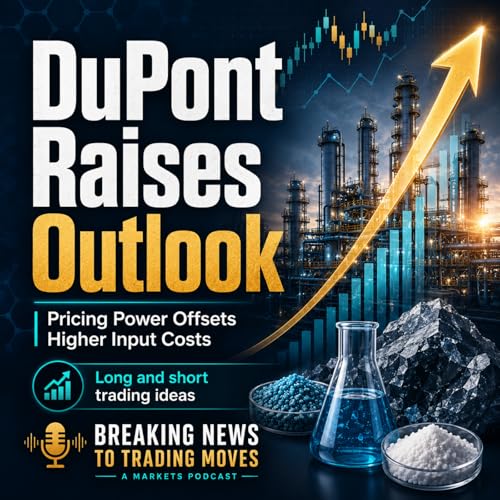
  • The DuPont Effect: Pricing Power and Sectoral Shifts
    May 6 2026

    DuPont raises outlook as pricing power offsets higher input costs

    DuPont raised its 2026 sales and profit forecast after stronger Q1 results, with price increases helping offset higher input costs linked to Middle East disruption. The trading signal is pricing power. If DuPont can protect margins while costs rise, investors may start looking for other US-listed companies that can pass higher costs through to customers without damaging demand.

    Winners:

    Specialty chemicals and higher-margin materials

    DuPont’s update suggests the market may reward chemical companies with differentiated products, stronger customer relationships and better pricing power. Specialty chemical names are usually less exposed to pure commodity pricing than basic chemical producers, which can make margins more resilient when input costs rise.

    Names: $DD (DuPont), $CE (Celanese), $ALB (Albemarle)

    Water technology and healthcare materials

    DuPont’s healthcare and water technologies exposure gives investors a positive read-through for companies tied to medical materials, lab tools, biopharma demand and water treatment. These areas can be more defensive because demand is often linked to healthcare, infrastructure and regulation rather than short-term consumer spending.

    Names: $DHR (Danaher), $A (Agilent Technologies)

    Industrial companies with strong cost pass-through ability

    The bigger story is margin protection. Industrial companies with strong backlogs, mission-critical products and long-term customer relationships may be better placed to pass on higher costs. DuPont’s guidance raise could support the idea that selected industrial names can keep earnings strong even in a higher-cost environment.

    Names: $ETN (Eaton), $EMR (Emerson Electric), $HON (Honeywell)

    Losers:

    Commodity chemical producers

    Commodity chemical companies are often more exposed to feedstock costs, energy prices and cyclical demand. If costs rise and pricing power is weaker, margins can come under pressure. DuPont’s strength could highlight the gap between specialty chemicals and lower-margin commodity chemical businesses.

    Names: $DOW (Dow), $LYB (LyondellBasell), $WLK (Westlake)

    Packaging and plastics users

    If resin, plastics and packaging material costs rise, companies that rely on these inputs may face margin pressure. They may try to raise prices, but if demand is soft, customers may push back. That makes earnings more sensitive to cost inflation.

    Names: $AMCR (Amcor), $BALL (Ball), $SEE (Sealed Air)

    Consumer staples with packaging exposure

    Consumer staples companies use large amounts of packaging, chemicals and logistics. If input costs rise, they either need to raise prices again or absorb the pressure. In a cautious consumer environment, price increases can be harder to push through.

    Names: $PG (Procter and Gamble), $CL (Colgate-Palmolive), $KMB (Kimberly-Clark)

    #StockMarket #Trading #Investing #DayTrading #SwingTrading #DuPont #DD #ChemicalStocks #IndustrialStocks #MaterialsStocks #PricingPower #Earnings #Guidance #MarginPressure #Packaging #ConsumerStaples #MarketNews

    Show More Show Less
    18 mins
  • Trading Small Accounts May Be A Waste Of Time
    May 5 2026

    Trading a small account can feel exciting because every trade seems like a chance to prove yourself. But this episode asks a harder question: are small accounts really a path to profit, or are they mostly a training ground for discipline and risk control?

    On this episode of Breaking News to Trading Moves, we look at the truth behind small account trading. Many traders start with a few hundred or a few thousand dollars and expect big results.

    Main Debate

    The core argument is simple: trading a small account may be useful for learning, but it can be a waste of time if the trader expects income too quickly.

    Small accounts create pressure. A 5% gain on a $1,000 account is only $50. That may be a strong trading result, but emotionally it can feel disappointing. This is where many traders begin forcing trades, increasing leverage, holding losers too long or chasing names because they want the account to grow faster.

    Key Points Covered

    • Why small account trading can teach skills but rarely produces meaningful profit early on.
    • How unrealistic expectations make traders abandon good risk management.
    • Why percentage return matters more than the cash amount when judging progress.
    • How leverage can turn a learning account into emotional decision-making.
    • Why traders should separate skill-building from income generation.
    • How a small account can still be valuable when used with strict rules.

    Skill Or Profit?

    One mistake traders make is treating a small account like a business income source before they have built a real edge. The account becomes less about testing strategy and more about trying to escape the small account itself. That mindset often leads to impulsive trading.

    A better approach is to see the small account as tuition. It gives you market exposure, real emotions and real consequences, but at a size where mistakes should not destroy your finances. If you can trade with patience and consistency, you are building habits that may matter when the account size becomes larger.

    The Risk Trap

    Small accounts can make bad behaviour look necessary. If normal position sizing feels too slow, a trader may start risking 10%, 20% or more on one trade. That can create big wins, but it also creates account-ending losses. Risk still compounds both ways.

    Before chasing profit, traders need to prove they can follow rules, protect capital and avoid revenge trades. A small account should not be an excuse to gamble. It should be a controlled environment for building evidence that your strategy works.

    Trading Lesson

    The real question is what you are using the account for. If the goal is to become rich quickly, then a small account may disappoint you and push you into reckless trades. If the goal is to develop execution, patience and emotional control, then it can be one of the most useful stages in your trading journey.

    Instead of asking, “How much money did I make?”, ask: Did I follow my plan? Did I cut losses? Did I avoid chasing? Did I take only valid setups? Did I review my trades?

    Final Thought

    Small accounts may not change your life financially, but they can change your trading behaviour. The trader who learns discipline with a small account has a better chance of handling a larger account later. The trader who gambles a small account often repeats the same mistakes at any size.

    #StockMarket #Trading #Investing #DayTrading #SwingTrading #SmallAccountTrading #TradingPsychology #RiskManagement #PositionSizing #TraderMindset #TradingDiscipline #TradingStrategy #RetailTrading #TradingPodcast #BreakingNewsToTradingMoves

    Show More Show Less
    22 mins
  • The Silicon Frontline: Defense and Enterprise AI Shifts
    May 5 2026

    Palantir raises outlook as US government AI demand accelerates

    Palantir raised its annual revenue forecast after strong demand from US government and commercial customers. The bigger signal is that AI is moving deeper into defence operations, battlefield data analysis, command software and enterprise decision-making. That creates winners and losers across software, defence, cloud and legacy IT services.

    Winners:

    Defence AI and government software platforms

    Palantir’s strong government demand shows federal agencies and defence departments are still spending heavily on AI, analytics and mission-critical software. Companies with classified project experience, federal relationships and defence software capability could see stronger contract momentum as AI becomes embedded in military workflows.

    Names: $PLTR Palantir, $LDOS Leidos, $BAH Booz Allen Hamilton

    Defence primes with AI-enabled battlefield exposure

    Modern defence spending is becoming more data-driven. Large defence primes may benefit if AI software gets bundled into drones, sensors, satellites, missile defence, radar and secure communications. The read-through is positive for companies building platforms that create and use battlefield data.

    Names: $LMT Lockheed Martin, $NOC Northrop Grumman, $RTX RTX

    AI infrastructure and cloud providers

    Government AI and enterprise AI need cloud infrastructure, GPUs, secure data environments and deployment platforms. Microsoft and Amazon could benefit through government cloud and enterprise AI demand, while Nvidia remains a key beneficiary if organisations need chips to run AI models and analytics systems.

    Names: $MSFT Microsoft, $AMZN Amazon, $NVDA Nvidia

    Losers:

    Legacy IT services and slower-moving government contractors

    As Palantir grows, it may take share from slower, consulting-heavy government technology models. Agencies may prefer ready-made AI platforms that can be deployed quickly rather than long custom IT projects. This may pressure companies relying on older systems integration and labour-heavy consulting.

    Names: $ACN Accenture, $SAIC Science Applications International, $CACI CACI International

    Traditional analytics and database software companies

    Palantir’s momentum shows customers may increasingly want full AI operating platforms rather than standalone data storage, monitoring or analytics tools. If enterprises want software that connects data, decisions and automation in one workflow, data platforms could face tougher comparisons.

    Names: $SNOW Snowflake, $DDOG Datadog, $ESTC Elastic

    Defence companies without strong AI or autonomy exposure

    If defence spending keeps shifting toward AI, autonomy, software-defined warfare and real-time data systems, companies more exposed to traditional platforms may not get the same investor excitement. These names can still benefit from defence budgets, but markets may favour clearer AI, autonomy and data-fusion exposure.

    Names: $GD General Dynamics, $HII Huntington Ingalls, $TXT Textron

    Trading angle:

    AI is not just a consumer internet story. It is becoming a defence, government and enterprise operations story.

    For traders, the question is whether Palantir’s growth lifts the defence AI ecosystem or whether investors treat $PLTR as the main winner and rotate away from slower software and legacy IT services names.

    #StockMarket #Trading #Investing #DayTrading #SwingTrading #Palantir #PLTR #AIStocks #DefenseStocks #GovernmentContracts #CloudComputing #Nvidia #Microsoft #Amazon

    Show More Show Less
    19 mins