• Reflexiones Católicas – Martes 3 de febrero de 2026, Semana 4 del Tiempo Ordinario (o San Ansgar, Obispo; o San Blas, Obispo y Mártir; o San Lorenzo de Canterbury), Marcos 5,21–43
    Feb 2 2026

    Reflexiones Católicas – No temas, solo cree

    Fecha: Martes 3 de febrero de 2026

    Litúrgico: Martes de la 4.ª semana del Tiempo Ordinario

    (o San Ansgar, Obispo;

    o San Blas, Obispo y Mártir;

    o San Lorenzo de Canterbury)


    Evangelio: Marcos 5,21–43

    «Niña, a ti te digo, levántate».

    Este pasaje bíblico del Evangelio de Marcos relata dos milagros entrelazados que demuestran la autoridad de Jesús sobre la enfermedad y la muerte. La narrativa comienza con Jairo, un líder religioso que suplica desesperadamente la sanación de su hija agonizante. Mientras se dirigen a su hogar, una mujer con hemorragias crónicas se cura instantáneamente al tocar con fe el manto de Cristo. A pesar de recibir noticias de que la niña ya había fallecido, Jesús exhorta a los presentes a mantener la confianza espiritual en lugar de ceder al miedo. Finalmente, el relato culmina cuando el Maestro devuelve la vida a la joven, asombrando a los testigos con su poder restaurador. Estos eventos subrayan que la fe inquebrantable es el vehículo principal para experimentar la compasión divina.

    ¿Qué papel juega la fe en los procesos de restauración mencionados?

    Explora el simbolismo de la vida frente a la muerte según el relato.

    ¿Cómo transforma Jesús la desesperación humana en esperanza en este pasaje?


    Show More Show Less
    9 mins
  • Catholic Reflections – Tuesday 3 February 2026, week 4 in Ordinary Time (or Saint Ansgar, Bishop; or Saint Blaise, Bishop, Martyr; or Saint Lawrence of Canterbury) Mark 5:21–43
    Feb 2 2026

    ‘Little girl, I say to you, arise.’

    This liturgical reading from the Gospel of Mark recounts two intertwined stories of miraculous healing driven by profound faith. The narrative begins with Jairus, a religious leader who begs for his dying daughter’s life, but his journey is interrupted by a woman seeking relief from a chronic ailment. By simply touching his clothes, the woman is instantly cured, leading to a public acknowledgment of her courageous belief. Despite receiving news that the young girl has died, the account concludes with a powerful display of divine authority as Jesus restores the child to life. Ultimately, the text illustrates the themes of restoration and hope even in the face of seemingly hopeless circumstances.


    Catholic Reflections – Do Not Fear, Only Believe

    Date: Tuesday 3 February 2026

    Liturgical: Week 4 in Ordinary Time (or Saint Ansgar, Bishop; or Saint Blaise, Bishop, Martyr; or Saint Lawrence of Canterbury)

    Gospel–Mark 5:21–43

    ‘Little girl, I say to you, arise.’

    At that time: When Jesus had crossed again in the boat to the other side, a great crowd gathered about him, and he was beside the sea. Then came one of the rulers of the synagogue, Jairus by name, and seeing him, he fell at his feet and implored him earnestly, saying, ‘My little daughter is at the point of death. Come and lay your hands on her, so that she may be made well and live.’ And he went with him.

    And a great crowd followed him and thronged about him. And there was a woman who had had a discharge of blood for twelve years, and who had suffered much under many physicians, and had spent all that she had, and was no better but rather grew worse. She had heard the reports about Jesus and came up behind him in the crowd and touched his garment. For she said, ‘If I touch even his garments, I will be made well.’ And immediately the flow of blood dried up, and she felt in her body that she was healed of her disease. And Jesus, perceiving in himself that power had gone out from him, immediately turned about in the crowd and said, ‘Who touched my garments?’ And his disciples said to him, ‘You see the crowd pressing around you, and yet you say, “Who touched me?” ’ And he looked round to see who had done it. But the woman, knowing what had happened to her, came in fear and trembling and fell down before him and told him the whole truth. And he said to her, ‘Daughter, your faith has made you well; go in peace, and be healed of your disease.’

    While he was still speaking, there came from the ruler’s house some who said, ‘Your daughter is dead. Why trouble the Teacher any further?’ But overhearing what they said, Jesus said to the ruler of the synagogue, ‘Do not fear, only believe.’ And he allowed no one to follow him except Peter and James and John the brother of James. They came to the house of the ruler of the synagogue, and Jesus saw a commotion, people weeping and wailing loudly. And when he had entered, he said to them, ‘Why are you making a commotion and weeping? The child is not dead but sleeping.’ And they laughed at him. But he put them all outside and took the child’s father and mother and those who were with him and went in where the child was. Taking her by the hand he said to her, ‘Talitha cumi’, which means, ‘Little girl, I say to you, arise.’ And immediately the girl got up and began walking, for she was twelve years of age, and they were immediately overcome with amazement. And he strictly charged them that no one should know this, and told them to give her something to eat.

    Key Points:

    1. Jairus shows humble, urgent faith

    2. One touch of trust can change everything

    3. Jesus notices the hidden believer

    4. “Do not fear, only believe”

    5. Jesus is Lord over sickness and death

    Concluding Prayer:

    Lord Jesus

    when fear rises in our hearts,

    teach us to hear Your voice saying

    “Do not fear, only believe.”

    Like Jairus, help us to fall at Your feet in trust.

    Like the suffering woman, give us courage to reach for You. Amen.

    Tag: Miracle

    Show More Show Less
    15 mins
  • Reflexiones Católicas – Lunes 2 de febrero de 2026, La Presentación del Señor, Fiesta, Lucas 2,22–40
    Jan 31 2026

    Fecha: Lunes 2 de febrero de 2026

    Litúrgico: La Presentación del Señor, Fiesta

    Evangelio: Lucas 2,22–40

    «El niño crecía y se llenaba de sabiduría».


    La Presentación del Señor en el Templo

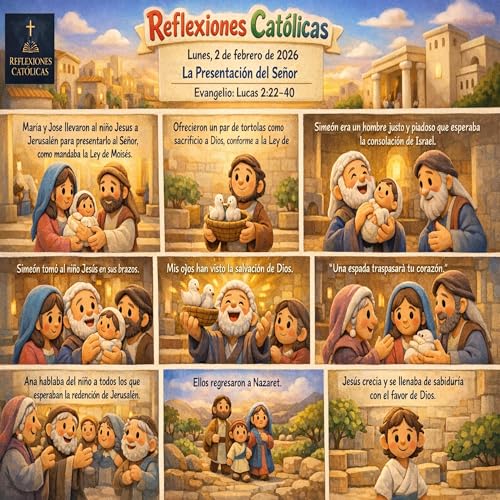
    Este pasaje describe el cumplimiento de los ritos religiosos judíos por parte de la Sagrada Familia tras el nacimiento de Jesús. Al presentar al niño en el Templo de Jerusalén, sus padres se encuentran con Simeón y Ana, dos figuras devotas que reconocen de inmediato la divinidad del infante. Simeon proclama una profecía sobre el papel de Cristo como salvación para el mundo y advierte a María sobre los futuros sufrimientos que enfrentará. El texto destaca cómo la llegada de Jesús representa la luz de la revelación tanto para Israel como para todas las naciones. Finalmente, la narrativa concluye con el regreso de la familia a Nazaret, donde el niño crece fortalecido por la gracia divina.


    ¿Qué simbolizan Simeón y Ana en el relato de la Presentación?

    ¿Cómo se entrelazan la ley judía y las profecías sobre Jesús?

    Explica el significado de la luz y el sacrificio en el templo


    Show More Show Less
    12 mins
  • Catholic Reflections – Monday 2 February 2026, The Presentation of the Lord, Feast, Luke 2:22–40
    Jan 31 2026

    Short Reflection:

    The Presentation of the Lord in the Temple

    The gospel of Luke 2:22-40 details the biblical account of Mary and Joseph bringing the infant Jesus to the Jerusalem Temple to fulfill religious requirements. Following these spiritual encounters, with a righteous man named Simeon and an elderly prophetess named Anna, the family returns to Nazareth, where the child matures in strength and divine grace. This liturgical reading for the Feast of the Presentation, emphasises the transition from ancient law to a new era of revelation. These specific witnesses in the passage underscore the sacred significance of Christ’s early life and his identity as a light to all nations.


    Long Reflection:

    Catholic Reflections – A Light for All Peoples

    Date: Monday 2 February 2026

    Liturgical: The Presentation of the Lord, Feast

    Gospel Luke 2:22-40

    ‘The child grew, filled with wisdom.’

    When the time came for their purification according to the Law of Moses, the parents of Jesus brought him up to Jerusalem to present him to the Lord (as it is written in the Law of the Lord, ‘Every male who first opens the womb shall be called holy to the Lord’) and to offer a sacrifice according to what is said in the Law of the Lord, ‘a pair of turtle-doves, or two young pigeons’.

    Now there was a man in Jerusalem, whose name was Simeon, and this man was righteous and devout, waiting for the consolation of Israel, and the Holy Spirit was upon him. And it had been revealed to him by the Holy Spirit that he would not see death before he had seen the Lord’s Christ. And he came in the Spirit into the Temple, and when the parents brought in the child Jesus, to do for him according to the custom of the Law, he took him up in his arms and blessed God and said,

    ‘Lord, now you are letting your servant depart in peace,

    according to your word;

    for my eyes have seen your salvation

    that you have prepared in the presence of all peoples,

    a light for revelation to the Gentiles,

    and for glory to your people Israel.’

    And his father and his mother marvelled at what was said about him. And Simeon blessed them and said to Mary his mother, ‘Behold, this child is appointed for the fall and rising of many in Israel, and for a sign that is opposed — and a sword will pierce through your own soul also — so that thoughts from many hearts may be revealed.’

    And there was a prophetess, Anna, the daughter of Phanuel, of the tribe of Asher. She was advanced in years, having lived with her husband seven years from when she was a virgin, and then as a widow until she was eighty-four. She did not depart from the Temple, worshipping with fasting and prayer night and day. And coming up at that very hour she began to give thanks to God and to speak of him to all who were waiting for the redemption of Jerusalem.

    And when they had performed everything according to the Law of the Lord, they returned into Galilee, to their own town of Nazareth. And the child grew and became strong, filled with wisdom. And the favour of God was upon him.

    Key Points:

    1. Jesus is presented as an offering

    Mary and Joseph bring Jesus to the Father.

    2. God keeps His promises

    Simeon waited for years, guided by hope. The Spirit brings him to Jesus at the perfect moment.

    3. Jesus is the Light for all nations

    Simeon calls Jesus “a light” for everyone.

    4. The Cross is already foretold

    Simeon’s words to Mary reveal suffering, rejection, and a heart-piercing love.

    5. Faithful prayer recognises Jesus

    Anna’s life of prayer makes her ready to see and proclaim the Messiah. Prayer opens our eyes to God’s presence.

    Concluding Prayer:

    Lord Jesus,

    teach us to offer ourselves to the Father—

    our time, our work, our families, and our future.

    Give us patient faith like Simeon,

    and persevering prayer like Anna.

    When Your path includes difficulty,

    strengthen us to remain faithful.

    Amen.

    Tags: Presentation of the Lord, Feast, Simeon, Anna, Light of the Nations, Candlemas, Holy Family, Temple, Jerusalem, Prayer, Discipleship.


    Show More Show Less
    15 mins
  • Reflexiones Católicas – Jesús enseña las Bienaventuranzas a los niños
    Jan 31 2026

    Las Bienaventuranzas: Jesús nos enseña cómo vivir (para niños)

    Jesús nos enseña las Bienaventuranzas para mostrarnos cómo quiere Dios que vivamos. Nos dice que Dios se alegra con las personas que son amables, humildes, perdonadoras y que tratan de hacer lo correcto, incluso cuando es difícil. Jesús nos ayuda a entender que amar a los demás, buscar la paz y tener un corazón bueno es mucho más importante que ser ricos o famosos.


    Show More Show Less
    5 mins
  • Catholic Reflections –Jesus teaches the Beatitudes to children
    Jan 31 2026

    The Beatitudes: Jesus Teaches Us How to Live (for kids)

    Jesus teaches us the Beatitudes to show us how God wants us to live. He tells us that God is happy with people who are kind, gentle, forgiving, and who try to do the right thing—even when it’s hard. Jesus helps us understand that loving others, making peace, and having a good heart matter much more than being rich or famous.


    Show More Show Less
    5 mins
  • Reflexiones Católicas–Domingo 1 de febrero de 2026, 4.º Domingo del Tiempo Ordinario, Mateo 5,1–12a
    Jan 29 2026

    Fecha: Domingo 1 de febrero de 2026

    Litúrgico: 4.º Domingo del Tiempo Ordinario

    Evangelio: Mateo 5,1–12a

    «Bienaventurados los pobres de espíritu».

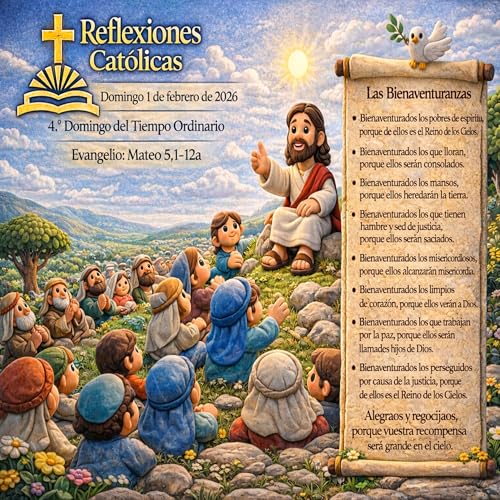
    Este pasaje presenta una serie de enseñanzas fundamentales conocidas como las Bienaventuranzas, pronunciadas por Jesús durante su famoso Sermón de la Montaña. El texto describe un conjunto de cualidades espirituales y morales, como la humildad, la misericordia y la pureza de corazón, que definen a los seguidores de Dios. A través de estas declaraciones, se promete un consuelo divino y una recompensa eterna en el cielo para aquellos que sufren persecución o viven con rectitud. La lectura busca inspirar esperanza y gozo en los fieles, asegurando que las dificultades terrenales serán transformadas en bendiciones espirituales. En última instancia, el escrito sirve como una guía ética que redefine el concepto de felicidad desde una perspectiva cristiana.


    ¿Qué significa alcanzar el reino de los cielos según Jesús?

    Explica la relación entre el sufrimiento humano y el consuelo divino.

    ¿Cómo transforman las bienaventuranzas la visión tradicional del éxito y poder?


    Show More Show Less
    12 mins
  • Catholic Reflections – Sunday 1 February 2026, 4th Sunday in Ordinary Time, Matthew 5:1–12a
    Jan 29 2026

    Short Reflection:

    The Beatitudes: Divine Promises on the Mount

    This liturgical reading presents a foundational passage from the Gospel of Matthew, commonly known as the Beatitudes. While addressing a large gathering from a mountainside, Jesus Christ outlines a revolutionary set of spiritual virtues and their corresponding divine rewards. The text promises heavenly comfort and inheritance to those who experience earthly suffering, such as the mournful, the impoverished, and the persecuted. By emphasizing qualities like mercy, purity of heart, and peace-making, the passage redefines success through a lens of righteousness rather than worldly power. Ultimately, the source serves as an encouragement for believers to find joy in hardship, assuring them of a significant eternal compensation for their devotion.


    Long Reflection:

    Catholic Reflections – Blessed Are You

    Date: Sunday 1 February 2026

    Liturgical: 4th Sunday in Ordinary Time

    Outline:

    • Opening prayer

    • Gospel reading (paraphrased for easy listening)

    • Reflection on the Beatitudes as the path of true happiness

    • Key points for discipleship

    • Concluding prayer

    Gospel – Matthew 5:1–12a (paraphrased):

    When Jesus saw the crowds, He went up the mountain. He sat down, and His disciples gathered around Him. Then Jesus began to teach them the way of the Kingdom—what real blessedness looks like.

    He said that the poor in spirit are blessed because the Kingdom of heaven belongs to them. Those who mourn are blessed because God will comfort them. The meek are blessed because they will inherit the earth. Those who hunger and thirst for what is right are blessed because they will be satisfied.

    Jesus said the merciful are blessed because they will receive mercy. The pure in heart are blessed because they will see God. Peacemakers are blessed because they will be called children of God. And those who are persecuted for doing what is right are blessed because the Kingdom of heaven is theirs.

    Jesus added that when people insult you, oppose you, and speak falsely against you because of Him, you should not lose heart. Instead, rejoice—because your reward with God is great.

    Key Points:

    1. The Beatitudes redefine “success”

    Jesus calls “blessed” what the world often ignores: humility, gentleness, mercy, purity, and perseverance.

    2. Poor in spirit means open-handed faith

    It is recognising our need for God and relying on Him—not on pride, control, or self-sufficiency.

    3. God is close to the suffering

    “Those who mourn” are not abandoned. God’s comfort is real, tender, and promised.

    4. The Beatitudes form the heart of a disciple

    Mercy, purity, peacemaking, and longing for righteousness are not optional extras—they are the shape of Christian life.

    5. Joy in persecution is supernatural

    Jesus does not glorify pain, but He promises meaning, grace, and reward when we remain faithful under pressure.

    Concluding Prayer:

    Lord Jesus,

    You taught us the Beatitudes—

    the path of true happiness and the way of the Kingdom.

    Make us poor in spirit: humble and trusting.

    Comfort us when we mourn,

    and help us to comfort others.

    Teach us meekness without weakness,

    and hunger for righteousness without compromise.

    Fill us with mercy,

    purify our hearts,

    and make us peacemakers in a divided world.

    When we are misunderstood or opposed for doing what is right,

    give us courage, joy, and perseverance.

    May Your Beatitudes be written in our lives,

    so others may see Your light through us.

    Amen.

    Tags: Catholic, Ordinary Time, Matthew 5, Beatitudes, Sermon on the Mount, Blessed, Poor in Spirit, Mourning, Meekness, Righteousness, Mercy, Pure in Heart, Peacemakers, Persecution, Discipleship, Prayer, Daily Gospel, Catholic Podcast, Catholic Reflections


    Show More Show Less
    19 mins