• Welcome to Coach Listens with Coach Pete
    Oct 15 2026

    Meet Coach Pete and hear why he shares these conversations. This short introduction features archive highlights from retirement author Tom Hegna, Pro Football Hall of Famer Terrell Davis, and bestselling author Jen Sincero—on income for life, consistency, and taking action.

    Call 800-661-7383 or text PLAN to 600-700.

    Hear the full conversations:

    • Tom Hegna: Don't Worry, Retire Happy and Income for Life
    • Terrell Davis: The Four-Yard Run, Football, and Financial Discipline
    • Jen Sincero: Making Money and the Mindset of Wealth (Full Interview)

    Produced October 15, 2026, from finished Coach Listens interview audio.

    Transcript

    Automatically transcribed from this episode; timestamps are approximate.

    00:00 I talk to very interesting people, and the most important part is that I shouldn't be the only one hearing it.

    00:05 I really feel that if these people make sense to me, that everyone out there needs to hear it.

    00:10 A successful retirement really has two key components.

    00:14 Number one is increasing income for the rest of your life, and number two is risk management.

    00:20 So my coach, when I got to the NFL, said, hey, man, we're not trying to have the long runs.

    00:26 If you break a long run, that's great.

    00:28 But what we want is consistency.

    00:29 We want to be able to say, what is repeatable?

    00:33 Absolutely, and it's because your mindset is what propels you to take action.

    00:38 So if your mindset is focused on, I can't, it's impossible, it's going to be hard and no fun, your actions are going to reflect that, and you're going to get very, very much nowhere.

    00:52 And very, very quickly.

    00:54 800-661-7383 is the number to call.

    00:56 800-661-7383.

    00:59 You can also text keyword plan to 600-700.

    01:02 Keyword plan to 600-700.

    See omnystudio.com/listener for privacy information.

    Show More Show Less
    1 min
  • Mike Milligan: QLACs, Annuity Choices, and the Total Retirement Picture (Part 4)
    Sep 4 2026
    Coach Pete D’Arruda and Mike Milligan discuss qualified longevity annuity contracts, retirement-account withdrawal requirements, and the differences among annuity products. They consider why evaluating a financial product requires more than a blanket endorsement or rejection, and why income, access to money, growth, and personal goals need to work together. Part four of their Financial Safari conversation.Call 800-661-7383 or text PLAN to 600-700.TranscriptAutomatically transcribed from this episode; timestamps are approximate.00:00 Welcome back into the Financial Safari. Loving the conversation today. I'm Thomas Lipscomb in studio with bestselling author Coach Pete D’Arruda, also joining us today, host of the One of a Kind Financial Show. He's an author. Mike Milligan, catch up on the show by heading over to FinancialSafari.com. Hey, Mike, do you do any QLACs? Yeah, I've been doing QLACs for like the last 11 years. Oh, okay, yeah. A lot of people don't understand them, so we don't talk about them too many times on the show. QLAC stands for Qualified Longevity Annuity Contract. Yep. You know, you've lived in a world for so long where you've deferred, deferred, deferred, and then all of a sudden you hit an age, and the IRS and the government says it's time to take a required minimum deposit. And you notice I say deposit there, right? Yep. Not distribution. Correct.00:45 Because it's a required minimum deposit back to their company, right, to the IRS first, right, in taxes, and then you get what's left over. The required minimum deposit that goes to the IRS in the form of taxes is because they're your business owner. So what a QLAC allows you to do is take a little bit of your IRAs, a little bit of your 401k money, and defer it out a little bit longer so those RMDs don't begin, you know, to as late as 85. Yeah. And most find it. You know, the interesting thing about QLACs, Pete, is most firms don't even know they exist. They, they, and then, and then when they hear the word that it's QLAC and they hear annuity, they're like, oh, that's bad. It's got to be bad. It's not bad, folks.01:31 Right? It's, it's longevity insurance. Right? It's a promise. Yeah. But Pete, did you find the name of the book? Yeah, Quiet Place. Quiet Place. And it's, it's a book about the QLAC, but it's also about how to, how to make sure you have the lifetime income. Now, here, here's one of the misconceptions about QLACs. It's a funny name. It sounds like Aflac a little bit. Yes, it does. That's what I thought. A duck. But a lot of people thought, Mike, and this is a misconception, and I think it's been fertilized by some people who, who don't want you to put money in a QLAC, fertilized, in other words, growing the rumor, the bad rumor, is that you could not touch the money once you put it in until age 85. But the, that's the exact opposite. You have to start taking the money by age 85. You could put it in today at age 65 and take it, start taking it out at age 66.02:18 Correct? Yeah. It is. Yeah. You know, the technical, I mean, what a QLAC really technically is, is a deferred income annuity. That's really all it is. Zadia. Right? It just has contract language from the IRS code that allows you to avoid RMD on that for a long period of time. It's a good way to pay less RMDs if you're not needing the money. Then put it in a long-term contract where the government can't touch it. Makes sense. And guess what you could do if you, and guess what you could do if you don't need the RMDs? You could use it for something like maybe a Roth conversion. A lot of people do that. Or, you know, you could lower, yeah, I mean, you could lower your tax bracket. The other thing that most people don't realize, too, about, like, later in life is your medical expenses are going to be a whole lot higher. They're just going to be higher when you're that age. And that's going to be for most people, not for everybody, but they're going to be higher.03:04 The good news is if your medical expenses are over 7.5% of your total income, guess what? You get to itemize that. Right? So there's a potential for even that QLAC income when it starts at 85 to be tax-free if you're using it for medical. QLAC, to me, is also, like, it's just another way to, like, protect long-term care without necessarily having to pay the premiums of long-term care insurance. It's a great strategy to use. You can self-protect yourself or self-fund yourself if you put enough money away. Self-fund. That's exactly right. That's a good way. And you're not paying tax every year on it while you're deferring, which is a very big part. That's right. Compared to anywhere else people have money, you're going to get taxed every year on that. So this way you're not. Exactly. I want to jump in and ask, what happens to a spouse or beneficiary when the person who owns the QLAC passes?03:54 It goes to the beneficiary. It's still an IRA, right? So it hasn't mysteriously gone to some new world of ...
    Show More Show Less
    14 mins
  • Mike Milligan: A Retirement Plan That Fits Your Life (Part 3)
    Sep 4 2026
    Mike Milligan continues his conversation with Coach Pete D’Arruda about matching a retirement strategy to the person who will live with it. They discuss risk, the tendency to rely on familiar products, and lessons from past planning conversations. Hear why the group favors reviewing the full picture rather than treating every retirement decision as a separate transaction. Part three of their Financial Safari conversation.Call 800-661-7383 or text PLAN to 600-700.TranscriptAutomatically transcribed from this episode; timestamps are approximate.00:00 And welcome back into the Financial Safari, having a great conversation today. I'm Thomas Lipscomb in studio with America's Wealth, Financial, and Income Coach, Coach Pete D’Arruda. Also joining us from Puerto Rico, Mike Milligan of One Oak Financial. Thomas, let's give a couple of websites out. Yes. I'm going to give one, and I want you to give it. We have so many. I love it. We really need one site where people go and have all our sites on there. We're going to do that. Master site, yes. We're going to do the master site coming up. Let's do it. Coach Pete's master site. Let's do it. But right now, we don't have it. Until then. But we're going to. So you see, you're getting a look inside my mind right now, folks. I've got over 700 domains, Thomas. I'm sure we can find one. I'm sure. So the one I want to give out is a very good one. It's about my new book, Modern Planning. But the site is planonceplanforlife.com. Planonceplanforlife.com.00:47 Go there. You can download the e-book right now. We're working on an audio book coming up. But right now, you can download the e-book by going to planonceplanforlife.com. It's about 250 pages. And it really puts things in perspective about lifetime income. We're talking about today. The financial termites. How much 2% or 3% fees can cost you as far as what you could have had in your retirement and what you don't have in retirement. And making sure that you have income you can't outlive. Principle that cannot lose due to the market. That's important, too, by the way. Yes, it is. A floor under the spouse. In other words, making sure your spouse always gets income even if you're not here anymore. Ah, yes. And so that's what I call a floor under the spouse. Not knocking your spouse on the floor. And making sure your money isn't doing nothing. It is doing something. It needs to be doing something at all times.01:33 Going up, not down. So planonceplanforlife.com. Now, what do you want to say? I love it. So the one I am going to focus on is a great do-it-yourself tool at asapplan.com. That's asapplan.com. As you folks know, if you're a regular listener to the show, Coach Pete has a 22-step total retirement plan process. And what we want to do is to try to enable you to take those steps yourself. Kind of figure out what are you missing? What do you have in hand? What questions do you need to be asking? We are developing a new electronic device. It's a calculator on steroids. But take your time. Go over there. I personally would love to hear your feedback. I'm helping develop this. And we want to make sure it's a tool that's beneficial to you. And again, that's at asapplan.com. Again, asapplan.com.02:18 And we also are keeping track of when you go there because we're going to give an award of a $100 gift card to Ruth Chris for people that go there and give us any feedback. So we're going to draw the name out here in a couple weeks on the show. There you go. Help me out and I'll help you out. asapplan.com. You can't win unless you go and visit and let us know you visited, right? So that's kind of... That's it. That's what Mike thinks. What else? We've got financialsafari.com too if you want to ask a question on the show. Always. Yeah. If you want to ask a question or just catch up on podcasts, check out the television show. And that leads into the Financial Fill-Up Challenge. If you go to financialfillup.com, we would love to have contestants or audience members for our financial game show. You can also subscribe to the channel. Check out our past episodes. It's a really, really fun game show. A great way to look at retirement. Find out how much you actually know about the process.03:04 We film episodes every three weeks, folks. So call, get on the list. Either be a contestant or if you want to be in the live studio audience. A lot of good giveaways there during the show too. Oh, it's fun. Yeah, we get gift cards we give away for winners too when they win. Yes, we do. And hey, it's a great way to learn the financial world rather than sitting in class trying to learn it. There you go. Hey, Mike, if you ever ask this question to somebody, you say, when the market had its worst week in years, did you have a single dollar sitting somewhere that you couldn't lose a dime? Oh, that's a great question. I mean, it's a fantastic question and one that a listener should listen to, right? Is, you know, I've never asked anybody that ...
    Show More Show Less
    12 mins
  • Mike Milligan: Income Riders and Questions to Ask Before Retirement (Part 2)
    Sep 12 2026

    Coach Pete D’Arruda and Mike Milligan discuss dedicating part of a retirement plan to income and understanding how an income rider works. They examine why a saver’s priorities can change near retirement, the importance of asking how a strategy is structured, and the difference between product recommendations and a plan built around a client’s needs. Part two of their September 12 Financial Safari conversation.

    Call 800-661-7383 or text PLAN to 600-700.

    See omnystudio.com/listener for privacy information.

    Show More Show Less
    13 mins
  • Mike Milligan: The Retirement Asset Beyond Your Account Balance (Part 1)
    Sep 4 2026
    Mike Milligan of One Oak Financial joins Coach Pete D’Arruda and Thomas Lipscomb to discuss retirement income as an asset. They explore the difference between an account balance and a plan for monthly spending, the uncertainty of market returns, and the role income can play in supporting a retirement lifestyle. Part one of their Financial Safari conversation.Call 800-661-7383 or text PLAN to 600-700.TranscriptAutomatically transcribed from this episode; timestamps are approximate.00:00 Welcome into the Financial Safari. Excited for our show today. I'm Thomas Lipscomb in studio alongside bestselling author Coach Pete D’Arruda. And joining us, we have on the line Mike Milligan, founder of One Oak Financial, host of One of a Kind Financial Show, and a friend of the show as well, a friend of Coach Pete's for a very long time. Hey, Mike, how you doing? I'm good, Pete. How are you? Good. Hey, Thomas, tell everybody where Mike is joining us from. So Mike is joining us from the beautiful land of Puerto Rico. Oh, Michael would say beautiful, right? Is it beautiful down here today? Oh, my gosh. It's 84. It's 84, 85 every day. It's absolutely gorgeous down here. And it's a little bit of a breeze. We haven't had that heat that you guys have had back in North Carolina, right? That has just kind of been stifling over the last month or so.00:46 It's been crazy. Same every day. Same every day. Watching the U.S. Open on TV the other day. And the players who aren't used to humidity, like even in the first set, they were like, they look like we're getting ready to die. We're used to this, Mike. I mean, I worked in the watermelon fields one year when I was in high school. And remember, I'd been working in the fields back in the day. I don't know if you ever did that. But you're a Scotland County guy, too, by the way, aren't you? Yeah, yeah, that's right. That's right. Coach Willard. Yeah, Coach Willard. Willard's watermelon. So a little history, folks. Mike Milligan there. My mom taught him seventh grade, and we found that out a couple years ago when we met. I didn't know who he was because I'm a little older. But my mom taught you, and that's pretty funny. That's funny, yes. That's right. Small world. Ten years different in age. We ran the same streets. As a matter of fact, we were talking, you know, before the show today,01:33 we were talking about just some things, you know, that happened back in Scotland County. Good old LBG. You had to make your own fun back in the day. Yes, you did. The good thing there was no social media to tell everyone about the fun you were making. Yeah. Nowadays, kids are getting into trouble. They post everything. Thomas, we always talk about, like, Pete and I, when we went through elementary, middle school, and high school in Scotland County in North Carolina, North Carolina was the 50th ranked school in education in the nation. Oh, wow. I didn't know that. Wow. There are 100 counties in North Carolina. Scotland County was 100th. So we literally got the worst education in America. The lowest below. Wow. Hey, you're talking junk about my mom? And yet, here we are. The college goes back in the road.02:20 You cannot be serious. Be serious. I said U.S. Open. So might as well play a little macro there. No, I mean, it is. My mom took it serious. My dad was a college professor. But, yeah, unfortunately, they don't put in. Well, back in the day, we had the mobile home classrooms, and we had the cinder block schools. Look at these Taj Mahals they're building now. I think they're putting money into the wrong places these days. Instead of building big buildings, they should build big mines. That's good. I like that. And the problem was is, like, when your mom had us in her class, right, there were 28 middle school kids in there, right? And we were more worried about, like, man, that girl looks good now because hormones were kicking off. Right? We weren't worried about, like, you know, Pythagorean's theorem or, you know, the atomic symbol of hydrogen. Right? We just weren't interested in it.03:06 We were interested in what we're going to do in the field later today and what we're going to do in the break. Unless you're going to be a chemist in the future, it really doesn't matter what the atomic symbol of hydrogen is. It's more important to worry about life. And what the most important thing is is to establish a plan in your life, even if you're not the kind of person that likes to write things down, at least have it in your mind. And when we do a plan, Mike, we like to call it Plan Once, Plan for Life. And it's how to give every dollar you own a color and a job and put a check back in your mailbox every single month for as long as you live when you retire. And stop the quiet leaks that have been eating your money alive while you weren't looking. Those are called financial termites. We put a plan together. We eliminate those financial termites, which could save you 2% to 3% to even 4% hidden fees a ...
    Show More Show Less
    13 mins
  • Phil Graham: Medicare Premiums, Social Security Taxes, and Quiet Costs (Part 4)
    Sep 2 2026
    Coach Pete D’Arruda and Phil Graham examine costs that can quietly reduce a retirement paycheck. Topics include Medicare’s income-related premium adjustments, taxes on Social Security benefits, Roth conversion considerations, and the cumulative effect of investment fees. They discuss why understanding these rules before making withdrawals can help frame a more useful conversation with your financial and tax professionals. Part four of the Financial Safari interview.Call 800-661-7383 or text PLAN to 600-700.TranscriptAutomatically transcribed from this episode; timestamps are approximate.00:00 Welcome back into the Financial Safari. Consumer advocate Thomas Lipscomb here with you alongside Phil Graham, special friend of the show here alongside bestselling author, America's Wealth, Financial, and Income Coach, Coach Pete D’Arruda. Get your own questions answered or tune in to past episodes and check out all of our free resources by heading over to FinancialSafari.com. Again, that's FinancialSafari.com. And don't forget to subscribe to us on YouTube. FinancialSpeakeasy.com is the way to get there. Again, that's FinancialSpeakeasy.com. We're releasing new videos all the time. Great way to make sure that you are up to date on what you need to know heading into retirement. Let me give you one more site while we're doing it. PlanOncePlanForLife.com. That's where you can, if you go there right now, we'll send you one of these e-books out right away. The Modern Planning, PlanOncePlanForLife.com.00:47 Thomas, there's five, and Phil, and everybody else out there in Radio Land, there are five quiet drains on your retirement paycheck, all right? These are quiet assassins. We don't like quiet assassins when it's touching our money. None of these is a scam, and nobody's going to call you about them. Every one is a rule working exactly the way it was written, and every one of them is far easier to deal with before it applies than after. Very, very important. That's why we're going to talk about it. That's good. Now, I've sat across the table from people who did everything right. They saved steadily. They stayed out of debt. They retired with more than they needed, and still watched a few thousand dollars a year walk out the door for reasons they never saw coming. So we're going to talk about what they are. And it's not because anyone cheated them, Thomas and Phil and everybody out there. It's because a threshold moved past them, or a look back caught them, or a rule that they had never heard of finally applied.01:42 That always stinks to be zinked by something like that. So what follows? We're going to talk about the five I see the most, the five quiet drains on your portfolio. And all the figures are 2026 figures that we're going to talk about here. So they're pretty up-date. But the first one is something that, Phil, we've talked about this, Thomas, as well, off show. And it's one that came out of nowhere. It's called your Aunt Irma. I-R-M-A-A look back. Thomas, not a good thing. Doesn't sound like a good thing. And when I first heard this word, I thought, because my wife is from Holland. Hold on. I feel like I've heard that as a name before. All right. Let me tell you what it stands for. It stands for Income-Related Monthly Adjustment Amount. In plain language, it's your income. If your income is above a certain line, you pay more for Medicare Part B and D.02:31 And these are two things about it that catch people. All right. The two big things. First, it looks backward two years. So your 2026 Medicare premium is set by your 2024 tax return. Whoa. Now, a lot of people didn't realize that. No, that's interesting. And not this year's income. Not last year's. The one you filed in 2025 for the year 2024. Talk about confusing. Phil, what do you think about that? Can you repeat the question? Can you just listen to it? I was listening to the years, and in my brain, I'm trying to track. And then that last part, I'm like, now I'm lost again. I don't know. That was the correct answer right there. You're lost. Yeah, I can't figure it out. Yeah. So keep in mind, if 2024, we're talking about 2024 and you're in retirement now, possibly03:18 that was your last full year of work. Or the year you sold a rental property. Or the year you did a large Roth conversion. And now it puts you way over that threshold. And second, it is a cliff, not a ramp. You know, ramps are easy to deal with because they're slow and steady and gradual. A cliff. Now, I've never jumped over one or walked through one or walked over one of you. You wouldn't be here. Exactly. No. You know, I think of those movies, though, where you see all the buffalo or wherever it is, and they're following each other, and they'll just go right over this. Yeah. So what do I mean when I say a cliff? Well, there's no gentle phase in. One dollar over the line. One dollar over that line that they say, the line of demarcation. Just one dollar. And the full surcharge applies ...
    Show More Show Less
    12 mins
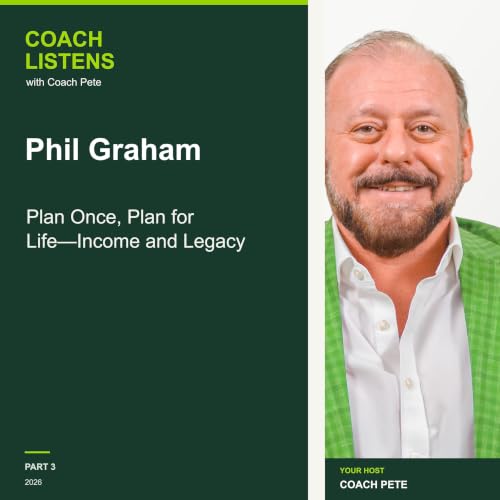
  • Phil Graham: Plan Once, Plan for Life—Income and Legacy (Part 3)
    Sep 2 2026
    Phil Graham and Coach Pete D’Arruda connect retirement income with the broader work of estate and legacy planning. They discuss the shift away from employer pensions, the stress of repeatedly second-guessing investments, and why a written strategy should explain how monthly income supports the rest of a plan. The conversation returns to beneficiary forms, financial blind spots, and reviewing costs before they erode savings. Part three of the Financial Safari interview.Call 800-661-7383 or text PLAN to 600-700.TranscriptAutomatically transcribed from this episode; timestamps are approximate.00:00 Welcome back into the Financial Safari. I'm having a great conversation. Thomas Lipscomb here with you alongside bestselling author, Coach Pete D’Arruda. Also in studio with us, veteran of the financial arena, financial strategist, Phil Gramming. Have a great conversation. If you want to catch up on it, just head over to FinancialSafari.com. Again, that's FinancialSafari.com. Not only can you catch up on this episode, you can catch up on past episodes, as well as check out all of the great resources Coach has made available right there, FinancialSafari.com. Yeah, I wrote a book called Plan Once, Plan for Life. Modern Planning. And modern planning, what is that? Well, I mean, our planning now, Phil, is a lot different than what our grandparents were planning because our grandparents had a pension. That's right. Most people listening now don't. And so this modern planning techniques, and if you're going to plan and spend all the time putting a plan together.00:46 Thanks to the government. Yeah. But if you're going to spend all this time putting a plan together, do it once and don't worry about it anymore. So Plan Once, Plan for Life is our motto here. And let me ask you this question out there in Radio Land. Listen, how many times a year do you catch yourself checking, worrying, and second-guessing your money? And be honest with yourself. Now, if your spouse is right next to you, don't give it away with a look on your face because you might be in trouble. But I really think I worry about money. Thomas, you ever worry about money? Oh, certainly. I mean, who doesn't worry about money? Oh, yes. But the worries need to have some action attached to it. Worrying all the time is not good. That's what they call the – something called an ulcer develops if you do that. So what we need to do is get rid of that. And how do you get rid of it? Well, you don't go see a pharmacist because they'll give you drugs for it, right? And then that covers it up.01:32 That really doesn't get rid of it. How you get rid of it is you rearrange your money. There you go. We're not talking about a Titanic, Thomas, by the way. You know, rearranging the furniture on the deck, was that a good job? It doesn't matter. It doesn't matter. So that's what happens a lot of times when people say, well, yeah, I'm just going to move from this brokerage house to this other brokerage gal. Well, that's just rearranging the furniture on the Titanic because the money is still all at risk. Correct? It's true. It is very true. And what was your point? And something else that you've mentioned in the past is paralysis by analysis where people get confronted with this, I think, of a tsunami coming at you and just don't know where to tackle it. And that can be very frustrating when you don't have a professional with you. Yeah. Well, it makes a lot of sense. So here's a question. Remember full service, Phil, at the gas station? Yeah. I think even in New Jersey, they still do that.02:18 They still do. Yeah, they do. So you drive up, go over that little thing, and then that little bell would ring. I remember back in the day, of course, I was little Pete back in the Ambassador Station Wagon days with the wood panel. It looked like Chevy Chase's station wagon. Dad would buy them from the state auction. They were cheaper, like they were state cars. But we'd pull in, and Mom would be driving, and I think Bob or Jeff would be in front. I like to be in back so I could stay out of trouble. Mom didn't see what I was doing a lot of times. But we'd pull in, and two guys would run out. They would pop our trunk. They'd check the oil. They'd refill the windshield washer stuff, and they would fill the car up. And we didn't have to get out. And so that same kind of theory is what we built the financial fill-up strategy around. And let me ask you this question. What if filling up your retirement income worked like filling up your car?03:07 You just pull in, and they top it off once a month, and it just keeps running all the way through your life. That's the everlasting gobstopper in the financial world. Remember Willy Wonka? Yeah. Yeah, I could get bored with the same candy, though, wouldn't you? I would. What if it kept putting new flavor, I guess? Remember the everlasting gobstopper? I mean, as a candy connoisseur, Thomas, growing up, I loved to watch Willy Wonka chocolate fag. ...
    Show More Show Less
    12 mins
  • Phil Graham: The Beneficiary Forms Your Will May Not Control (Part 2)
    Sep 2 2026
    Coach Pete D’Arruda and Phil Graham discuss why a will does not necessarily decide who receives every account. They explore beneficiary designations, payable-on-death and transfer-on-death arrangements, life insurance, and the problems that can follow outdated paperwork. Hear the questions they suggest asking when reviewing who is named on your accounts and how those choices fit your family’s legacy plan. Part two of the Financial Safari interview.Call 800-661-7383 or text PLAN to 600-700.TranscriptAutomatically transcribed from this episode; timestamps are approximate.00:00 Welcome back into the Financial Safari. Having a wonderful show today. I'm Thomas Lipscomb here in studio with bestselling author, Coach Pete D’Arruda. We also have Phil Graham on the line, a friend of the show, who has been a financial strategist for going on 30 years. Coach, you have such great friends. Well, yeah, I keep good friends around. If they're very nice people, then I get along good with them. They're not trying to jump off a bridge, right? No, we don't want any of that. You know, we talked, I teased people before we left. I said six accounts that never read your will. And that's a strange way to look at it, but what does that mean? Well, you spend a lot of money on a will or even a trust, and some accounts that don't depend on that or don't even look at it, or you can bypass that. And so people spend real money on a will and then assume it governs everything they own. For a great many households, it governs almost none of it.00:48 In other words, it doesn't really handle much at all. So the largest accounts pass from a form somebody filled out years ago. It's a form you fill out when you get in certain things. We're going to talk about that. And the will never gets a vote. In other words, there's some ways to bypass that will or trust. This is not a loophole, and it's not a mistake in the law. It's just how these accounts were designed to work quickly, privately, and outside of court. That's a good thing, by the way. The trouble is that the form is usually signed on the first day of employment, filed away, and never looked at again through a marriage, a divorce, a death, and 30 years of life. So, Phil, in other words, the 20-year-old Coach Pete has nothing to do with the 60-year-old Coach Pete. Right? A whole different thing. What if I had filled out a form when I was 23 and I started a 401K with a company, and now I'm 60?01:36 I don't remember filling that form out. I don't remember what I did yesterday these days sometimes. What I had for dinner, that kind of thing. So there's six accounts, though, that you can buy. This is a good thing. I set it up to make it sound like it was maybe mysterious or not good. These are good things to bypass the court, bypassing probate and bypassing even trust a lot of times. You have to know what forms. A lot of people write all the language in the will or trust, but no one will ever read that because they filled out a form that bypasses it. So, Phil, do you want to give one of the six that don't depend on the trust or will? I would say probably 401K because it has a beneficiary. Exactly. But the real question is, do you know who the beneficiary is you have on your 401K? Could be an ex-spouse.02:22 Is it your ex-wife? Yeah. So you never know. That's why we encourage people to review your beneficiary forms. And a lot of people don't even remember filling it out. But once a year, if you can, at least every five years. And when we get closer to retirement or in retirement, maybe every year because things speed up. That's right. I mean, years seem to go faster. So 401Ks, 403Bs, and TSPs. Now, TSPs are the Thrift Savings Plan. We've got a brand new book out called Thrift or Thrive. And if you're a federal employee, you really need to get your hands on this. And by the way, I love federal employees, Thomas. That's our mail people, and they do a great job. Anyone who works for FBI people. I love my FBI people. Don't want to get mad at me. But, you know, federal employees, you spend all your time. I mean, think about the mailmen and women. They're working seven days a week now, it seems like.03:07 I'm getting mail all the time. So I really appreciate them. So I want to donate to them my appreciation. I've got the book, Thrift or Thrive. If you are a federal employee, all you have to do is call now, and I will send you a copy of this book. It's over 100 pages of very helpful tips and techniques to make sure you can maximize and truly benefit from your retirement plan and make sure you're doing the right things. So, Thomas, federal employees, the next 20 right now. All right, folks, just call 800-661-7383, 800-661-7383, or you can text keyword free to 600-700. That is keyword free to 600-700 because, Coach, great gift here. Yeah. Phil, this is just a fun topic to me because this is talking about bypassing probate. We've heard that phrase before. I just rephrased it a little bit. But ...
    Show More Show Less
    12 mins