• Has the Middle East Benefitted from the Abraham Accords?
    Oct 7 2026
    It's been six years since the Abraham Accords were signed and like so much in the Middle East, their impact and future are very much an open question. The agreements were originally aimed at normalizing relations between Israel and several Arab states. But analysts debate whether they have strengthened regional cooperation and security, or contributed to greater instability in the Middle East. Welcome to Counterpoint, where we take one big question facing world leaders and look at it from opposing points of view. In this episode, we’re asking: Has the Middle East benefitted from the Abraham Accords? Arguing in favor is Steven A. Cook, senior fellow for Middle East and Africa studies at the Council on Foreign Relations, and a columnist at Foreign Policy. Arguing against is Matt Duss, executive vice president at the Center for International Policy and a former foreign policy advisor to U.S. Senator Bernie Sanders. He recently co-authored the piece “How the Abraham Accords Fueled a New Era of Conflict” with Zuri Linetsky. Counterpoint is a production of Foreign Policy, in partnership with the Doha Forum. The show is hosted by FP deputy editor Nick Danforth. Learn more about your ad choices. Visit megaphone.fm/adchoices
    Show More Show Less
    42 mins
  • Is a Confrontational Approach With Iran Necessary?
    Sep 30 2026
    Last week at the United Nations, U.S. President Donald Trump made clear that another round of war with Iran was on the table. But after more than 200 days of conflict, what else can the United States do to force the Iranian leadership to reopen the Strait of Hormuz and abandon nuclear enrichment? Welcome to Counterpoint, where we take one big question facing world leaders and look at it from opposing points of view. In this episode, we’re asking: Is a confrontational approach to Iran necessary? Arguing in favor is Matt Kroenig, a professor at Georgetown University and former U.S. Defense Department strategist. And to argue against this is Trita Parsi, a co-founder of the Quincy Institute for Responsible Statecraft and former president of the National Iranian American Council. Counterpoint is a production of Foreign Policy, in partnership with the Doha Forum. The show is hosted by FP deputy editor Nick Danforth. Learn more about your ad choices. Visit megaphone.fm/adchoices
    Show More Show Less
    47 mins
  • Can the U.S. and China Build a Stable Relationship?
    Sep 23 2026
    This week, Chinese President Xi Jinping is in Washington to meet with U.S. President Donald Trump. Trade, technology, and Taiwan are all expected to be on the agenda. It’s the two leaders’ second meeting in less than six months, as they try to stabilize the future of U.S.-China relations. Many fear tensions are brewing, but with their tariff war in the past, could it be possible for the world's two biggest economies to work together? Welcome to Counterpoint, where we take one big question facing world leaders and look at it from opposing points of view. In this episode, we’re asking: Can the United States and China build a stable relationship? Arguing in favor is Jessica Chen Weiss, a professor of China studies at Johns Hopkins University and a former senior advisor at the U.S. State Department. Arguing against it is Zack Cooper, a senior fellow at the American Enterprise Institute, where he studies U.S. strategy in Asia and U.S.-China competition. He is also a former staffer at the U.S. National Security Council. Counterpoint is a production of Foreign Policy, in partnership with the Doha Forum. The show is hosted by FP deputy editor Nick Danforth. Learn more about your ad choices. Visit megaphone.fm/adchoices
    Show More Show Less
    41 mins
  • Has NATO Expansion Made Europe Safer?
    Sep 16 2026
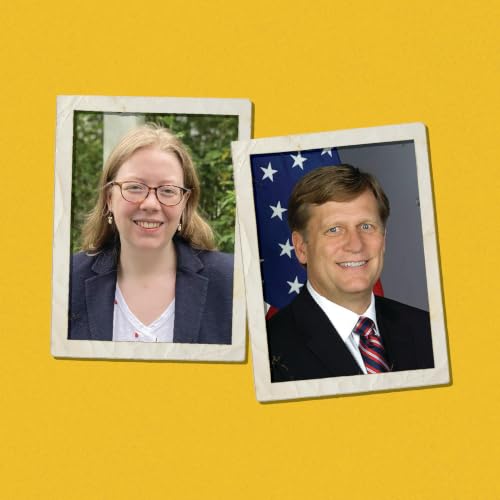
    NATO was created after World War II to deter the Soviet Union and protect Western Europe. But the trans-Atlantic organization did not disband after the collapse of the Soviet Union in 1991. In fact, in the years since, its membership has doubled to include countries in Eastern Europe and eventually Finland and Sweden. Supporters say the expansion helps protect countries from Russian aggression and makes Europe safer. But critics argue that NATO’s growth has provoked a confrontation with Vladimir Putin. Welcome to Season 3 of Counterpoint, where we take one big question facing world leaders and look at it from opposing points of view. Our host this season is Nick Danforth, a deputy editor at Foreign Policy. To launch the season, we’re asking: Has NATO expansion made Europe safer? Arguing in favor is Michael McFaul, a former U.S. ambassador to Russia and a political science professor and senior fellow at Stanford University. Arguing against is Emma Ashford, a senior fellow at the Stimson Center and an assistant professor at Georgetown University. Ashford is also a columnist at Foreign Policy. Counterpoint is a production of Foreign Policy, in partnership with the Doha Forum. Learn more about your ad choices. Visit megaphone.fm/adchoices
    Show More Show Less
    45 mins
  • Counterpoint Season 3: Trailer
    Sep 15 2026
    The world at this moment is more fractured than it’s been in decades: more wars, more extremism, and deeper disagreements on a range of issues. On season 3 of Counterpoint, we get to the heart of those disagreements with a series of debates—hosted by Nick Danforth, a deputy editor at Foreign Policy magazine. Nick brings together two of the smartest people in their field on each episode, to face off over the world’s most vexing questions, including: Are the U.S. and China on a collision course? Has NATO expansion made Europe safer? And will AI destroy the world? Counterpoint is a production of Foreign Policy, in partnership with the Doha Forum. Learn more about your ad choices. Visit megaphone.fm/adchoices
    Show More Show Less
    2 mins
  • Live from Doha with Hillary Clinton
    Dec 11 2025
    On a special bonus episode of Counterpoint, FP editor in chief Ravi Agrawal sits down with former U.S. secretary of state Hilary Clinton on the main stage of this year’s Doha Forum to discuss the Trump administration’s newly released National Security Strategy, what Congress needs to do better, the ongoing conflicts in Gaza and Ukraine, and more. Counterpoint is a production of Foreign Policy, in partnership with the Doha Forum. Learn more about your ad choices. Visit megaphone.fm/adchoices
    Show More Show Less
    31 mins
  • Live from UNGA80 with Kaja Kallas
    Sep 24 2025
    On a special bonus episode of Counterpoint, FP editor in chief Ravi Agrawal sits down with Kaja Kallas, the European Union’s top diplomat, on the sidelines of the United Nations’ annual meetings to discuss relations with Washington, Russia’s war in Ukraine, recognizing Palestine, and dealing with China. Counterpoint is a production of Foreign Policy, in partnership with the Doha Forum. Learn more about your ad choices. Visit megaphone.fm/adchoices
    Show More Show Less
    36 mins
  • Did the Dayton Accords Set Bosnia Up for Failure?
    May 21 2025
    The Bosnian War in the early 1990s was at the time the bloodiest conflict on European soil since World War II. Some 100,000 people were killed and more than 2 million displaced amid widespread ethnic cleansing and massacres. In 1995, the warring parties struck a power-sharing deal in negotiations just outside Dayton, Ohio, in what came to be known as the Dayton Accords. But the deal didn’t really resolve the underlying problems. Bosnia continues to be plagued by ethnic division, and the country’s political structure is widely seen as ineffective and unstable. Welcome to Counterpoint. On each episode, we look at one pressing question facing world leaders—from two opposing points of view. In our season finale, we’re tackling the question: Did the Dayton Accords set Bosnia up for failure? Arguing that the agreement put Bosnia on a path to perpetual crisis is Jasmin Mujanović, a senior nonresident fellow at New Lines Institute. He is the author of two books, Hunger and Fury: The Crisis of Democracy in the Balkans and  The Bosniaks: Nationhood After Genocide. And making the case that the Dayton Accords were essential to bringing peace and maintaining stability is Chris Hill. A career diplomat, Hill was part of the U.S. delegation that brokered the agreement. Most recently, he served as the⁠ U.S. ambassador to Serbia⁠ under President Joe Biden. Counterpoint is a production of Foreign Policy, in partnership with the Doha Forum. The show is hosted by Sasha Polakow-Suransky. Learn more about your ad choices. Visit megaphone.fm/adchoices
    Show More Show Less
    38 mins