• What Did I Explain Away? | Ken Woodward #110
    Nov 19 2026
    I was brought in to save a Navy program, and years later I was the one building the slides recommending we kill it. In part two of this look at critical thinking, I ask why capable thinking often fails to change what I do. On an unmanned minehunting program, I felt a doubt about tow cables, explained it away with true things, and kept pressing forward, because I didn’t have another solution. A rotation to the Pentagon gave me a second bearing. By the time I reached my next program, I had built a team where I could doubt out loud. With mines in the Strait of Hormuz making the need real, I look at escalation of commitment, identity, and orders, and at what it takes to keep a doubt open until it gets an answer. The question I’m carrying this week: What have I felt, and then explained away? This Curated Questions episode can be found on all major platforms and at CuratedQuestions.com. Be sure to subscribe to the weekly Curated Questions Dispatch newsletter for more fun with questions and curiosity! (https://substack.com/@curatedquestions (https://substack.com/@curatedquestions?)) Keep questioning!
    Show More Show Less
    30 mins
  • Who Checks Your Thinking? | Ken Woodward #109
    Nov 12 2026
    "The pin says I knew it once. The drill wants to know about today.” - Ken Woodward What happens to a skill after the signature? In this episode, Ken Woodward starts in a submarine chow line, where his name sat on a public list of sailors who hadn’t qualified. He was delinquent, a “dink,” for weeks. From there, he looks at how the Navy tested what he knew: checkouts and lookups from shipmates whose lives depended on his answers, and drills that kept asking. He sets that beside the research on whether college builds critical thinking, and finds his question about atrophy is three questions. Did I learn enough, does it carry over, and do I bother to use it? He also argues that critical thinking comes in many forms, from the bricklayer’s plumb line to a navigation fix, and admits to once reposting a political meme he never checked. Ken closes with a question the poet David Whyte taught him: To whom or what am I apprenticing myself? This Curated Questions episode can be found on all major platforms and at CuratedQuestions.com. Be sure to subscribe to the weekly Curated Questions Dispatch newsletter for more fun with questions and curiosity! (https://substack.com/@curatedquestions (https://substack.com/@curatedquestions?)) Keep questioning!
    Show More Show Less
    31 mins
  • What We Stop Seeing Once We Have A Name For It | Ken Woodward #108
    Nov 5 2026
    "Same cells. A different question. And a different answer.” - Ken Woodward A friend told me about a question they were asked: What is your wake? My body jolted before I had a single thought. Christina Sharpe’s In the Wake: On Blackness and Being had already broken that word open for me: the track behind a ship, the watch kept over the dead, coming up out of sleep. I couldn’t hear it as one thing anymore. That sent me looking at other words I treat as single things, and I landed on one I use every day: brain. In September, a Stanford team published a study in Nature Neuroscience finding that the brain begins as two separate groups of cells, one building the front and one building the back. One organ, two beginnings. Their work points to how a familiar word and a long-held assumption can shape what we expect to find, and how a different question opened the answer. From there I go back to the streets of Washington, D.C., and the word I wore on my chest for two years: Brown. Strangers kept stopping me to ask who it included, and each brought a meaning I hadn’t put there. Then back to my early twenties, standing lookout on a submarine in the Caribbean, watching a glowing green wake trail behind us. A memory that hasn’t changed, but no longer stands alone. This episode is about the words we stop opening, and what we stop noticing because we already have a name for it. What word have I been letting stay one thing? This Curated Questions episode can be found on all major platforms and at CuratedQuestions.com. Be sure to subscribe to the weekly Curated Questions Dispatch newsletter for more fun with questions and curiosity! (https://substack.com/@curatedquestions (https://substack.com/@curatedquestions?)) Keep questioning!
    Show More Show Less
    23 mins
  • What Do We Owe The Things We Inherit? | Ken Woodward #107
    Oct 29 2026
    "The dead don't get a vote, so the living write their lines for them, and the person writing the line is usually the same person who needs the money." - Ken Woodward Mom handed me a plastic baggie with a ring and a note card. When she was twelve, her dying step-grandfather let her pick something from his shaving bag, and she chose his first wedding ring. Years later, a jeweler told her the ruby wasn’t real. Three weeks after Mom gave it to me, I gave it to my daughter. This episode asks where I find value, and who gets to decide. I revisit my conversation with Rob Walker from episode 61 and his Significant Objects experiment, where invented stories turned thrift-store finds into collectibles. Anil Seth’s work on perception helps me ask what changes when something isn’t what I believed, and what doesn’t. Then I turn the questions on myself: my great-grandfather’s gold-tipped walking stick that I hold but don’t own, Jerry Colonna’s question about complicity, and what I’m willing to ask of the next generation. This Curated Questions episode can be found on all major platforms and at CuratedQuestions.com. Be sure to subscribe to the weekly Curated Questions Dispatch newsletter for more fun with questions and curiosity! (https://substack.com/@curatedquestions (https://substack.com/@curatedquestions?)) Keep questioning!
    Show More Show Less
    19 mins
  • What Would You Do If You Were Me? | Ken Woodward #105
    Oct 22 2026
    "I sat there with them and realized I had no story to trade. Not a faded one. None." - Ken Woodward With the election less than two weeks away, I caught myself asking how those knuckleheads could vote that way. Underneath it: I would never do that if I were them. It starts with an observation from Jason Pargin about a particular question that is often misinterpreted and a couple others that sound alike. What would you do? What would you do in my shoes? What would you do if you were me? I tell the story of my turn from straight-ticket Republican to bright blue, and the six months in 2016 when new friendships showed me how little I understood about lives I thought resembled mine. Drawing on Melissa Harris-Perry’s Sister Citizen, Thomas Nagel’s idea of moral luck, and research on deep canvassing, I ask how much credit I can take for changing, and what I owe the people who pay for a vote. It closes with sonder and a question: What don’t I know about the life behind this choice? This Curated Questions episode can be found on all major platforms and at CuratedQuestions.com. Be sure to subscribe to the weekly Curated Questions Dispatch newsletter for more fun with questions and curiosity! (https://substack.com/@curatedquestions (https://substack.com/@curatedquestions?)) Keep questioning!
    Show More Show Less
    19 mins
  • The Question After the Aha! | Ken Woodward #105
    Oct 15 2026
    "A statement claims to be finished, and that claim is exactly what time comes back to audit. A question never claimed to be finished." - Ken Woodward Some ideas arrive like lightning. Others crawl. In 2016, one of my slowest ideas began with a turtle in John Steinbeck’s The Grapes of Wrath. Ten years later, it’s still walking. This episode explores a new study on the “Aha! glow.” Professional writers and physicists logged their most creative ideas, then rated them again six months later. The physicists’ flashes of insight held up. The writers’ faded. The quiet ideas grew in both groups. I revisit my year of daily questions, where the statements aged and the questions didn’t. I also return to Hank, an 85-year-old I nearly walked past during my walk of every street in DC, because I’d already decided he had little to say. Along the way: submarine navigation, the cocked hat, and why one bearing is never a fix. The question I’m carrying: What answer am I trusting because of how it felt when it arrived? This Curated Questions episode can be found on all major platforms and at CuratedQuestions.com. Be sure to subscribe to the weekly Curated Questions Dispatch newsletter for more fun with questions and curiosity! (https://substack.com/@curatedquestions (https://substack.com/@curatedquestions?)) Keep questioning!
    Show More Show Less
    18 mins
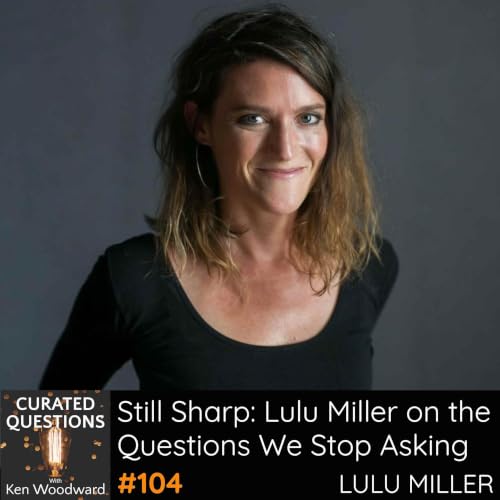
  • Still Sharp: Lulu Miller on the Questions We Stop Asking | Lulu Miller #104
    Oct 8 2026
    " Real curiosity, untethered, unsoftened, it's a pretty intense tool. And I think the kids haven't blunted the weapon by politeness or by fear of looking dumb or by the belief that there are certain things we should know. It's still sharp." - Lulu Miller Lulu Miller first found the power of questions on a subway train, listening to an early Radiolab episode about fireflies that blink in unison. That question opened a door she had been looking for since childhood: another world, inside this one. Today she co-hosts Radiolab with Latif Nasser, co-founded Invisibilia, and created Terrestrials, a nature podcast for kids and families. Her international bestseller, Why Fish Don't Exist, begins with a question many of us carry quietly: what is the point? Her answer reminds us that the categories we trust are often questions we stop asking. But the power scared her. She once fled journalism for a fiction MFA, convinced her questions could hurt people. Jad Abumrad's reframe brought her back: those worries are the sound of your moral compass. In this conversation, Lulu shares three ways to move a conversation past the rehearsed version: ask something tactile, ask the elephant-in-the-room question, and interrupt with care. Then the kids on Terrestrials take over, asking NASA scientists and the poet laureate the blunt, open questions adults soften away. Real curiosity, unsoftened, is still sharp. Who blunted ours? This Curated Questions episode can be found on all major platforms and at CuratedQuestions.com. Be sure to subscribe to the weekly Curated Questions Dispatch newsletter for more fun with questions and curiosity! (https://substack.com/@curatedquestions (https://substack.com/@curatedquestions?)) Keep questioning! Resources Mentioned Radiolab (https://radiolab.org/) Latif Nasser (https://latif-nasser.squarespace.com/about) NPR (https://www.npr.org/) Invisibilia (https://www.npr.org/podcasts/510307/invisibilia) Terrestrials Podcast (https://www.wnycstudios.org/podcasts/radiolab-kids) Why Fish Don't Exist by Lulu Miller (https://www.simonandschuster.com/books/Why-Fish-Dont-Exist/Lulu-Miller/9781501160349) This American Life (https://www.thisamericanlife.org/) Radiolab, Fireflies "Emergence" episode (https://radiolab.org/podcast/91501-there-is-no-lord-of-the-fireflies) Olbers' paradox (https://en.wikipedia.org/wiki/Olbers%27_paradox) Jad Abumrad (https://en.wikipedia.org/wiki/Jad_Abumrad) Robert Krulwich (https://en.wikipedia.org/wiki/Robert_Krulwich) Jocelyn Ford (https://mediaeducationlab.com/about/jocelyn-ford) Nell Greenfieldboyce (https://www.nellgreenfieldboyce.com/) Gregory Warner (https://gregorywarner.substack.com/) Ellen Horne (https://www.linkedin.com/in/ellen-horne-78a45a2) The Addams Family (https://en.wikipedia.org/wiki/The_Addams_Family) Radiolab parasites episode (https://radiolab.org/podcast/darkode) Hanna Rosin (https://en.wikipedia.org/wiki/Hanna_Rosin) Alix Spiegel (https://en.wikipedia.org/wiki/Alix_Spiegel) Zoopharmacognosy (https://en.wikipedia.org/wiki/Zoopharmacognosy) Terrestrials, "An Ocean in Space" episode (https://podcasts.apple.com/au/podcast/an-ocean-in-space/id1504895463?i=1000702888723) Europa Clipper (https://en.wikipedia.org/wiki/Europa_Clipper) Europa (https://en.wikipedia.org/wiki/Europa_(moon)) Ada Limón (https://adalimon.com/) Voyager Golden Record (https://en.wikipedia.org/wiki/Voyager_Golden_Record) Producer Ben Ford (https://www.producerbenford.com/) Beauty Pill (https://www.beautypill.com/)
    Show More Show Less
    1 hr and 3 mins
  • The People Who Leave Get the Last Word: Revisiting a Question Ten Years Later | Ken Woodward #103
    Oct 1 2026
    "What do former members say about the organization?" - Ken Woodward Ten years ago today, I asked a question on my daily practice, IOTD365: what do former members say about an organization? I wrote it after my daughter gave up on an internship. One conversation in a hallway with a senior who'd done it was all it took. In 2016 I read that question as an insider asking leaders to listen. Today I read it as a former member who left federal service after thirty-two years without anyone asking what I knew. I also read it as a founder who can't hear what's said after I leave the room. In this episode, I reread the original post and question the man who wrote it. I look at where reputation really lives and the courage it takes to tell someone the truth. Then I borrow a habit from my years navigating submarines in and out of port. Taking a fix on an old question shows how far I've moved. What question did you answer years ago that deserves a second look? This Curated Questions episode can be found on all major platforms and at CuratedQuestions.com. Be sure to subscribe to the weekly Curated Questions Dispatch newsletter for more fun with questions and curiosity! (https://substack.com/@curatedquestions (https://substack.com/@curatedquestions?)) Keep questioning!
    Show More Show Less
    12 mins