

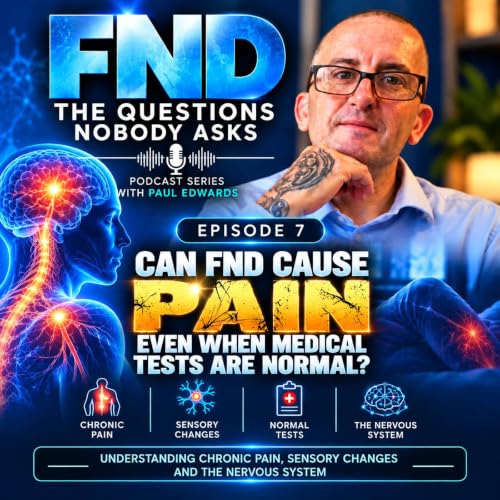
Episode 7: Can FND Cause Pain Even When Medical Tests Are Normal? | Chronic Pain Explained
Failed to add items
Add to cart failed.
Add to wishlist failed.
Remove from wishlist failed.
Follow podcast failed
Unfollow podcast failed

Episode 7: Can FND Cause Pain Even When Medical Tests Are Normal? | Chronic Pain Explained
-
Narrated by:
-
Written by:
Imagine experiencing burning sensations, sharp nerve-like pain, tingling or persistent discomfort that significantly affects your everyday life.
You undergo blood tests, scans and medical examinations, yet the results appear normal.
Does that mean your pain isn't real?
Absolutely not.
In Episode 7 of FND: The Questions Nobody Asks, Paul Edwards explores the relationship between Functional Neurological Disorder (FND), chronic pain, sensory disturbances and the nervous system.
This educational episode challenges the misconception that pain must always be visible on medical investigations to be genuine.
What We Explore in This Episode
- Can someone with FND experience chronic or severe pain?
- Why can pain exist even when MRI scans and routine investigations appear normal?
- What is pain sensitisation, and how does the nervous system process pain?
- Can FND be associated with burning sensations, tingling, numbness and altered sensation?
- Why can pain fluctuate from one day to another?
- How can persistent pain affect mobility, concentration, sleep and fatigue?
- Why shouldn't every new symptom automatically be attributed to an existing FND diagnosis?
- How can specialist physiotherapy, occupational therapy and multidisciplinary pain management help?
Normal Tests Do Not Mean Imaginary Pain
Pain is a genuine experience involving complex processes within the nervous system.
Although medical investigations can identify many causes of pain, not every painful condition produces abnormalities on routine scans or blood tests.
Importantly, FND is diagnosed using positive clinical findings, not simply because medical investigations are normal.
Pain can occur alongside FND, but it can also result from other medical conditions requiring their own investigation and treatment.
People living with FND deserve the same careful assessment of new or changing symptoms as anyone else.
A Personal Perspective
Paul Edwards lives with Functional Neurological Disorder and functional aphonia, which affects his ability to speak.
Through his educational work, research and lived experiences, Paul aims to challenge misconceptions and improve understanding of neurological conditions among patients, families, carers and healthcare professionals.
Although the narration is computer-generated, the words, research and personal experiences are Paul's own.
An Important Message
Pain does not have to be visible to be real.
Someone may smile during a conversation while experiencing significant discomfort.
They may appear comfortable while sitting but struggle with movement later.
Their ability to complete one activity does not invalidate their difficulties with another.
People living with persistent pain deserve appropriate medical investigation, compassionate treatment and individualised support.
Normal medical investigations do not mean someone is imagining their pain.
And having FND does not mean every new symptom should automatically be attributed to it.
FND: The Questions Nobody Asks — because understanding begins when we stop making assumptions.
Presented by Paul Edwards | FND Education & Advocacy
Medical Disclaimer: This podcast is intended for educational and awareness purposes only. It does not replace professional medical advice, diagnosis or treatment. New, persistent, severe or changing pain should be assessed by an appropriately qualified healthcare professional.