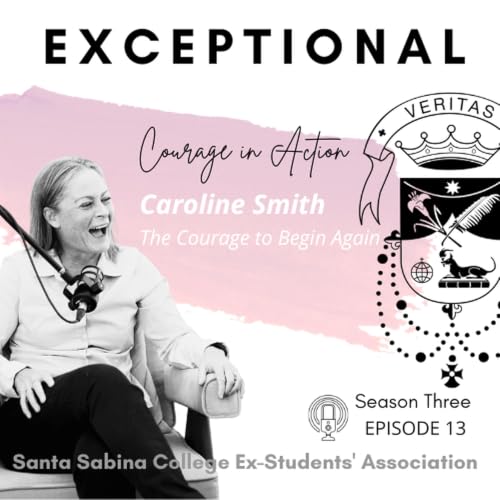
Exceptional cover art

Exceptional

Exceptional

Written by: Santa Sabina Ex-Students Association
Listen for free

Stories, conversation and wisdom from the Santa Sabina Ex-Student’s community. Season two focuses on 'Legacy in Action' with Cynthia Myssy (Santa Alumni) as the host for this season

Careers Economics Leadership Management & Leadership Personal Success
Episodes
  • Women in Family Law: Boundaries and Quiet Courage | Monica Serci
    Oct 6 2026

    Monica Serci has spent her career in family law, sitting with people at the worst moments of their lives. She's a special counsel at Walter and Elliot Family Lawyers, was named a Doyle's Guide Rising Star, and she gives her own time to advocacy work she believes in. In this conversation with Cynthia Myssy, Monica talks about the early warning signs of coercion and control, why the census undercounts what women actually do, and what happens when you treat a non negotiable as negotiable.

    Key Takeaways:

    • The warning signs are built to be dismissed: Coercion and control rarely announces itself, arriving instead as a comment about a friend, a preference that your mother visits less, or an offer to take over the budget, and it is the accumulation rather than any single incident that matters.
    • A non negotiable has to look like one: If you treat something that is genuinely not up for discussion as though it is, it will be negotiated, which is why the moment to hold the line is early, while the thing is still small.
    • The legal system is a tool, not a remedy: Courts can recognise what happened to you but cannot deliver emotional repair, so going in search of validation sets you up to leave disappointed whatever the outcome.
    • What is not counted does not count: The census records paid hours precisely and caps unpaid domestic work at thirty, and that gap flows into the administrative systems that calculate child support, leaving two systems pointing in opposite directions.
    • The relationship with yourself sets the ceiling for the rest: After a career spent watching relationships end, the one Monica worked hardest on was her own, drawing a clear line between self care and selfishness and treating her own limits as maintenance rather than indulgence.
    • Imposter syndrome does not resolve with seniority: It is real, it is worse for women, and it persists in people with every reason to feel qualified, which makes the correction worth borrowing: you are the adult in the room.
    • Courage is usually quiet: The most consequential acts are often private, unrecorded and witnessed by nobody, as one small kindness in wartime Sardinia proves three generations later.

    Notable Quotes:

    1. "If you have behaviour that is a non negotiable for you, but then you treat it as a negotiable thing, it will be negotiated." — Monica Serci
    2. "Many people are taught to keep the peace, but sometimes to your own autonomy, there's nothing more that one should protect." — Monica Serci
    3. "Thirty hours a week is almost a joke if they were to think about everything they did." — Monica Serci
    4. "They're not just names. They're whole worlds." — Monica Serci
    5. "You don't need permission." — Monica Serci
    6. "Sometimes the greatest acts are quiet and deeply personal." — Monica Serci
    7. "I think you see things that many of us don't see." — Cynthia Myssy

    See omnystudio.com/listener for privacy information.

    Show More Show Less
    33 mins
  • Career Change, Caring and Losing a Husband |Caroline Smith
    Sep 22 2026

    Caroline Smith started out teaching PE. She's now General Manager of Apprenticeship Careers Australia, and the road between those two things ran straight through her husband's terminal diagnosis. Caroline retrained in accounting while caring for Nigel, raising Emily, and later watching her mum slip into dementia. She'll tell you she hasn't done anything special. Cynthia Myssy disagrees. They talk career change under pressure, why resilience isn't a personality trait some women have and others lack, and why the gender gap in trades runs in both directions.

    Key Takeaways:

    • Career Change You Did Not Choose: When Nigel was told he could no longer work, Caroline's retraining stopped being a someday idea and became a decision. She chose accounting deliberately, for employability across any industry rather than for any love of numbers.
    • Resilience Is Not a Personality Trait: Caroline's position is that she did nothing exceptional, that anyone facing the same circumstances would have done the same, and that capability only reveals itself once it is tested.
    • What a School Gives You Decades Later: She credits the strength that carried her to her teachers at Santa Sabina and to a Year 12 class in 1994, absorbed rather than taught, years before she knew she would need it.
    • Admitting You Cannot Do It Alone: Looking herself in the eye and accepting she could not manage on her own is what made everything afterwards possible, including keeping Nigel at home rather than in a nursing home.
    • Recovery Takes Longer Than the Crisis: After years of running on adrenaline, Caroline had to learn how to stop being on alert, and says she has only really managed it in the last three or four years.
    • The Gender Gap in Trades Runs Both Ways: Women make up as few as 4 per cent of some construction and automotive roles, men under 10 per cent in aged care and health, and Caroline argues that any field dominated by one gender will create skills shortages in that field.

    Notable Quotes:

    1. "We're all capable of it, but it just depends on whether we're ever confronted by something like that." — Caroline Smith
    2. "You've got to look yourself in the eye and say, can I manage this on my own? And the answer is no." — Caroline Smith
    3. "Whether they did it directly or whether you sort of picked up some of that resilience and some of that determination through osmosis, it certainly stuck." — Caroline Smith
    4. "It just felt like everything was necessary." — Caroline Smith
    5. "Courage is having a crack, even if it means that you're potentially going to fall over or you're going to make a fool of yourself." — Caroline Smith
    6. "I think no one goes through life unscathed." — Cynthia Myssy

    See omnystudio.com/listener for privacy information.

    Show More Show Less
    35 mins
  • Victim Advocacy: 36 Years, Mostly Unpaid | Howard Brown
    Sep 9 2026

    About the Guest

    Howard Brown is an advocate for victims of crime in Australia with over three decades of dedication to helping victims and their families navigate the judicial system. His journey into advocacy began after the traumatic murder of his client and friend, Andrew, in 1988. Howard's relentless commitment has led to significant legal reforms, including the integration of victim impact statements in the judicial process. He has served on influential bodies like the New South Wales Sentencing Council and the New South Wales Victims Advisory Board, earning him the Medal of the Order of Australia in 2004 for his extraordinary service.

    Key Takeaways:

    • Howard Brown's advocacy work was initiated by personal tragedy, which spurred him to support victims through a frequently indifferent justice system.
    • Victim impact statements, a significant reform Howard helped to implement, are crucial in ensuring victims' voices are heard in court.
    • Despite the extensive personal and financial costs, Howard continues his work pro bono, driven by a profound sense of duty and capability.
    • Howard’s expertise and passion have influenced major legal reforms in Australia, advocating for more transparent justice systems.
    • His personal experiences with trauma, and disease have deepened his empathy and commitment to advocating for others.

    Notable Quotes:

    • "Someone has to stand up." – Howard Brown reflecting on his decision to advocate after Andrew's murder.
    • "Once the jury has reached a verdict… a judge then has to evaluate what type of punishment is appropriate for the defendant." – Howard on the importance of victim impact statements.
    • "If you live a life devoid of emotion… you're a psychopath." – Highlighting the necessity of empathy in justice.
    • "You need to support those people because dealing with such a tragedy is so enormously difficult." – Howard on supporting crime victims.
    • "The Santa ethos has led my life the way it is." – Howard expressing how his education and upbringing shaped his values.

    See omnystudio.com/listener for privacy information.

    Show More Show Less
    34 mins
adbl_web_anon_alc_button_suppression_t1
No reviews yet