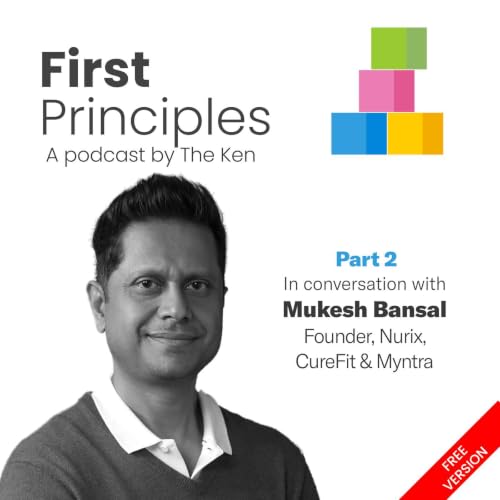
First Principles cover art

First Principles

First Principles

Written by: The Ken
Listen for free

First Principles is a weekly interview podcast comprising authentic, candid, and insightful conversations between some of India’s most accomplished founders and business leaders, and Rohin Dharmakumar, The Ken’s CEO & co-founder. From personal philosophies, mental models and decision making frameworks, to reading habits, parenting styles or personal interests, each episode will delve into what makes each of these leaders unique.(c) 2022 The Ken Economics Leadership Management Management & Leadership
Episodes
  • Part 2: Mukesh Bansal on hiring for loyalty to a mission, "no means not now", writing three books, and compounding sideways
    Aug 17 2026

    Where Part 1 followed the companies, Part 2 is about the person behind them. Picking up from Mukesh Bansal's move from one venture to the next, this half gets into how he finds talent ("work with them for six months"), the mental models he runs his life by, and the beliefs underneath them. He explains why rationally no one should start a company, how he processes every rejection as "no means not now", why he writes three books by simply showing up to a blank page, and how he separated the longevity basics he trusts from the biohacking he no longer does. It ends close to home: loyalty as loyalty to a mission, what he wants for his two children, why parents' expectations matter less than they did, and a life he rates an 8 out of 10.

    Chapters
    0:00 Where we left off
    1:46 Finding talent: "work with them for six months"
    3:23 The one open-ended question he asks
    5:57 Winning vs looking good
    8:00 The compounding argument, revisited
    9:40 Learning vs winning: drawing the 2x2
    11:17 Three books, and the annual look-back
    16:18 Making time to think in a full life
    18:45 What a chief of staff is actually for
    21:27 "No means not now" and other mental models
    25:57 How he writes a book
    28:30 How health became a throughline
    31:24 From ecosystem to the longevity basics
    34:29 Why strength training matters after 50
    38:08 Why he runs SparX, and the deep-tech turn
    44:05 Loyalty to a mission, and the number two
    50:35 The Apple teaching model
    52:52 Three adjectives, and being "scary" to juniors
    55:30 His kids' worldview
    57:54 Do parents' expectations still matter?
    1:00:12 Weekends, food, and reading now
    1:02:17 Rating his life an 8

    Quotes
    [8:44] "I don't know if this rocket thing will work. But if it works, it'll take at least ten years… they said, we are willing to work on it for the rest of our lives."
    [21:56] "I call this no means not now. That's how I process all the nos in my life."
    [24:59] "Zomato was started in 2007. They did not pivot into food delivery till 2017."
    [26:05] "Just show up and stare at a blank page for an hour. Sooner or later you'll start writing."
    [61:43] "I feel very privileged and very fortunate. So many lucky breaks have worked out for me."

    Frameworks & mental models

    • No means not now: process every rejection as timing, not a verdict; it protects the ego and the relationship.

    • Long-term patient, short-term aggressive / product is marketing: charge hard daily, give the ten-year game room, and let a product people love do the selling.

    • Horizontal compounding: compound entrepreneurial skill across ventures, not tenure in one sector.

    • Loyalty to a mission: the durable teams are bound to an unfinished job, not to a person; build a number two and give people room.

    • The longevity basics beat biohacking: sleep, eat less, move, strength-train after 50, tend emotional health; the exotic stuff is largely unproven.

    Credits & sharing
    This episode was produced by Rohin Dharmakumar and mixed and mastered by Rajiv CN.
    Write to us at fp@the-ken.com with your feedback, suggestions, and guests you would want to see on First Principles.
    If you enjoyed this episode, please help us spread the word by sharing and gifting it to your friends and family.

    Show More Show Less
    1 hr and 3 mins
  • Part 1: Mukesh Bansal on founder mode in the AI age, the three kinds of professionals in the AI age, and the Haridwar boy who found entrepreneurship in a library
    Aug 10 2026

    Mukesh Bansal has founded and left more companies than most people build in a lifetime, and in Part 1 he explains why. He founded Myntra and sold it to Flipkart; he co-founded Cult.fit and turned fitness into a category; and today he runs the AI company Nurix and the Meraki Labs studio. Asked what he is now, he says "a learner", and admits he gets bored the moment a company starts working. Part 1 traces the thesis and the companies: how he allocates his weeks, why he thinks the AI era rewards the hands-on operator over the people-manager, what Nurix and Fermi are, why Myntra's move into fashion was an "adjustment" not a pivot, and the small-town Haridwar upbringing and library habit that set him off. This is Part 1 of 2; Part 2 turns to the person, the mental models, and how he thinks about health, family and success.

    Chapters
    0:00 Welcome and who Mukesh Bansal is
    3:15 How First Principles is already connected to him
    4:21 "Do you see yourself as an operator, a founder, an investor?"
    5:27 Zero-to-one, and where learning stops
    9:11 Allocating time across companies
    10:34 Why an hour of his time isn't what it was
    12:59 The three kinds of professionals in the AI age
    14:52 His stack: Claude, Warp, agents overnight
    17:58 Founder mode, reversed by AI
    20:19 No more waiting for a tech co-founder
    23:02 How big Nurix is; and what Fermi is
    25:38 The Socratic tutor that won't answer
    27:18 Back to Myntra: the fashion category today
    31:30 Koyu, Lyskraft and the CRED hypothesis
    33:41 Why a venture studio, one company a year
    38:18 Rejecting the compounding path
    42:57 The near-death at Myntra, and raising with a short runway
    45:03 Haridwar, BHEL, and the books that lit the fire
    48:15 Pivots as chess "adjustments"
    50:48 Conviction vs discovery: betting the megatrend
    53:08 The Bay Area years and the return to India

    Quotes
    [4:33] "I see myself as a learner… doing one company over a period of time, I get bored."
    [7:08] "Crisis always comes wrapped with a massive gift, if you are only willing to unpeel the onion."
    [17:12] "I'm making an even stronger point. If you're only a people manager, watch out."
    [18:58] "For the first time you can hire something equivalent to human cognition for cents an hour."
    [48:50] "I use the word adjustment rather than pivot. You come to work every day, you're playing chess."

    Frameworks & mental models

    • Learner over operator: hand off once a company stops teaching you.

    • Crisis and momentum: cut the bad, double down on the good.

    • The three professionals in the AI age: the hands-on veteran is the one AI turns into a superpower.

    • Adjustment, not pivot: the best move on the board each day; a true "wipe the slate" is just a new company.

    • Bet the megatrend, stay loose on the path.

    Credits & sharing
    This episode was produced by Rohin Dharmakumar and mixed and mastered by Rajiv CN.
    Write to us at fp@the-ken.com with your feedback, suggestions, and guests you would want to see on First Principles.
    If you enjoyed this episode, please help us spread the word by sharing and gifting it to your friends and family.

    Show More Show Less
    58 mins
  • Fireside Ventures' Kanwaljit Singh on the decade at Hindustan Lever that gave him consumer, raising half the fund he could have, and keeping a coach in his sixties
    Jul 27 2026

    1 · Summary

    Part 2 of 2. Part 1 laid out the bet: a fund built only for Indian consumer brands, back when the idea sounded absurd, and the anti-power-law machine Kanwal Singh built to make it work. This half is the person. The near-decade at Hindustan Lever that gave him his love of consumer, the Intel years, and the Paper Boat conviction that taught him to back the founder over the idea. Then the man himself: parents who came to India as refugees from Pakistan, a father who kept collecting degrees while feeding the family, the coach he started seeing in his sixties and what separates coaching from therapy, and how he reads a founder by meeting their family. He turned down twice the money he could have raised. He rates his life a 10.

    2 · Chapters

    0:00 Part 2 intro 1:22 The Hindustan Lever decade that started it all 2:25 Intel Inside, and bringing the inside out 4:22 The Paper Boat conviction: backing the founder 6:38 What he adds as Fireside's "CEO," and value of good 17:53 Capping the fund: turning down 2x the money 20:24 Hiring: read the person, meet the family 27:01 Refugees, and a father who never stopped studying 30:39 Three words, and a 100%-locked calendar 33:30 Motivating through the down days 34:51 The coach, and coaching vs therapy 43:40 How he learns, and consumer vs tech founders 51:27 Rating his life a 10, and success redefined 52:47 Cotswolds, golf, and the empty nest refilled

    3 · Pull-quotes

    • [17:56] "I could have raised 2x of this. Genuinely, we could have raised 2x of this."

    • [23:55] "You cannot build to sell. You build for sustenance, you build for good."

    • [27:04] "Both my parents were refugees from Pakistan."

    • [51:34] "A 10." (asked how happy he is with his life)

    4 · Frameworks & mental models

    • Founder assessment through the family: read a founder by their story and support system, often over a meal with their spouse, on the belief that no one survives a decade-long build without one.

    • Build for sustenance, not to sell: the best businesses are bought, not sold; you build for the long run and treat a sale as a business decision along the way.

    • Value of good ("do good to do well"): founder first, planet first, one Fireside, with goodness as the foundation of doing well.

    • Coaching vs therapy: therapy addresses a medical issue; coaching is vulnerability and honesty in a business context, and only works once you have the self-awareness to accept there's a problem.

    This episode was produced by Rohin Dharmakumar and mixed and mastered by Rajiv CN.
    Write to us at fp@the-ken.com with your feedback, suggestions, and guests you would want to see on First Principles.
    If you enjoyed this episode, please help us spread the word by sharing and gifting it to your friends and family.

    Show More Show Less
    1 hr
adbl_web_anon_alc_button_suppression_t1
No reviews yet