• Ep 68: Mentorship Program
    Feb 10 2026

    In this episode of Fostering Conversations, host Amy Smith sits down with Michelle Ostmark, the Statewide Mentoring Coordinator for Utah Foster Care, to discuss the Utah Foster Care Mentoring Program and why it matters.

    Michelle explains how the program pairs experienced foster parents with new or existing foster and kinship families to provide guidance, emotional support, and real-life insight throughout the fostering journey. From navigating first placements and court processes to coping with reunification, burnout, and self-care, mentors help ensure families don’t feel alone.

    The conversation highlights how mentoring builds community, strengthens placements, and improves outcomes for children by supporting the adults who care for them. Michelle also shares how the program began, its statewide growth, success stories, and how former foster parents can continue giving back as mentors—even if they’re no longer licensed.

    Learn how to request a mentor or become one at:

    https://utahfostercare.org/foster-parent-resources/mentors/

    Transcript:

    Welcome to Fostering Conversations. On today’s episode, we’ll be talking about the statewide Utah Foster Care Mentoring Program and its importance to our Utah foster families.

    Amy: Welcome to Fostering Conversations. I’m your host, Amy Smith. Today we have Michelle Ostmark, who is the statewide mentoring coordinator for Utah Foster Care.

    Thanks for joining us, Michelle.

    Michelle: Thank you for having me.

    Amy: So we’re excited to talk about the mentoring program. It is part of Utah Foster Care and available to all of our foster families in the state of Utah. Is that correct?

    Michelle: It’s also available to kinship families that have gone through the licensing process or have started the licensing

    Amy: which is awesome. I think kinship, all foster families need support, but kinship have an added layer of need of support, so I love that you’ve included that now.

    Michelle: Yeah. I think it’s important that they also have support for the children that are coming into their home. They have the same. Needs that any other child coming into care have, and they just have an extra dynamic of having a personal relationship with the biological families.

    Amy: Yeah, absolutely. So let’s just start by what is the mentoring program?

    Michelle: So the mentoring program is designed to pair a seasoned foster family with a new or existing family that needs additional support, or. Resources in each of their communities. We gear it towards new families just so that as they’re starting their foster care journey, they’re able to have somebody that they can call and gather information from, learn what’s appropriate, what’s not, questions to ask as they’re getting placements in their home, um, when they’re struggling, when there’s. exciting news for a child or their family, they have somebody that they can share those things with. Yeah. So that they’re not feeling alone.

    Amy: I love that because I think back to when I started fostering and I didn’t know like anything, like you just like you get trained. But then you forget what you’re doing and then a kid shows up and you’re like, wait, what am I doing again?

    Yeah.

    Michelle: Yeah. And I think our training is amazing,

    Amy: It is. It’s beautiful.

    Michelle: But like during that process, you go through the training and then you wait for your licensing and approval, and oftentimes there’s a few months that pass by. Yeah. And so all of that training that you’ve had, you’re super excited.

    But once you get that call for that child, all of that training and al...

    Show More Show Less
    26 mins
  • Ep 67: Trust-Based Relational Intervention
    Jan 13 2026

    In this episode of Fostering Conversations, host Amy Smith sits down with Terumi Sagers, TBRI Specialist for Utah Foster Care, longtime foster parent, and adoptive parent. Together, they unpack the foundations of Trust‑Based Relational Intervention (TBRI)—a relationship‑centered, trauma‑informed caregiving approach developed by Dr. Karen Purvis and Dr. David Cross.

    This conversation is filled with real‑life examples, practical tools, and compassionate insights for foster parents, kinship caregivers, educators, and anyone raising children—because, as Terumi explains, TBRI works for all humans, not just those with trauma backgrounds.

    Episode Summary

    Terumi shares her extensive experience fostering, adopting, and training caregivers for over 15 years. She explains the three core TBRI principles—Connecting, Empowering, and Correcting—and why trust must be rebuilt from a “negative starting point” for many children who enter care.

    You’ll hear:

    • How simple, consistent connection builds safety
    • Why correcting behavior isn’t effective until trust is established
    • How sensory needs, movement, nutrition, and hydration affect behavior
    • Practical examples caregivers can implement today
    • Clear guidance on where families (foster or not) can access TBRI training

    This episode is a comforting mix of vulnerability, practical strategy, and hope for caregivers navigating the complexities of trauma‑impacted parenting.

    Guest

    Terumi Sagers TBRI Specialist, Utah Foster Care 20 years as a foster parent • Adoptive parent • Trainer and practitioner

    Key Topics Covered 1. What Is TBRI?
    • A trauma‑informed parenting philosophy centered on trust‑building and relational connection.
    • Originally developed for children with trauma histories, but now shown to benefit all children and even adult relationships.
    2. Why Trust Starts Below Zero
    • Children in care often enter new homes with trauma, loss, and disrupted attachment.
    • Caregivers must focus on connection to help kids reach “zero” before growth can begin.
    3. The Three TBRI Principles
    • Connecting: Relationship‑building through presence, attunement, and positive interactions.
    • Empowering: Meeting physical and sensory needs (movement, hydration, blood sugar, calm environments).
    • Correcting: Teaching life skills and addressing behavior after safety and connection are in place.
    4. Real‑World Examples
    • A withdrawn teen reconnecting through daily small affirmations.
    • A family eliminating after‑school meltdowns simply by offering protein snacks and water right after pickup.
    5. Training Opportunities
    • Utah Foster Care’s 8‑class TBRI Caregiver Series (20 hours).
    • Community resources including My Healing Home, Raise the Future, and online courses from TCU.
    6. Becoming a TBRI Practitioner
    • A rigorous process including 10 weeks of study, an intensive adult attachment interview, and a 5‑day immersive training.
    Resources Mentioned
    • Books: The Connected Child and The Connected Parent by Dr. Karen Purvis
    • Training: UtahFosterCare.org → TBRI Caregiver Series
    • Community Providers: My Healing Home • Raise the Future
    • Online Learning: TCU’s TBRI 101 resources
    ...
    Show More Show Less
    28 mins
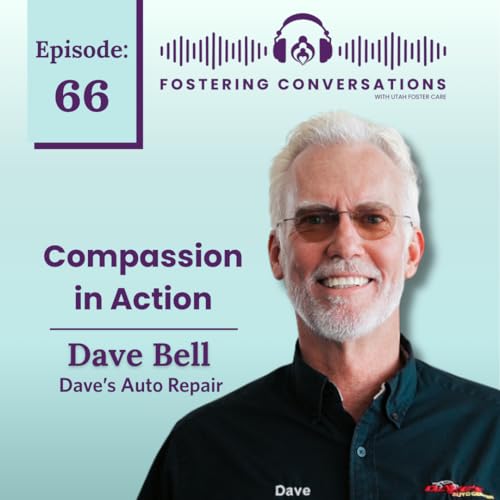
  • Ep 66: Compassion in Action
    Dec 9 2025

    Podcast: Fostering Conversations Host: Amy Smith Guest: Dave, Owner of Dave’s Auto

    Episode Summary

    In this heartfelt episode, Amy sits down with Dave Bell from Dave’s Auto Center to discuss his incredible journey of giving back to the community through Utah Foster Care and other charitable initiatives. Dave shares the deeply personal story of his mother’s childhood in an orphanage, how that shaped his values, and why supporting foster families and children is so meaningful to him. From partnering with Mountain America Credit Union to organizing a massive community Christmas event, Dave’s passion for service shines through every story.

    Key Topics Covered

    • Dave’s Background: From starting his auto shop in a storage unit to building a successful business over 36 years.
    • Personal Connection: How his mother’s experience as an orphan inspired his commitment to foster care.
    • The Power of Service: Why giving back changes lives—both for those who receive and those who give.
    • Community Christmas Event: Details about the annual Family Community Christmas in Farmington, serving thousands of families with food, clothing, toys, and holiday cheer.
    • Encouragement for Listeners: Practical ways to get involved and make a lasting impact during the holiday season.

    Memorable Quotes

    • “Service is a dividend that pays double.” – Dave
    • “Be careful what you fill your mind with—your life depends on it.” – Dave
    • “One caring adult can make all the difference.” – Amy

    Resources & Links

    • Utah Foster Care: utahfostercare.org
    • Family Community Christmas (Farmington, UT): December 20th at Farmington Fair Park
    • Mountain America Credit Union: macu.com

    Call to Action

    Want to make this holiday season meaningful? Join the Family Community Christmas event or support foster families in your area. Your time and kindness can change lives.

    Transcript:

    Amy: Welcome to Fostering Conversations.

    I’m your host, Amy Smith. Today we have Dave with Dave’s Auto,

    Thank you so much for joining our podcast today. We’re excited to chat with you.

    Dave: I’m happy to be here. Thank you.

    Amy: So let’s start off by just introducing yourself, you know, what’s a little bit of your background and how did you get involved with Utah Foster Care?

    Dave: my background is, I’ve been a mechanic my whole life since I was 15. So that’s 50 years now. And I started the business here in Utah in 1990. So we’re starting our 36th year this year. And started in a storage unit in the dead of winter with no heat. And Lord, I’ve been very blessed.

    So that’s a little bit about me and where I came from and why I’ve gotta shop. Mountain American Credit Union came to me last year, a little before Christmas, and asked me to collaborate with them with Utah Foster Care. And I was so honored to do it, and they didn’t even know it.

    They just came to me because they wanted a a working kind of guy to be part of their ad campaign and everything. And then through, meeting the people and you know, talking to Utah foster care and everything a story came up and that story is probably why this is so near and dear to me, but no one knew that.

    But it’s unusual how people will get put in your life or you’ll get put in people’s lives and then it’s an answer to somebody’s prayer. You know, for me it’s an answer to my prayer ’cause I can give back. I’ve been so blessed in my life. And I hope that in some way t...

    Show More Show Less
    26 mins
  • Ep 65: Blocked Care
    Nov 11 2025

    In this episode of Fostering Conversations, host Amy Smith talks with Utah Foster Care clinical support specialist and LCSW Les Harris about blocked care: why it happens, how it impacts foster parents, and practical steps to restore connection. Les explains how chronic stress can suppress the parenting response system, making it difficult to feel joy or affection toward a child, even when we deeply care. They discuss what blocked care looks like, why it’s different from burnout, how small “doses” of positive interaction can rebuild connection, and why acceptance, playfulness, curiosity, and empathy are powerful tools for healing relationships.

    Resources mentioned in this episode

    • Brain-Based Parenting by Daniel Hughes & Jonathan Baylin

    • What Happened to You? by Dr. Bruce Perry & Oprah Winfrey

    • Utah Foster Care Clinical Support Services

    Transcript:

    Amy: On today’s episode, we’re talking to Les Harris, a Utah foster care clinical support specialist, and LCSW about blocked care and how it affects foster parents. Welcome to Fostering Conversations. I’m your host, Amy Smith. Today we have Les Harris who works for Utah Foster Care as the clinical support specialist, and also is an LCSW. Welcome Les.

    Les: Thank you. Happy to be here.

    Amy: Today we’re excited to be talking about blocked care. Blocked care really affects foster parents, but it affects all parents. So will you give us the dumb down version of what blocked care is?

    Les: It’s one of those terms that’s relatively recent in the trauma informed literature, even though we know it’s been around forever. So it’s often used in, as you said, in foster care, adoptive care and in parenting in general. It’s a, it’s refers to the chronic stress that often comes with working with children with difficult emotions and behaviors, and forces the parent then to shut down emotionally and almost stop caring about the child.

    It’s and in other words, they no longer find joy in parenting,

    and that’s one of the most common outcomes where. Foster and adoptive parents, when they get pushed emotionally, their own parenting response system starts to shut down, and the next thing they know, they don’t even want to be around the child

    anymore. And so that’s the basic definition but there’s so much more to it in the context of why does that happen? What do I do about it when it happens? And so on and so forth. So we’ll probably get into to more of that as we go.

    Amy: Yeah, I know that when I started fostering, I had never heard that term. It was very interesting to me to learn about it from you and from different classes and things that I went to as a foster parent to, to understand that. So maybe we can just start, by talking about what are some of the reasons why a parent might be facing blocked care?

    Les: Yes. I think that’s important because once we have a bit of awareness about the underlying causes and why it’s happening, then it gives me at least some information I could use to, to change some things about my approach to parenting, some of the most difficult children that will ever encounter. So, Let me go back.

    I’m gonna get back to basics. Talk a little bit about. The idea that all humans, are born with an instinct, as we get older, particularly, and you can even see this in young children, but particularly as we start to get a certain age, we start to, that nurtur...

    Show More Show Less
    32 mins
  • Ep 64: Building Care Communities
    Oct 7 2025

    In this episode of Fostering Conversations, host Amy Smith welcomes Utah’s First Lady Abby Cox to announce the statewide launch of the Care Communities program. After a successful two-year pilot with Utah Foster Care, Care Communities are expanding across the state to provide essential support for foster families and children in care.

    Abby shares how this initiative was born out of a desire to strengthen foster care in Utah and ensure that every child has a safe and supportive environment. The Care Communities model surrounds each foster family with 8–10 trained volunteers who provide emotional support, physical assistance, and trauma-informed care. This helps foster parents feel less isolated and ensures children in care have healthy, lasting connections with caring adults.

    Key highlights from this episode:

    • Statewide Care Communities launch – a first-of-its-kind effort in Utah.

    • The top three benefits foster families experience: emotional support, physical help, and positive impact on children.

    • How Care Communities prevent burnout and keep families fostering longer.

    • Success stories from the pilot program, including mentorship moments, adoption celebrations, and lifelong community bonds.

    • Practical ways listeners can get involved, even if they aren’t able to foster themselves.

    Abby emphasizes that Care Communities not only support foster families but also give children the community connections they desperately need. This initiative is backed by faith organizations, nonprofits, local businesses, and state agencies—all working together to improve outcomes for Utah’s most vulnerable kids.

    • Learn more or sign up at utahcarecommunities.org
    • Explore Utah Foster Care programs at utahfostercare.org

    Transcript

    Fostering Conversations Podcast

    Episode 64: Building Care Communities

    Amy: Thanks for joining us for Fostering Conversations. I’m your host, Amy Smith, and today we have our amazing guest and First Lady Abby Cox. Thanks for joining us, Abby.

    Abby: Thanks so much for having me.

    Amy: So we are excited. Today is a special episode because, there is an exciting announcement that Abby is going to share with us.

    So go ahead and share that with us and we’ll dive in.

    Abby: we are super excited to announce that we are having a statewide launch of our Care Communities program. So we have been doing a two year pilot, around this Care Communities program. We’ve had. Great successes. We’ve had some incredible stories. we are thrilled with the outcomes, frankly, of what we’ve been seeing, and we are ready to launch statewide, which is very exciting.

    Amy: It is so exciting and honestly for me as a former employee, this is flown by, so I can’t believe it’s already out of the two year pilot and ready to go, so that’s exciting. So would you just tell us a little bit about why you started the Care Communities program, why you joined up with Utah Foster Care to create this specific program?

    Abby: Yeah, so when I got into this position,and wanted to see where in child welfare, really didn’t know that much about it, but knew that I wanted to, see if there was. Somewhere that I could have an impact or that my team could really maybe help in ways that, that some of the other organizations needed.

    And so for us, it was, it really was a learning thing. and the more I got into it, and the more I started learning about it, the more, I learned great organizations...

    Show More Show Less
    28 mins
  • Ep 63: Native Voices
    Sep 9 2025

    In this episode of Fostering Conversations, guest host Liz Rivera guides a powerful dialogue with Native leaders and advocates about the importance of culture, tradition, and belonging for Native children in foster care.

    You’ll hear from:

    • James Toledo (Utah Division of Indian Affairs) on how culture provides a foundation for resilience.

    • Stephanie Benally (Native American Specialist, Utah Foster Care) on supporting Native children’s traditions in foster homes.

    • Craig Sandoval (Urban Indian Center of Salt Lake) on creating culturally responsive models for Native youth and families in urban Utah.

    Together, they reflect on the sacred role of clans, ceremonies, and language, as well as the ongoing significance of the Indian Child Welfare Act (ICWA) in preserving tribal sovereignty and protecting children’s cultural identity.

    Listeners will learn why everyday practices—from observing ceremonies to speaking Native languages—help children thrive, and how foster parents can honor and support these connections, even outside of tribal communities.

    Transcript:

    Liz: [00:00:00] On today’s episode, you’ll hear how cultural traditions give Native children strength and belonging, and why the Indian Child Welfare Act or ICWA is so critical , in protecting those connections for children in foster care. Welcome to Fostering Conversations. I’m your host, Liz Rivera, filling in for Amy Smith. We have a special episode for you today. We’re weaving together conversations with several native leaders and advocates here in Utah.

    Liz: Let’s begin with introductions in Navajo culture, introductions are not just about your name, they’re about where you come from, your clans, your language, and [00:01:00] lineage. First, we’ll hear from James Toledo from the Utah Division of Indian Affairs, followed by Stephanie Benally, the Native American specialist from Utah Foster Care, and finally, from Craig Sandoval from the Urban Indian Center of Salt Lake.

    James: Ya, uh, James Toledo

    James: and, and again. Thank you. I, I’m a member of the Navajo Nation and we introduce ourselves, sharing our clans. So as we probably will talk about this later in the program, our clans are a way to identify our family relationships, connections with others within our community.

    Stephanie: Hello. Thank you. I am a citizen of Navajo Nation. My clans are Red Streak people born for Bitter Water. My maternal grandfather is Mexican People clan, and my paternal grandfather is Red House. Thank you very much for the opportunity to participate on the podcast.

    Craig: Hello everybody, and wanted [00:02:00] to introduce myself and my native language. First [Navajo introduction].

    Craig: So I introduced myself in my native Navajo language. Just wanted to reintroduce myself in English for all the non Navajo speakers. Good day to everybody. My name is Craig Sandoval, and I’m originally from New Mexico in a small community named Pueblo Pintado, New Mexico. So it’s [00:03:00] just west of Albuquerque, made about two hours.

    Craig: And my clans are Near the Water People. I’m born for the Mexican clan. My maternal grandparents are the Red Paint People, and my paternal grandparents are the Towering House People. And so that’s who I am, and that’s where I come from. And then now I’m here in Salt Lake working to p...

    Show More Show Less
    29 mins
  • Ep 62: Aging Out Strong
    Aug 2 2025

    In this powerful episode of Fostering Conversations, host Amy Smith sits down with Sheri, a resilient young woman who aged out of Utah’s foster care system and is now thriving as a leader at Angels Landing Foundation. Sheri shares her deeply personal story from entering foster care at age 12 after bravely reporting abuse, to cycling through 13 foster homes, and ultimately finding healing, empowerment, and purpose.

    Listeners will gain insight into:

    • The emotional reality of sibling separation in care

    • The challenges of instability and aging out alone

    • The importance of supportive adults and safe spaces

    • How Angels Landing Foundation is transforming outcomes for aged-out foster youth

    Sheri’s journey highlights the real-world impact of organizations like Angels Landing, which provide community, mental health support, life skills training, and financial empowerment to young adults aged 18–26 transitioning out of care.

    Resources Mentioned:
    • Angels Landing Foundation: angelslandingfoundation.org

    • Follow Angels Landing on Instagram: @angelslandingfoundation

    • Big Brothers Big Sisters of America: bbbs.org

    • Learn About Foster Care in Utah: utahfostercare.org

    Transcript:

    Episode 62: Aging Out Strong

    Amy: Thank you for joining us for Fostering Conversations. I’m your host, Amy Smith. Today we have Sheri who grew up in foster care and aged out of the foster care system. She currently works at Angels Landing, and we’re so excited to have her with us today. Thanks, Sheri.

    Sheri: Thank you.

    Amy: You have a really incredible story and I’m sure filled with also a lot of heartache and pain as well. So we wanna be sensitive to that. But would you just start by introducing yourself?

    Sheri: Absolutely. [00:01:00] Like you said, my name’s Sheri. I’m 23 years old. Gonna be turning 24 this year and I , work at Angels Landing. I, that’s like the best introduction I think I’ve got.

    Amy: I love it. So tell us a little bit what Angel’s Landing is for those who don’t know.

    Sheri: So Angels Landing is a nonprofit organization that serves young adults from eighteen to to 26. And our mission statement is Angels Landing builds community centered on empowering young adults transitioning from foster care to achieve self-sufficiency and create a life that they love. And so that is absolutely something that I needed when I aged out of foster care. And it’s been an absolute great opportunity and another resource as someone who doesn’t have tons of resources, and especially that family unit. Having another spot is always something that creates [00:02:00] So much support in my life. And so Angel’s Landing been great and I’m excited to, to dive into what that looks like.

    Amy: I love that. So maybe start by telling us a little bit about your story and how you found.

    Sheri: I aged into foster care when I was 12 years old. My mom passed away when I was three and a half, and so she passed away in a car accident on Valentine’s Day,

    Amy: Oh man.

    Sheri: so it’s the love day. So I try to always look at it like all the positives, right? But yep. Lost my mom at thre...

    Show More Show Less
    28 mins
  • Ep 61: Support Through Service
    Jul 8 2025

    In this episode of Fostering Conversations, host Amy Smith and co-host Tami Carson welcome Melina Moore, Utah Foster Care’s Volunteer Services Manager. Melina shares how individuals and organizations can support foster families across the state—not by fostering, but by volunteering.

    Learn how opportunities like Kids’ Night Out, Service Saturdays, and event support offer much-needed connection and respite to foster families. Hear inspiring stories of volunteers making balloon animals, leading pottery nights, or helping families with yard work. Plus, discover how simple acts of service—like assembling connection kits or hosting mindfulness events—can make a lasting impact.

    Whether you’re a student, parent, professional, or business owner, there’s a role for you. Find out how volunteers create meaningful connection and contribute to the wellbeing of children and families in foster care.

    Volunteer with Utah Foster Care: https://utahfostercare.org/get-involved/volunteer/ Learn about Care Communities: https://mycarecommunity.com

    Key Topics:

    • Why connection and childcare are essential for foster families

    • Types of volunteer roles across Utah

    • Training, background checks, and trauma-informed practices

    • Ways organizations can get involved

    • Heartwarming stories of impact and community

    Show More Show Less
    27 mins