Episodes

  • A Few Presidential Libraries Including Obama
    Oct 28 2026

    Four presidents. Four libraries. This episode explores the LBJ Library, where the Civil Rights Act and Voting Rights Act reshaped the law. The JFK Library, where leadership, public service, and the enduring relevance of American ideals converge. The Carter Library, where human rights became foreign policy, but domestic racial equity continues to be a complicated story. And finally, the Obama Presidential Center, the first of its kind built without federal archives, built instead as a living investment on Chicago's South Side. Christopher John offers a candid reflection on the institutions, what resonated with him, and what it means for a nation still deciding how honestly it will tell its own story.

    Show More Show Less
    19 mins
  • ABOUT TIME | Once Upon a Time in Harlem
    Nov 18 2026

    In the darkest of times, creatives are called to illuminate awareness, and Black creatives have had the most practice building a world that rises above anti-Blackness. Nowhere is that clearer than it was in Harlem.

    Christopher John shares his take on Once Upon a Time in Harlem, David Greaves’ documentary built from footage his father, William Greaves, shot in 1972. In this film surviving artists, writers, musicians, and intellectuals of the Harlem Renaissance gather at Duke Ellington’s townhouse to reflect, candidly, on their generation and its legacy.

    Provoking an awakening on the realities of the Harlem Renaissance, this episode connects that ideals of an awakening to today’s anti-woke propaganda, the loud demand that we close our eyes rather live with our eyes wide open.

    Show More Show Less
    13 mins
  • Post-Election Take: Georgia on My Mind
    Nov 4 2026

    Georgia, the last former Confederate state readmitted to the Union is now the state that elected the first Black woman governor in American history. Keisha Lance Bottoms made history on November 3, 2026, and history, as it turns out, has a long memory and a sharper sense of timing.

    Georgia now holds eight Black women in key statewide positions, including Governor Keisha Lance Bottoms, Attorney General Tanya Miller, Secretary of State Penny Brown Reynolds, State School Superintendent Lydia Glaize Powell, Labor Commissioner Nikki Porcher, Insurance and Safety Fire Commissioner Keisha Sean Waites, Agriculture Commissioner Katherine E. Juhan-Arnold, and Public Service Commissioner Shiela Edwards.

    In this episode, we connect Henry McNeal Turner’s defiance in 1868 to today’s historical Georgian milestone, while honoring Stacey Abrams for paving the way.

    The hands of time keep moving. Press play and decide what you will do with yours.


    Show More Show Less
    8 mins
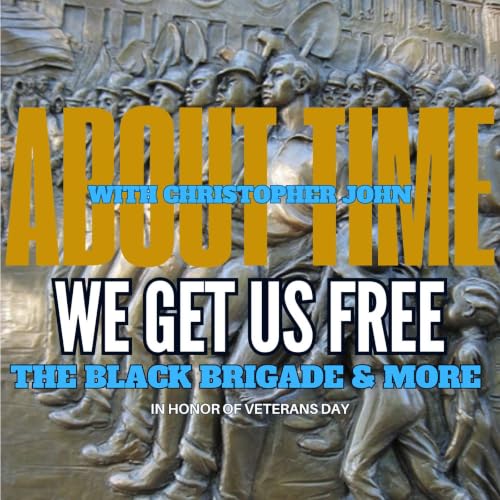
  • ABOUT TIME | We Get Us Free | The Black Brigade & More
    Nov 9 2026

    In this episode, we honor Black Veterans and the origins Veterans Day. We lift up the National Association for Black Veterans, founded by Vietnam veterans who came home and found the fight for benefits, services, and recognition still unfinished. We also illuminate Cincinnati and the story of the Black Brigade of 1862, as well as the reoccurring them of Black military labor.

    Show More Show Less
    11 mins
  • About TIME | From Mississippi Goddam to Mississippi Good God
    Nov 12 2026

    History has a way of returning to unfinished business. With Scott Colom’s historic election as Mississippi’s first Black U.S. senator since Reconstruction, a 145-year absence comes into sharp focus. This episode revisits the remarkable life and legacy of Blanche K. Bruce, who rose from enslavement to become the first Black senator to serve a full term, and examines the promise of Reconstruction, the consequences of its abandonment, and the enduring struggle for political representation. From Bruce to Colom, this is more than a story of two men. It is a reflection on memory, democracy, and the responsibility each generation carries to shape what comes next.

    Show More Show Less
    11 mins
  • America Two-Fiddie | Hair, Housing, and More
    Oct 22 2026

    When and how did Black hair become political in America? And what does that long history tell us about why we are still fighting this fight in 2026?

    Here is the answer. It was never about hair.

    American beauty standards labeled natural Black hair "unkempt" and "unprofessional," pressuring generations to straighten, conform, and shrink. That was not a trend. It was a system of racial control and assimilation. Then came the 1960s and 70s, when the Afro became a crown of the Black Power movement, a visible rejection of Eurocentric norms and a declaration of cultural pride. Wearing your hair as it grows from your head became an act of resistance.

    In this episode, we explain the CROWN Act, which stands for Creating a Respectful and Open World for Natural Hair. It protects people from discrimination based on hair texture and protective styles like braids, locs, and twists in schools and workplaces. We ask why a law like this is needed at all, and why a federal version keeps stalling in Congress.

    But hair is only the doorway.

    Walk through it and you land in the neighborhood where redlining still draws the map. Between 1935 and 1940, the Homeowners’ Loan Corporation graded 239 cities by race, ethnicity, and perceived risk. Black and immigrant neighborhoods were marked red, and federally backed mortgages vanished. The Federal Housing Administration refused to insure loans in those areas while subsidizing white suburban growth.

    Today, more than 8 million Americans still live in formerly redlined neighborhoods. The Fair Housing Act of 1968 outlawed the practice, but the patterns did not disappear. They evolved.

    Press play. Learn the history. Then ask who is leading with humanity, and who is just leading.

    Show More Show Less
    8 mins
  • ABOUT TIME | The Black Church & Social Justice ft. Rev. Dr. Richard Hughes
    Sep 22 2026

    September is International Underground Railroad Month. And if you're looking for the blueprint on civil disobedience converged with social justice, look no further than the UGRR itself, a movement the Black church led.

    In this candid conversation, Rev. Dr. Richard Hughes shares his poignant perspective on the social justice identity of the Black Church. We ask the question too many congregations are avoiding: what happened to the church that used to hide freedom seekers in its basement and now can't say the word "injustice" from the pulpit?

    Somewhere between then and now, too many of our churches have adopted capitalistic mindset. Prosperity gospel replacing liberation gospel. Comfort replacing conviction. The same institution that once provided refuge for Freedom Seekers now hesitates to name injustices.

    It's ABOUT TIME we call it what it is!

    Show More Show Less
    20 mins
  • Black Women in Politics ft. Dr. Vaneesa Enoch “Doc Enoch”
    Oct 13 2026

    Dr. Vaneesa Enoch comes to the table for a provocative conversation that challenges conventional narratives about power, politics, and who gets to shape the future of American democracy. Long before they were elected to public office, Black women were organizing communities, building institutions, mentoring future leaders, and creating the political infrastructure that has sustained movements for justice and equality. Yet their leadership has too often been overlooked, undervalued, or deliberately marginalized.

    This episode examines the undeniable influence of Black women as pioneers of political organizing, civic engagement, and transformational leadership. We explore why Black women consistently demonstrate extraordinary campaign effectiveness and voter mobilization while continuing to confront systemic barriers, including fundraising inequities, racialized and gendered stereotypes, media scrutiny, and institutional gatekeeping.

    Dr. Enoch also shares the personal convictions that inspired her congressional candidacy, offering insight into the challenges, responsibilities, and opportunities of seeking public office in an era marked by deep political division and heightened attacks on representative democracy.

    At its core, this candid conversation asks a bold question: What would American democracy look like if the leadership, vision, and political labor of Black women were no longer treated as exceptional, but recognized as essential? Through history, experience, and an unwavering commitment to public service, this episode invites listeners to reconsider who has truthfully been doing the work of strengthening our democracy and who will help shape its future.

    For more information: https://enochforcongress.com/

    Show More Show Less
    48 mins