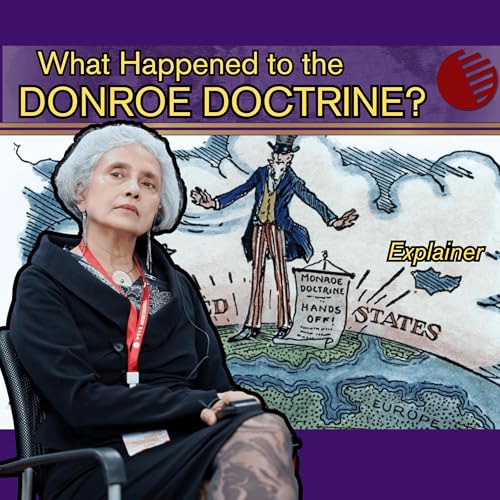
• Geopolitical Economy Explainer: Whatever Happened to the Donroe Doctrine?
    Apr 1 2026

    GEOPOLITICAL ECONOMY EXPLAINER

    Just over a month ago, the world was abuzz with talk of the Donroe Doctrine? Radhika explains what the so-called "Donroe Doctrine" was supposed to be, what it really was, how it lined up with the Monroe Doctrine and the Roosevelt Corollary, and why it is hardly surprising that it was barely proclaimed before it was violated. The explanation may surprise you.

    Show More Show Less
    22 mins
  • Reading Capital with Radhika Desai: 1. Mandel Introduction and Marx & Engels Prefaces
    Mar 25 2026

    Starting Sunday, 22 March 2026, Radhika Desai is leading a Capital Reading Group on line. It will consist of an hour’s lecture followed by at least an hour’s discussion.

    In her lectures, Radhika will be presenting an interpretation of Capital that she arrived at in the course of developing Geopolitical Economy, the Marxist approach to understanding the international relations of the capitalist world, which placed imperialism and anti-imperialist resistance at its centre and has required rescuing Marx’s original analysis of capitalism as contradictory value production from more than a century and a half of misinterpretation by Marxists themselves.

    In this first episode, Radhika analyses an Introduction by Ernest Mandel as well as two Prefaces by both Marx & Engels.

    Show More Show Less
    1 hr
  • The West Couldn't Break North Korea And Now They're Afraid | Keith Bennett and Radhika Desai
    Jun 16 2026

    President Xi Jinping followed up his summits with Presidents Putin and Trump with his first foreign trip of the year. The destination – North Korea, or the Democratic People’s Republic of Korea, a nation of some 26 million normally portrayed in the Western media as a dangerously authoritarian state, an economic basket case, worthy of attention only for its nuclear weapons – may seem a surprise to many.

    However, as veteran Korea observer, Keith Bennett and Radhika Desai discuss, neither the destination nor the timing should surprise anyone with a sense of the intertwined histories of the Chinese and Korean revolutions (not to mention the Soviet) and the continuing cooperation between the two countries, founded on socialist solidarity. Nor should it surprise them that, amid the chaos unleashed on the world by a declining West, China and North Korea are quietly renewing their relations for a new phase of history, and their common history.

    Keith and Radhika discuss the socialist foundations of one of the most enduring international relationships of the modern era, the myths Western journalists and scholars perpetuate about North Korea, and the unexpected twist the matter of Korean reunification has taken.

    Show More Show Less
    1 hr and 5 mins
  • (Blocked) Paths to Dedollarization | GEH with Paolo Nogueira Batista
    Jun 1 2026

    What does the future look like for Dedollarization? How does BRICS play a role? Radhika takes a deep dive with co-founder of New Development Bank, Paolo Nogueira Batista.

    Show More Show Less
    55 mins
  • Mohammad Marandi Reveals Iran's True Nuclear Power Goal
    May 21 2026

    In this interview, Radhika Desai speaks with Mohammad Marandi about Iran’s nuclear programme, the latest escalation with the United States, and the wider geopolitical struggle behind the so-called “Iran nuclear threat.” Is Iran really trying to build a nuclear weapons, or is the nuclear issue being used once again as a pretext for sanctions, pressure and imperialism? Professor Marandi explains how Iran views its nuclear rights, why Western governments continue to portray Iran as a danger, and how the confrontation fits into the broader decline of US power and the crisis of the Western-led order.

    Show More Show Less
    53 mins
  • Is NATO Falling Apart? Trump, Ukraine, Russia and the Crisis of the West | GEH w Kees Van der Pijl
    May 20 2026

    German Chancellor, Friedrich Merz says, before an audience of schoolchildren, that Iran has humiliated the US. Donald Trump announces the withdrawal of 5000 of its troops from his country. Meanwhile, Minister Donald​Tusk, Prime Minister of the most loyal of East European states loyal to the US and the Atlantic alliance, told the Financial Times that Europe's "biggest, most important question is if the United States is ready to be as loyal as it is described in our (NATO) treaties.

    The question is if NATO is still an organisation ready, politically and logistically, to react - for example, against Russia if they try to​attack." The trouble is not recent but in the first year and a half of Donald Trump’s second administration these strains now seem to be building up to breaking point. The two sides of the Atlantic find themselves on opposite sides of both the major conflicts of our time, that in Ukraine and that against Iran. Tariffs on the European Union are hurting its economy.

    There is increasing discussion particularly in Brussels, on how that body should seek an autonomous defence infrastructure. Europe and Canada are ramping up defence expenditure and if such an infrastructure were to be built, notwithstanding the interminable squabbles of EU member countries, it would represent a major reversal of the foundation of the post Second World War North Atlantic alliance, the security umbrella that the United States provided to Europe in acceptance of US leadership. Radhika Desai and Kees van der Pijl, foremost critical international relations scholar of the Atlantic Alliance discuss

    Show More Show Less
    45 mins
  • Trump’s China Trip Was A Disaster — And It’s Getting Worse | Michael Hudson And Radhika Desai
    May 19 2026

    Trump had hoped to go there in triumph after an easy victory over Iran. He actually went there in despair, hoping for China’s help in cleaning up the mess he made there. Last year, he had hoped to cow China into submission with his tariffs, only to push himself in a submissive position.

    In Beijing, the very tone of his comments – what a great leader Xi is, how wonderful China, is, how well he gets on with everyone, and how the US and China are going to have a ‘fantastic future together’ shows that for all his grandiose plans to project US power, he has ended exactly where China wanted him, having to accept parity with China. How else did he manage to expose the reduction of US power in Beijing? Given that the meeting was initiated by the Chinese, how well did they realise what they wanted?

    Who budged or blinked on all the major issues: tariffs, investment, Hormuz, Taiwan, Iran’s nuclear programme? How will this summit re-shape the contest between China and the US that has shaped the 21st century? Will the retinue of CEO’s that went there get what they want? Where will it leave the Iran war? and, above all, where will it leave the world which the Trump regime, shall we call it that, has landed in chaos of one sort or another since Trump’s election, let alone his inauguration…..

    With me to discuss all this is the most regular of regulars, Professor Michael Hudson.

    Show More Show Less
    40 mins
  • Turning Point in the West's Century of War: Geopolitical Economy Interview with Laith Marouf
    Apr 30 2026

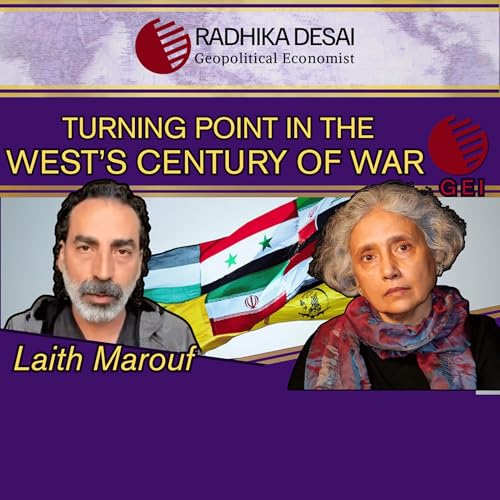
    In this collaboration between Radhika Desai – Geopolitical Economist and Free Palestine TV, its founder, Laith Marouf discuss the historical conjuncture of Trump and Netanyahu’s war on Iran, how it is the culmination of the West’s 100-year war, itself hundreds of years in preparation, on the West Asian region. The many questions we range over include the following:

    • What gives Iran and the Axis of resistance its strength?
    • How are we to understand the role of religion, particularly Shia Islam in it
    • How does it contrast with the instrumental use of synthetic religion in the West, whether by Hegseth or Trump or Netanyahu or Zionism?
    • How have sanctions on Iran boomeranged even more spectacularly than those on Russia, giving that country a military confidence and autonomy few countries have enjoyed?
    • When and how might the war on Iran end?
    Show More Show Less
    48 mins