PRIME MEMBER EXCLUSIVE | 3 Months Free Trial

Auto-renews at INR 199/mo after 3 months. Cancel anytime. Offer ends 15 July, 2026.
History For Busy People cover art

History For Busy People

History For Busy People

Written by: John Higginbotham
Listen for free

Short on time but big on curiosity? History for Busy People delivers fascinating historical tidbits, figures, and events in bite-sized episodes perfect for your commute, coffee break, or whenever you have a few spare minutes.

From ancient civilizations to modern turning points, we uncover the stories that shaped our world, providing you with intriguing insights without demanding hours of your day. Get your daily dose of history and become the most knowledgeable person at the dinner table, all while managing your busy schedule!2026
Social Sciences World
Episodes
  • Before Florida Was American, St. Augustine Was Spanish… Then British… Then Spanish Again
    Jun 19 2026
    Long before Florida became part of the United States, St. Augustine spent centuries caught between rival empires fighting for control of North America. Founded by Spain in 1565, the city would later become British territory after the Seven Years’ War — only to return to Spanish control again after the American Revolution.

    In this episode of History for Busy People Podcast, we explore the turbulent colonial history of America’s oldest continuously inhabited European-founded city. From Spanish forts and British governors to loyalist refugees and shifting imperial borders, St. Augustine became a living symbol of how global wars reshaped everyday life in early America. You’ll hear the story of:
    • Why Spain founded St. Augustine in the first place
    • How Britain took control of Florida
    • What life was like during British rule
    • Why loyalists fled there during the American Revolution
    • How Spain reclaimed the city yet again
    • And how St. Augustine finally became American
    This is the story of a city that changed flags repeatedly without ever moving an inch.
    Show More Show Less
    24 mins
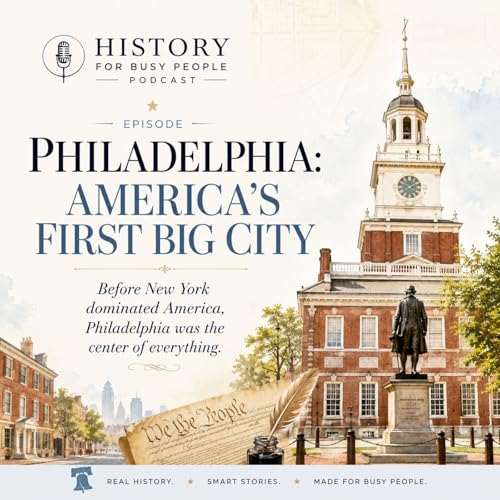
  • Philadelphia: America’s First Big City
    Jun 12 2026
    Long before Manhattan became America’s financial and cultural capital, Philadelphia was the nation’s largest and most important city. Founded by William Penn as a carefully planned “greene country towne,” Philadelphia was designed with wide streets, public squares, and a strict grid meant to avoid the fires and disease that plagued European cities. By the late 1700s, it had become a booming port filled with immigrants, merchants, craftsmen, and revolutionaries — a place where religious freedom, commerce, and new ideas collided.

    In this episode of *History for Busy People*, we explore how Philadelphia became the cradle of American independence and a city of remarkable firsts. Inside Independence Hall, the Declaration of Independence was signed and the U.S. Constitution was drafted. The city also became home to America’s first lending library, public hospital, medical school, and U.S. Mint, while leaders like Benjamin Franklin pushed for civic improvements that transformed everyday urban life.


    We also trace Philadelphia’s explosive 19th-century growth as it battled unrest, absorbed surrounding districts through the Consolidation Act of 1854, and evolved into the “Workshop of the World,” producing everything from Baldwin locomotives to Stetson hats. For a brief but critical moment in history, Philadelphia wasn’t just another American city — it was America itself.
    Show More Show Less
    6 mins
  • Why the Sun Belt Exploded After Air Conditioning
    Jun 5 2026
    For most of American history, much of the Sun Belt was considered too hot, too humid, or too harsh for massive population growth. Summers in places like Phoenix, Houston, and Las Vegas weren’t just uncomfortable — they shaped where people lived, worked, and built their futures.

    Then came air conditioning.

    In this episode of History for Busy People, we explore how one invention quietly rewrote the map of America. Reliable cooling didn’t just make life more comfortable — it transformed deserts into booming suburbs, fueled the rise of sprawling metropolitan areas, and helped turn the South and Southwest into economic powerhouses.

    From movie theaters advertising “refrigerated air” to the rise of malls, office towers, retirement communities, casinos, and massive suburban developments, this is the story of how climate control changed American migration, business, politics, and daily life forever.
    Show More Show Less
    43 mins
adbl_web_anon_alc_button_suppression_t1
No reviews yet