• Before Florida Was American, St. Augustine Was Spanish… Then British… Then Spanish Again
    Jun 19 2026
    Long before Florida became part of the United States, St. Augustine spent centuries caught between rival empires fighting for control of North America. Founded by Spain in 1565, the city would later become British territory after the Seven Years’ War — only to return to Spanish control again after the American Revolution.

    In this episode of History for Busy People Podcast, we explore the turbulent colonial history of America’s oldest continuously inhabited European-founded city. From Spanish forts and British governors to loyalist refugees and shifting imperial borders, St. Augustine became a living symbol of how global wars reshaped everyday life in early America. You’ll hear the story of:
    • Why Spain founded St. Augustine in the first place
    • How Britain took control of Florida
    • What life was like during British rule
    • Why loyalists fled there during the American Revolution
    • How Spain reclaimed the city yet again
    • And how St. Augustine finally became American
    This is the story of a city that changed flags repeatedly without ever moving an inch.
    Show More Show Less
    24 mins
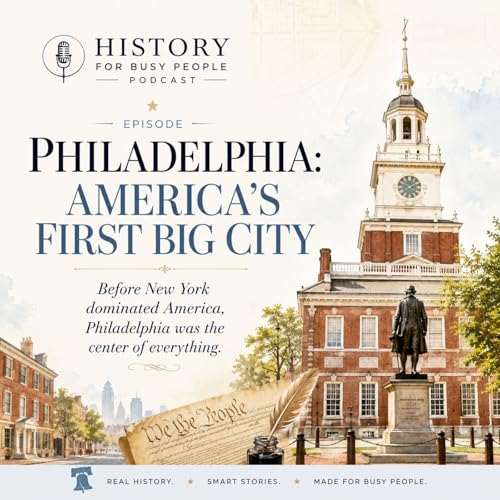
  • Philadelphia: America’s First Big City
    Jun 12 2026
    Long before Manhattan became America’s financial and cultural capital, Philadelphia was the nation’s largest and most important city. Founded by William Penn as a carefully planned “greene country towne,” Philadelphia was designed with wide streets, public squares, and a strict grid meant to avoid the fires and disease that plagued European cities. By the late 1700s, it had become a booming port filled with immigrants, merchants, craftsmen, and revolutionaries — a place where religious freedom, commerce, and new ideas collided.

    In this episode of *History for Busy People*, we explore how Philadelphia became the cradle of American independence and a city of remarkable firsts. Inside Independence Hall, the Declaration of Independence was signed and the U.S. Constitution was drafted. The city also became home to America’s first lending library, public hospital, medical school, and U.S. Mint, while leaders like Benjamin Franklin pushed for civic improvements that transformed everyday urban life.


    We also trace Philadelphia’s explosive 19th-century growth as it battled unrest, absorbed surrounding districts through the Consolidation Act of 1854, and evolved into the “Workshop of the World,” producing everything from Baldwin locomotives to Stetson hats. For a brief but critical moment in history, Philadelphia wasn’t just another American city — it was America itself.
    Show More Show Less
    6 mins
  • Why the Sun Belt Exploded After Air Conditioning
    Jun 5 2026
    For most of American history, much of the Sun Belt was considered too hot, too humid, or too harsh for massive population growth. Summers in places like Phoenix, Houston, and Las Vegas weren’t just uncomfortable — they shaped where people lived, worked, and built their futures.

    Then came air conditioning.

    In this episode of History for Busy People, we explore how one invention quietly rewrote the map of America. Reliable cooling didn’t just make life more comfortable — it transformed deserts into booming suburbs, fueled the rise of sprawling metropolitan areas, and helped turn the South and Southwest into economic powerhouses.

    From movie theaters advertising “refrigerated air” to the rise of malls, office towers, retirement communities, casinos, and massive suburban developments, this is the story of how climate control changed American migration, business, politics, and daily life forever.
    Show More Show Less
    43 mins
  • Bread, Circuses, and the Slow Death of the Roman Empire
    May 29 2026
    What happens when a civilization becomes more focused on entertainment than solving its problems?

    The Roman Empire mastered distraction long before smartphones, streaming, and social media existed. Free grain. Massive spectacles. Celebrity gladiators. Endless public entertainment. Rome called it “bread and circuses” — a strategy designed to keep the population distracted, emotionally occupied, and politically quiet while deeper problems quietly grew beneath the surface.

    The empire didn’t collapse in a single dramatic moment. It slowly weakened while the crowds kept cheering.

    Nearly 2,000 years later, the story feels strangely familiar.

    In this episode of History for Busy People, we explore how the Roman Empire used entertainment, spectacle, and public distraction to keep its citizens calm during times of growing instability.

    From gladiator games and chariot races to free grain handouts and massive public events, Rome built one of history’s first “attention economies.” But while the people were entertained, deeper cracks were spreading through the empire — economic pressure, political corruption, military overstretch, failing infrastructure, and social exhaustion.

    Was “bread and circuses” simply harmless entertainment… or did it help delay the public’s awareness of Rome’s slow decline?

    This episode connects the ancient world to modern culture, exploring how distraction, celebrity obsession, and endless entertainment still shape society today.History has a way of rhyming.
    Show More Show Less
    58 mins
  • The Ghost of the Caesars: Why the Papacy is the Ultimate Living Link to Ancient Rome
    May 22 2026
    The papacy may be the last true living institution of Ancient Rome.

    In this episode of History for Busy People, we explore how the modern Vatican still carries the echoes of the Caesars — from Roman titles and imperial rituals to architecture, Latin, law, and power itself.

    Why does a pope still feel ancient in a way no president or prime minister does?
    How did the Catholic Church survive the collapse of the Roman Empire?
    And why does walking through Vatican City sometimes feel like stepping into a world where Rome never truly fell?

    This is the story of emperors, bishops, collapsing empires, and the strange continuity between Ancient Rome and the modern world.

    ⏳ In this episode:
    • The fall of the Western Roman Empire
    • How the papacy inherited Roman authority
    • Pope Leo the Great and Attila the Hun
    • Why Latin still matters
    • Roman symbolism hidden in the Vatican
    • The transformation from Caesars to Popes
    • Why the papacy still feels timeless in the digital age

    If you enjoy history, nostalgia, lost worlds, and “history meets now” storytelling, subscribe for more episodes.
    Show More Show Less
    50 mins
  • Before Amtrak: When Trains Were the Internet of America
    May 17 2026
    In this episode of *History for Busy People*, we travel back to the era before Amtrak — when America’s passenger rail network functioned like the internet of its time. Long before smartphones, social media, interstate highways, and commercial air travel dominated daily life, trains connected cities, small towns, businesses, families, and ideas across the nation.

    We explore how railroad stations became the social and economic hubs of America, why entire towns set their clocks by railroad timetables, and how famous passenger trains like the Broadway Limited and Super Chief shaped the rhythm of American life. From mail delivery and business travel to tourism, migration, and wartime movement, the railroads formed a vast human network that transformed how Americans experienced distance and connection.

    This episode also examines the slow decline of private passenger rail service after World War II, the rise of automobiles and air travel, and how the creation of Amtrak in 1971 became a last effort to preserve a fading transportation system that once unified the country.

    **Keywords:**
    Amtrak history, passenger rail history, railroad history, history of trains in America, before Amtrak, American railroads, passenger trains, railroad stations, train travel history, Broadway Limited, Super Chief, railroad nostalgia, transportation history, interstate highway system, history meets now, American infrastructure, railway culture, golden age of railroads, train podcast, History for Busy People, railroad decline, American travel history, rail network, historic trains, history podcast, industrial America, mail by rail, railway timeline, classic passenger trains, transportation revolution
    Show More Show Less
    55 mins
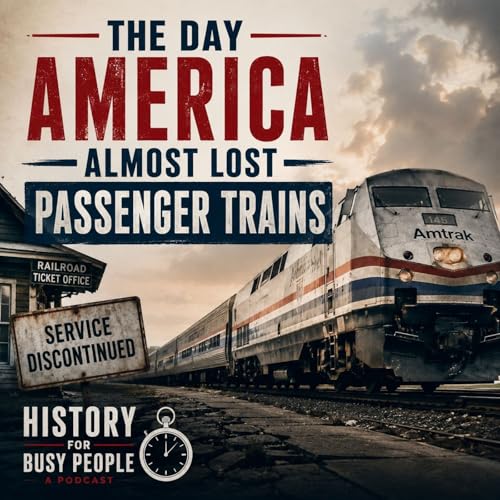
  • The Day America Almost Lost Passenger Trains
    May 10 2026
    “By the late 1960s, America’s railroads were collapsing. Passenger trains were bleeding money, airlines were booming, and the interstate highway system was rewriting the country. Then came Amtrak.”

    We discuss:
    • Decline of private railroads
    • Cars + interstate highways
    • Jet age competition
    • Why railroads wanted out
    • Creation of Amtrak in 1971
    Modern angle:
    • Why passenger rail still struggles today
    • Comparison to Europe and Japan
    Show More Show Less
    33 mins
  • The 300-Year Story – What if the way people talk in Appalachia is actually a time capsule?
    Mar 15 2026
    The 300-Year Story – What if the way people talk in Appalachia is actually a time capsule?

    Why do some people in Appalachia have strong accents while others don’t—even when they grew up only a few miles apart?

    In this episode of History for Busy People, we explore the surprising history behind the Appalachian accent and how language can act like a living time capsule.

    From Scots-Irish settlers in the 1700s to the rise of river towns, railroads, and industrial cities, the way people speak in Appalachia has been shaped by migration, geography, and history.

    You’ll discover:

    • Why Appalachian English preserves pieces of language from centuries ago
    • How the Ohio River shaped the accents of towns like Huntington, West Virginia
    • The hidden dialect boundary where Appalachian, Southern, and Midwestern speech meet
    • Why younger generations are losing the traditional Appalachian accent
    • How mountains, isolation, and migration preserved unique speech patterns

    The Appalachian accent isn’t just a way of talking—it’s a 300-year story about the people who settled the mountains and the forces that shaped their culture.

    If you enjoy history, language, and hidden stories from America’s past, this episode is for you.
    Show More Show Less
    47 mins