Episodes

  • How Might We Build Trust Internationally
    Sep 12 2025
    In this episode, we ask a simple question with complex answers: how do you build trust across borders, cultures, and systems? Scott is joined by three voices with lived, global experience. Fahd shares how his teams serve families across Pakistan and the diaspora, and why trust is the real product when support is delivered from afar. Douglas reflects on leading across regions and why celebrating what is right with the world changes how we partner. Geoff brings two decades on global boards, arguing that trust starts with how we listen, engage, and follow through. Together they cover: Culture, context, and why “one message fits all” fails. Media noise, facts, and the human habit of de-humanising “the other.” Practical habits that travel well: clear expectations, empathy, openness, and delivery. Ideas like Ubuntu, and why being there for each other builds credibility over time. The role of data and technology, and why human experience still decides outcomes. If you lead teams, sell across markets, or simply want to work well with people who are not like you, this conversation will help. Listen in for practical ways to earn trust—one interaction at a time. Geoff Linkedin Profile https://www.linkedin.com/in/geoffsearle/ Douglas Linkedin Profile https://www.linkedin.com/in/douglaslines/ Fahd Linkedin Profile https://www.linkedin.com/in/fahd-khan-406bb835/ Transcript - Generated by AI and may not be 100% accurate Hello and welcome to the latest edition of How Might We, and this time we're talking about how might we build trust internationally and at the time we are. I think that's a very interesting subject. And with me on this podcast is one of my regular guest, Jeff, another Douglas, who's been on many times and for the first time, and welcome is Fard. Welcome to the podcast gentlemen who would like to introduce themselves first. I think Fard should introduce himself first. Okay, there we go, please, Fard. Alright, so thank you for having me, onto the podcast. my name is Fahard and I'm the CEO of, two companies. One is, Mosen and the other is Moja. Moha is a private 9 1 1 service, or a private 9, 9, 9 service. in third world countries you typically don't have. very efficient systems, that work. So I have to make a private 9, 9 9, solution for the people of Pakistan in and through this company, we've, helped save more than 15,000 lives and, handle more than 55,000 events, globally. The other company is Mosin Mosin, is, very relevant to the topic today because, Mosin is all about helping, expat and overseas Pakistanis look after their families back home and making sure that they're looked after safe, provided for and everything. The typical challenge that we're trying to address is, establishing trust with the people who are sitting outside of Pakistan. They're looking for a service provider who basically look after their families like a surrogate child. So, you can imagine nobody wants to stand in unless they can trust them. So, it's very relevant to the topic today. Okay. Thank you very much and welcome. So, Douglas, do you wanna go next? Thank you, Scott, and it's, wonderful to, to see everybody again and far just amazing, , what you're doing in that region. And looking forward to having a conversation together today. And thank you, Scott, for including me. I said my name is Douglas Lyons. I'm a co-founder and director of IBM Group Limited based in London, and, have been so for a number of years. And Jeff and I are business partners and good friends. As, yourself, Scott and Fahd. So I think this is a collection of amazing people, but amazing friends, with these real trusts. So really looking forward to wonderful conversation from all the perspectives this afternoon. Okay, thank you very much. And last but not least, Jeffrey. Thank you young man. Geoff Hudson Sill, independent non-executive director for the last 20 years on, global technology companies. senior executive, C-suite executive on both publicly listed and privately listed companies. author of seven books, regular thought leader and also, co-founder and and director with Douglas, as I said on on IBM group and group of companies. Okay. Welcome gentlemen. we're gonna talk today about how, how do we or how might we build trust internationally, which I think with the way that's [going on, especially geopolitically, and trade wise is quite an interesting topic. And, as far as you said, even in business, how do we build trust internationally that, especially the business you are doing with. Looking after people for expats or people abroad, and they're trusting you to deliver services and things from them, from afar, from a distance. I think, I think one of the things that we, we, so trust is a very expansive, very overreaching sort of word, but it is so fundamental in nature. It starts, from almost childbirth, where, where a child is, is, brought into the world and, he grows up in the cradle in the arms of people that ...
    Show More Show Less
    1 hr and 4 mins
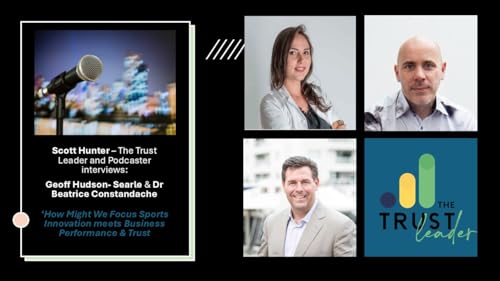
  • How Might We Align Sports Innovation With Leadership and Trust
    Aug 1 2025
    Welcome to How Might We Align Sports Innovation With Leadership and Trust, the podcast that explores bold questions at the intersection of leadership, innovation, and trust. In this episode, we’re diving into a powerful question: How might we align sports innovation with leadership and trust? Joining me are two exceptional guests bringing insight from two very different—but deeply connected—worlds. Dr. Beatrice Constandache is a specialist in sports medicine with a career spanning elite athletics, Olympic-level performance, and cutting-edge research into energy, emotion, and innovation in sport. She is currently a member of the medical committee of the International Association of Ultrarunners and founder of the Luce Innovations Medical Academy. Also with us is Geoff Hudson Searle, an international bestselling author and seasoned executive with over 30 years of experience in design-led innovation and trust-based leadership. Geoff brings deep business insight and a compelling vision for how human intelligence, collaboration, and emotional connection can transform both teams and organisations. Together, we explore what business can learn from elite sport—from team culture, emotional intelligence, and resilience, to the power of energy, empathy, and trust. It’s a wide-ranging conversation that challenges conventional thinking and offers a fresh take on high performance—on and off the field. Dr. Beatrice Linkedin Profile: https://www.linkedin.com/in/dr-beatrice-constandache-2650639b/ Geoff Hudson Searle Linkedin Profile: https://www.linkedin.com/in/geoffsearle/ -------------------------------------------------------------------------------------------------------------------- Transcript: This is AI generated and may contain errors [00:00:00] Hello and welcome to the latest edition of How Might We, in this episode is how might we Align sports innovation with Leadership and Trust? And I've got two guests with me today, one of my regular guests, which is Jeff Hudson Cell and a new guest, which is Dr. Beatrice. So welcome both of you to the podcast and would you like to introduce yourselves? Who would like to go first? Thank you so much. Welcome. Thank you so much. My Hi everyone. My name is Dr. Ris Constantia. I am a sports medicine specialist with experience in rugby medicine, athletics, medicine. I've worked with Olympic athletes and now I am currently a member in the medical committee of Ultra Running International Association. And I founded the Loose Innovations Medical Academy currently [00:01:00] supporting the elite athletes and sports medicine to bring up the innovations in in this area. Okay, lovely. Thank you very much. It'll be, and Jeffrey, would you like to Thank you. Thank you, sir. Thank you. Jeff Hudson, sell 30 years plus global international seasoned executive in independent non-executive director for the last 20 years, around two separate businesses in the UK specializing in consultancy growth and design led innovation and trust. I'm an author of seven books, sorry, international bestselling author of seven books and public thought leader and speaker. Okay. We could, we've gotta get the international bestselling, haven't we? We can't. We're just not bestselling. We are in, we're Global. We remember. You remember that was what I was saying to Oak when we spoke last round. Yes, I remember that from Oak. Yeah. Hilarious. Hilarious. I was the only one who was not an author. So the whole list. So Dr. Beatrice, welcome and welcome to the podcast. [00:02:00] Thank you so much for having me. Oh, you're more than welcome. . So from your experience and obviously working through all the sports and bringing sports innovation, how do you think that would transpire into the business world and leadership? I think that throughout the years I've saw the struggles of the athletes at the highest level of sports Yeah. And the medicine level also there . and I would like here to give the microphone, to Jeff so to say overdue there, Jeffrey. Excellent. Thank you, sir. So I've got a couple of school of thoughts on this. Okay. So I have worked with sports professionals around the world. In fact, one of my very good friends was an NBA basketball championship. And he, when he left basketball, he transferred over to the business world and became a very successful c-suite executive in a Fortune 100 company a after his sports career. So [00:03:00] I've had the chance to actually spend quality time with. True professionals from sports. I've also looked at sports coaching. So if I look at sports coaching that really innovated the world my favorite coach of all time is Vince Lombardi. And I, he was the most successful NFL coach in the world. So successful that the rugby world particularly the All Blacks decided in their wisdom that they wanted to improve their percentage. They used the Lombardi methodology and no big surprise there was an 84% percentage win as a direct result of using the ...
    Show More Show Less
    59 mins
  • How Might We Impact Leaders Mindset
    Dec 19 2024
    Introduction Welcome to How Might We, the podcast that explores transformative ideas and strategies for leadership. In this episode, we delve into how leaders can cultivate impactful mindsets, featuring two exceptional guests: Geoff Hudson Searle, an international business leader, author, and keynote speaker with extensive global experience, and Oakland McCulloch, a retired Army officer with over 40 years of leadership expertise spanning combat, peacekeeping, and boardroom operations. Together, they bring a wealth of insights into the power of trust, collaboration, and mindset in shaping leadership. From the challenges of modern communication to the erosion of institutional trust, this conversation examines practical ways to build connection, foster community, and lead with purpose in a rapidly changing world. Get ready for an engaging discussion on the privilege of leadership, the importance of curiosity and care, and actionable strategies to create meaningful impact in organisations and beyond. Let’s dive in! Transcript Scott: [00:00:00] Hello, welcome back to the latest edition of how might we, and this edition, we're talking about how might we impact leadership mindset and joining me are Jeff Hudson Searle and Oakland McCulloch. I know you've been on some of the other episodes, both of these people have been on before, so it's going to be an interesting discussion. But for those who don't know you gentlemen, if you'd like to introduce yourselves to the audience and who would like to go first. Oakland: Oh, please. I'm glad to be back. Thanks, Scott. And thanks, Jeff, for inviting me to come back. I live here in the United States. I retired from the army after 23 years on active duty. You got over 40 years of leadership experience in combat, peacekeeping operations, disaster relief operations, and in the boardroom. And now I'm just a keynote speaker. I go around and talk about leadership and success. And as we talk about a lot, Jeff, trust. Absolutely. [00:01:00] I'd Geoff: like Oakland: to know Geoff: though, you're an international keynote speaker these days, aren't you? That's right. Right. Just Scott: in front of that. Okay. It lets yourself down. You're not just a keynote speaker. You Geoff: are international. Yes. It's like Scott: a man of wisdom. Right. And Jeff. Geoff: I'm myself. Yeah ex banker city bank head of commercial finance. That's where I started really my career and actually my, my formal education, really anything else 10 years around the world, launching fortune, 100 bands, C suite executive and CEO of both. Public and privately listed companies. International. Sorry, international. Very international. I've worked in over 121 countries in the world. I'm also an independent non executive director and chair of Remco. I've been doing that for the last 17 years. in my independent capacity. I'm currently on the executive board of two companies, one a metaverse company out of Australia, London and also one an AI sustainability [00:02:00] business which is very much based on Europe, UK, and also in MENA. I'm also an author of seven books and this family movie Discussion really highlights is going. I hope we'll highlight some of the important issues around, you know, collaboration, community, partnership and very much, you know, trust and what we do today. Scott: Okay. Welcome gents. So, and you didn't say you're an author as well. Oakland: Yeah. Yeah, I am. I've got one book out. I'm not as good as Jeff, but I got one out. You are? Talks about leadership and you know, and one of the things I always tell people is, You know, I don't mention theory at all in my book or in my talks. I talk about everyday things that everyday leaders can do to help improve their leadership ability and empower the people they have the privilege to lead. And it is a privilege to be the leader. And unfortunately as Jeff and I have talked about several times, it's too many leaders today have [00:03:00] forgotten that it's a privilege to be the leader and you see the results. Scott: Okay, well, you've got one more book than me, so I'm on zero, so you're okay. No books. I keep getting told I should write one, but I haven't got around to it. Okay, so before we came on here, we were talking, I think the word that came out that interested me quite a lot was community, sort of leadership through community and what that means globally. And obviously, We'll be talking about all the elections that are happening in 2024, and they're all settled down now, so during 2024 into 2025, the results of those elections are going to become apparent and the new governments are coming into shape. So how does that sort of pan into what we're talking about, the impacts of leadership and mindset? Yeah. So, I mean, let me kick this off. Oak and I were having lunch recently and we, we did talk about this and I think it's an incredibly important subject. Firstly, it's like, you know, when I start to think about community, I ...
    Show More Show Less
    54 mins
  • Ho Might We Create Inclusive Leadership
    Oct 10 2024
    This episode I have three distinguished guests chatting about inclusivity and leadership. My guests are Mark, Gary and Douglas - see below for more details about them Mark Freed Mark Freed, a trailblazer in diversity and inclusion, co-founded E2W over two decades ago when he left a successful fintech career to become the type of husband and father that he always wanted to be. Mark grew E2W to become a community with a reach of more than 15,000 women in Financial Services, aiding institutions with best-practice recruitment and retention of diverse talent. Wishing to accelerate change, Men for Inclusion was born, and Mark shares his own lived experience as to why inclusion benefits all men, providing more opportunities and breaking free from outdated stereotypes. Mark's distinctive voice is not just heard within this community. He’s a vocal advocate for workplace inclusivity, and recently provided evidence to the UK Government Treasury Select Committee during their 'Sexism in the City' inquiry, and collaborates on initiatives like the Women in Finance Charter and the Diversity Project. Mark brings a refreshing perspective to the industry, making him an engaging and insightful commentator for journalists seeking a fresh take on diversity, allyship, recruitment, and workplace culture. Gary Ford Gary Ford worked as a technologist within Financial Services for over 35 years. He was a Managing Director at JPMorgan where he co-founded their male allies programme for Women in Technology. The programme was rolled out to thousands of men globally and was ultimately launched across the whole firm. For the last 10 years Gary has actively promoted gender equality. He’s been the male ally advisor to Women On The Wharf, and was a winner of the WeAreTheCity Rising Star award in the Men for Gender Balance category. In 2020, he co-authored his first book, 'The Accidental Sexist: A Handbook for Men on Workplace Diversity and Inclusion’ (Rethink Press), showcasing his commitment to fostering inclusivity in workplaces. Gary’s not just a co-founder; he's a driving force behind Men for Inclusion, bringing a wealth of experience and a passion for creating transformational culture change. A compelling and knowledgeable industry commentator, Gary provides insights and data that will interest those fostering inclusive workplaces through DEI employee engagement and inclusive leadership. Douglas Lines Douglas Lines is a digital first leader with a successful track record of growing and transforming businesses as well as innovating and commercialising new digital business models including successfully launching a global EdTech start-up amongst others. Douglas has been enabled by building a design thinking school in collaboration with Duke and Stanford Universities, appreciating the application of new technologies and having mastered business model innovation and cultural transformation practices. A purpose led and values driven senior business leader, executive committee member with substantial global commercial experience, operating principally in financial services. Pedigree business acumen underpinned by successful delivery of large complex transactions & portfolio managed businesses from > £1m to £8bn. Highly articulate communicator, C-Suite negotiator & influencer; comfortable engaging with all stakeholders. Motivated mentor & people leader who removes barriers to delivery & celebrates team successes, empowering personal goal development & cohesive team service delivery. Mark's LinkedIn Profile - https://www.linkedin.com/in/mark-freed-3a496a6/ Gary's LinedIn Profile - https://www.linkedin.com/in/garypford/ Douglas's LinkedIn Profile - https://www.linkedin.com/in/douglaslines/ Men for inclusion website - menforinclusion.com IBEM website - https://ib-em.com/ Transcript Scott: Hello and welcome to the latest edition of how might we and I've got with me , this week, we've got Douglas, Gary and Mark, and we are going to discussing how might we create inclusive leadership, . And that's not just related to work, but leadership in general and communities, ourselves, our families and with us. So welcome, gentlemen. How are we all today? Mark: Great. Scott: All good. Doing Mark: good, doing good. Scott: I'll give you a hint. We're audio. So nodding doesn't help. We are on audio. So the people need to listen to us, but there we go. Okay. So welcome gentlemen. So if we'd like to go in around Robin, just a quick introduction about yourselves. And then we will start the discussion. So as we've had a quick chat, we'll do it in the same order as before. So Gary, would you like to go first? Yeah, thanks, Scott. Gary Ford [00:01:00] former technologist within the financial services industry previously a managing director at JPMorgan Chase author of a book, The Accidental Sexist, and the co founder of Men for Inclusion with Mark. Okay. Thank you very much. And a nice segue into you, Mark, if you want to introduce ...
    Show More Show Less
    54 mins
  • How Might We Focus In Leadership
    Jul 18 2023

    My guests this episode are Geoff Hudson Searle, Douglas Lines and Oakland McCulloch. During the podcast we discuss focus in leadership, trust, psychological safety amongst other topics.

    Corporate leaders today are measured by a new yardstick. The supreme test of a CEO and board of directors is now the value they create not just for shareholders, but for all stakeholders.

    The shift to stakeholder capitalism creates pressure for corporate leaders to try to satisfy a wide range of constituencies with different, sometimes conflicting interests and perspectives. Earning their trust is key to navigating this tricky terrain.

    Research shows that trust is the key to success. Yet growing distrust, cynicism and misinformation are eroding confidence in corporate impact and Environmental Social & Governance (ESG) claims.

    To prosper in the age of stakeholder capitalism, companies must actively cultivate the trust of employees, investors, customers, regulators and corporate partners: developing strategies to understand these stakeholders more intimately, implementing deliberate trust-building actions, tracking their efforts over time, and communicating openly and effectively with key stakeholder groups.

    We have entered the trust era: a time where (mis)information is omnipresent, individual perceptions reign supreme, and digital security and data privacy are constantly threatened. Now more than ever, stakeholders expect organizations to do the right things and do them well. These expectations range from entrusting an organization to safeguard one’s private data to requiring a company to have a strong stance on environmental, social, and governance (ESG) issues.

    Trust also drives performance. When stakeholders trust an organization, their behaviors will reflect that trust can affect more traditional key performance indicators that directly affect financial performance. Trust elevates customer and brand loyalty, which can lead to revenue. It enhances levels of workforce engagement, which can result in increased productivity and retention. And the data confirms it.

    Trustworthy companies outperform nontrustworthy companies by 2.5 times, and 88% of customers who highly trust a brand will buy again from that brand. Furthermore, employees’ Trust in their leaders improves job performance, job satisfaction, and commitment to the organization and its mission.

    Despite the data, however, many leaders and organizations still view trust as an abstract concept. Trust should be managed proactively because, when trust is prioritized and acted upon, it can become a competitive advantage. An organization that positions trust as a strategic priority—managing, measuring, investing in, and acting upon it can ultimately build a critical asset.

    No heroic leader can resolve the complex challenges we face today. To address the important issues of our time we need a fundamental change of perspective. We need to start questioning many of our taken-for-granted assumptions about our business and social environments.

    Leaders serve as role models for their followers and demonstrate the behavioral boundaries set within an organization. The appropriate and desired behavior is enhanced through the culture and socialization process of the newcomers.

    Employees learn about values from watching leaders in action.

    The more the leader “walks the talk”, by translating internalized values into action, the higher level of trust and respect he generates from followers.

    To help bridge the trust gap we recognise that organizations need to work with each other and with wider society to identify practicable, actionable steps that businesses can take to shape a new relationship with wider society: a new ‘settlement’ based on mutual understanding and a shared recognition of the positive role that business plays in people’s lives.

    To create such a settlement, businesses need to see themselves as part of a diverse, interconnected, and interdependent ecosystem – one that involves government, regulators, individual citizens, and more. Trust within and across this ecosystem is key to its long-term sustainability and survival. That’s why trust needs to be restored to the heart of the business world.

    Show More Show Less
    1 hr and 8 mins
  • How Might We ReleaseTime In Our Business So We Can Go On a 6 Week Road Trip
    Nov 11 2022

    The latest edition of How Might We is out.

    In this edition Alexis Kingsbury talks to me about releasing time in business so you can go on a 6 week road trip. And this is not just theory, Alexis was talking to me whilst he was on his trip.

    He shares insights and ideas on how to document processes and be able to delegate them confidently to others. How this documentation accelerates onboarding, increases performance and engages and empowers team members.

    Alexis is an award-winning entrepreneur, with over 10 years of experience, currently running two SaaS businesses (AirManual and Spidergap) with a remote and global team. I also support others as a board member and consultant/coach (e.g. Sony Interactive Entertainment). He is an enthusiastic public speaker, podcast interviewee & facilitator, providing practical guidance to help business leaders to onboard and develop amazing teams — getting employees up to speed, reducing mistakes, and freeing up time.

    Alexis LinkedIn : https://www.linkedin.com/in/alexkingsbury/

    Alexis Website: https://www.airmanual.co/

    Show More Show Less
    1 hr and 3 mins
  • How Might We Guide Our Mind for Success
    Oct 28 2022
    My guest is Adelaide Goodeve. Adelaide is an elite performance coach, who, within 10 years, went from nearly bedridden to Ironman athlete and go-to performance coach for some of the world’s best companies, leaders, teams and athletes. In this episode Adelaide talks about her journey and how brain training helped her, and how it helps people change mindsets to become elite performers. Adelaide's linkedIn profile: https://www.linkedin.com/in/adelaide-goodeve/ Adelaides's website: https://www.adelaidegoodeve.com/ ----more---- Transcript Scott: [00:00:00] Hello and welcome to the latest edition of How Might We, and we're gonna do something slightly different today. So what we're gonna do is we're gonna have a conversation and based on where we go with the conversation is how we going to. So we are going to name this show at the end of the recording. So my guest on this episode, it's Adelaide Goodeve. So Adelaide, welcome. Adelaide: Thank you so much for having me. I'm excited to be here. Scott: You're welcome. So we'd like to introduce yourself to the audience. Yes. Adelaide: My name is Adelaide and I'm an elite performance coach. I teach people how to reprogram their brains to tech the, to take their mindset to the next level and achieve their desired results, whether it's increased performance or enhanced happiness. Scott: Okay. So, Helping people think differently is, is and sort of reprogramming that, that aspect of the brain. So do you wanna talk me through that a little bit, what that means? [00:01:00] Adelaide: Yes. So our brain is plastic. So they used to think our brain was hardwired like an electric circuit. So once those pathways were laid down, they didn't think that they could change. So you're kind of stuck with the results you got, whether they were great or not so great, but they now know that it's actually very far from the truth and the brain is plastic. You wanna think about your brain like a muscle. The more you train one neuro pathway, the stronger and better and faster it is at its job, the less you train another neuro pathway. The weaker and weaker it becomes and the slur it is at its job. So if you're at the gym and you just worked out one arm, that one arm is gonna get super strong and then that other arm is gonna look like a noodle in comparison. And this is a bit like how your brain works. Cause if you were to train your left arm and it would, so it could catch up with your right arm. And this is how the brain works, is, is always strengthening the neuro pathways that you use the most, not necessarily the ones which get you the results you want, but it's saying, [00:02:00] okay, they're using, for example, energy and. In the morning the most. So this is the pathways that are gonna make really strong. We're gonna bring them closer together and it's gonna become easier for them to activate those feelings when thinking about the morning. And so it'll enhance those ones. But if we think of the morning and we're thinking dread the most, then it's going to strengthen and bring close together the neuro pathways for the morning and dread. So when we think about the morning, we're like, Ugh, my gosh, I have to get up so early. And we're kind of already in that. State, It's a bit like sheep in the field. You have this chief sheep and every single day he takes his team to the same patch of grass. And over time that pathway is eroded and it's more and more visible. It's deeper, and it's stronger in that ground. You can see it from space cause the grass is just not there anymore. And that path is very deep. It's a dirt path deep in the ground. Cause they're traveling it every single. But then one day that chief sheet kind of looks across the field and he goes, Wow, the grass of [00:03:00] there is so much greener. Like, I bet my sheep could thrive if I took them to that area. So in that moment, in less than a split second, he change, He changes the path that they follow, and now that new neuro pathway or that new pathway in the field, Is now becoming the stronger one. They're walking it more and more often, they're using it the most. That now becomes eroded away and you can see that pathway from space. The old pathway that they used to use is now taken back by nature and you can barely see it and it's very difficult to follow. And this is how the brain changes growth and develops as a result of how we use it and how we use it is determined by our language. Scott: Okay, so there's a phrase, I can't remember if it's when I coined or had a conversation with or read somewhere. It says, language guides the mind. Adelaide: Yes, a hundred percent. So the words we use are the architecture and structure, or by reality. Scott: Yes. Yeah. Cuz what we say is, and our brain can't tell the difference between [00:04:00] reality and I what we think either kind of, so we can be thinking about something in the future, but it hasn't happened. But our brain. We'll react as if we are in that situation. Exactly....
    Show More Show Less
    56 mins
  • How Might We Learn From History To Make Better Decsions
    Oct 14 2022
    In this Episode my guest is Brad Borkan. Brad has a great interest in how people and businesses build resilience. In this episode Brad shares his thoughts on how lessons from leaders of the past can help us make better decisions today. Brad's first book was the award-winning book: WHEN YOUR LIFE DEPENDS ON IT: Extreme Decision Making Lessons from the Antarctic. This book puts the reader right into the action of the life-and-death decisions made by early explorers. In it, we reveal unparalleled lessons in leadership, teamwork, and the sheer determination that can help all of us make better decisions in life. It won 1st Place in the Chanticleer International Book Awards for Insightful Non-fiction. Brad's second book, AUDACIOUS GOALS, REMARKABLE RESULTS: How an Explorer, an Engineer and a Statesman Shaped our Modern World, focuses on six epic achievements made by three extraordinary people, one of whom is Theodore Roosevelt and another is the great Victorian-era engineer, Isambard Kingdom Brunel. The book explains the mindset they each developed to make monumental impacts in their fields. Transcript Scott: [00:00:00] Hello and welcome to the latest edition of How Mike We, And on this episode, I'm pleased to welcome Brad Balkin and we are gonna be talking about how might we learn from history, make better decisions. So, Brad, welcome. Would you like to introduce yourself Brad: please? Hi, Scott. Great to be here. Thanks for having me on your show. I'm Brad Borkin, as you said, and I've written two books that have to deal with history in terms of looking at great explorers and great people in history and great endeavors that were occurred in history and ask what can we learn from this? Focusing on the decision making side of these people and these endeavors. Scott: And I think, I mean, I like decisions cuz I think we've mentioned before when we're off air is decisions are basically the precursor to every action we. Brad: Yes, they're at the heart of, of everything. And one of the things when it came to the early [00:01:00] Antarctic explorers was there's lots of books written about them as people, about the expeditions, like what they ate and how, where they traveled and the challenges they faced. But actually up until the, the book that my coauthor and I wrote, no one ever looked at the decisions. And we looked at the life and death decisions, which were actually the most exciting ones because they all, they all came near death all the time, but they actually very rarely ever died. Scott: Well, I can't, I suppose dying only happens once, so Yeah, that's it. Brad: That's that's true. But, but they, but they came, they came, they faced all sorts of commodities and, and challenges and, and you know, these, these, you know, everything from frostbite, curvy to, to flowing, harasses and, and all sorts of things and that, but somehow they, they were sort of at one level sort of indestructible. Yeah. Scott: I think the interesting thing is, as I say, you make a, you make a decision. I think we've talked about this as well before, is, and basically you're trying to predict the future with a decision. Cause when [00:02:00] we don't know the outcome, until we actually make that decision and enact it. Brad: That's right. Yeah. And, and, and actually a good, good point is, is I retired from my main job in 2021 in, in July, 2021, which coincide with to launch my second book. And inflation was 2% and the stock market was slowly growing and the world was at peace. And a year later, you know, it seemed like a sane. Normal rational decision. Inflations at 10%, the stock market is down 25%, and the war, you know, at least Ukraine and, and Russia at war. And it's, it's just a complete un perhaps not predictable, but it's, it's the, the outcome of a decision that you, you don't know until you look back many years later on. What's that? A good decision or a bad decision? Scott: Well see, I, my view on decisions is I think the decision, we make decisions, and usually it's one of the, with the. Capabilities we have at that time, whatever they may be with the best [00:03:00]intentions for the outcome that we want this, that that's there. So I would say a decision either has the desire, Or unexpected outcomes. Brad: Yes. And I think one of the things that's exciting about life and about looking, whether you're looking at explorers or you're looking at, at his great people in history, is that you can't, no one could predict the future. And even for them, like, just like we can't predict the weather that well, we really can't predict what the outcome is. Whether you're heading to the South Pole and you're running outta food and you're trying to decide what do we do next? Or you're trying to build a Panama Canal and you're dealing with workforces, dying of yellow fever and, and all sorts of other engineering challenges and building the Panama Pinella. It's like you just, you, you make. Best decision you can. But one of the things ...
    Show More Show Less
    56 mins