I Listen Space cover art

I Listen Space

I Listen Space

Written by: Chiradeep Patra
Listen for free

About this listen

Welcome to the "I Listen Space" podcast, where empathy, understanding, and active listening matter, while promoting mental health awareness, fostering a non-judgmental mindset. In addition to discussing mental health, "I Listen Space" also offers motivational and inspiring content that is rooted in biblical principles. For 1:1 Counselling - https://topmate.io/chiradeepChiradeep Patra Hygiene & Healthy Living Psychology Psychology & Mental Health
Episodes
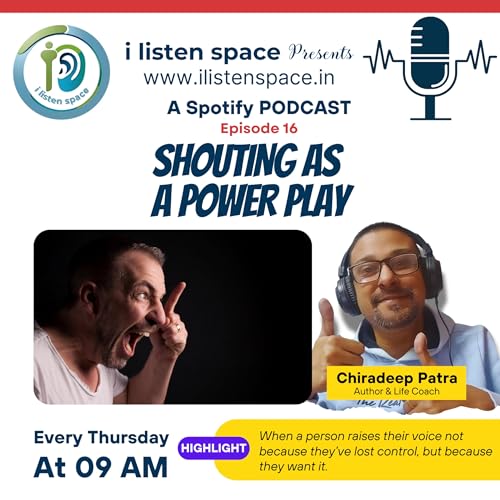
  • Shouting as a Power Play
    May 15 2025

    Why do people shout? Is it just because they’re angry? Or is there something deeper going on?


    Welcome to I LISTEN SPACE. I’m Chiradeep, your host.


    Today, we’re going to talk about something we’ve all encountered, whether in our families, workplaces, or sometimes even in ourselves—shouting.


    Let’s pause for a moment and think of all the possible reasons behind someone raising their voice. Sometimes it’s raw anger. Sometimes it’s fear. There are people who shout when they panic or feel anxious. Some raise their voice because they feel no one is listening—they just want to be heard, to be seen. And then there are those who shout out of insecurity, not knowing how else to assert themselves. But there’s another layer, one that we often overlook—shouting as a power move. A tool to control, not to communicate.


    Let’s talk about that.


    There are people who raise their voice not because they’ve lost control—but because they want control. They use shouting as a way to shut others down. They believe that being louder makes them stronger, more in charge, more important. And this happens in very familiar places—at home, in a marriage, at the dinner table. It happens at work, in leadership, in friendships. One person raises their voice, not to express emotion, but to dominate the moment.


    But is that really strength?


    In reality, shouting to control others reveals something else. A fear of not being heard. A fear of losing ground. It’s as if they believe their words won’t carry weight unless they’re thrown loudly. And the sad part? It often works—temporarily. People go quiet. They back down. They don’t argue. But that silence is not agreement—it’s withdrawal. That nod is not respect—it’s exhaustion. Slowly, relationships wear down. People start keeping a distance. They become careful around you. They stop sharing honestly.


    And if you find yourself in that place—using volume to be heard—pause and ask yourself: What am I afraid of? Why do I feel the need to be louder to make a point? What am I trying to prove? What am I trying to protect?


    The truth is, shouting may work for a moment, but it damages in the long run. It chips away at trust. It silences connection. And what’s left is not respect—but fear. A fragile kind of fear that pretends to be authority.


    Real strength? It’s calm. It’s clear. It knows when to speak and when to listen. It doesn’t need to shout to be heard.


    Thank you for listening. If this conversation touched something in you, share it with someone who might need to hear it—softly, kindly. Because the loudest voice doesn’t always carry the deepest truth.


    Until next time, take care of your voice and those around you.

    This is I LISTEN SPACE. I’m Chiradeep. Keep listening.

    Show More Show Less
    4 mins
  • Present: The Only Time That’s Truly Ours
    May 8 2025

    Have you ever come across people who are constantly talking about their past—about the hurts, the losses, the betrayals?
    Or people who are endlessly anxious about their future?
    They ask, “What will happen to me if this person doesn’t live anymore?” or “I’ve gone through so much... it has ruined my entire life.”

    Whenever they get an opportunity to speak, they go back to their past or shoot forward into their future.
    And what do you observe in them?
    They are often restless, anxious, or disconnected.
    They seem to be living everywhere—except in the now.

    Welcome to I LISTEN SPACE. I’m Chiradeep, your host.
    And today’s episode is titled: “Living in the Present: The Only Time That’s Truly Ours.”

    Let’s reflect for a moment.
    The present is the only time we actually have in our control.
    We can neither rewrite the past nor predict the future.
    Still, so many of us spend our lives haunted by what has already happened or paralyzed by fear of what might happen.

    So what happens when we don’t live in the present?

    We carry a heavy emotional burden—regret, guilt, sorrow, anxiety—and we miss the simple joys and opportunities that the present moment holds.
    Relationships suffer. Peace escapes us.
    And our emotional wellbeing stays compromised.

    But here’s the good news:
    Being present is a skill. And like any skill, it can be cultivated.

    Let me offer you a few simple ways to anchor yourself in the present:

    • Practice mindful breathing: When you feel overwhelmed, just pause and take three slow, deep breaths. Focus only on the inhale and the exhale. This simple act brings your attention back to the here and now.

    • Notice your surroundings: Look around you and identify five things you can see, four things you can touch, three things you can hear, two things you can smell, and one thing you can taste. This grounding exercise reconnects you with the present moment.

    • Name your feelings without judgment: Instead of reacting quickly, pause and say to yourself, “I’m feeling anxious” or “I’m feeling frustrated.” Acknowledging your emotions without criticizing yourself helps you gain control over them.

    • Set a daily intention: Every morning, ask yourself, “What do I want to focus on today?” or “How do I want to show up for myself and others today?” This keeps your mind focused on one clear direction instead of spiraling into what-ifs.

    • Be where your feet are: Literally look at your feet and say, “I am here. This moment is enough.” It's a physical and mental reminder to stop drifting into the past or future and to return to now.

    The present isn’t always perfect. But it’s real.
    It’s all we’ve got.
    And it’s more than enough when we choose to live in it fully.

    Thank you for listening to I LISTEN SPACE.
    If today’s episode resonated with you, follow and share it with someone who might need this reminder.

    Until next time—breathe, feel, and be here.

    Show More Show Less
    4 mins
  • The Emotional Blind Spot
    May 1 2025

    Have you ever seen people in the family who keep overdoing things for others—taking up responsibilities, giving their time and energy, and then quietly or not-so-quietly complaining about not being appreciated?
    And then, in the same family, you’ll notice others—who, despite being on the receiving end of that help—don’t even care enough to acknowledge it. They move on as if it’s all expected of the other person.

    Why does this happen?

    Welcome to I LISTEN SPACE. I’m Chiradeep, your host, and today’s episode is called “The Emotional Blind Spot.”

    In today’s episode, we’ll explore how a lack of emotional intelligence can cloud not only our understanding of ourselves—but also of others.
    We fail to process where we stand emotionally. We act out of obligation, guilt, or habit—and then expect others to read our unsaid expectations.
    On the flip side, some of us stay so emotionally self-absorbed, we don’t pause to understand what someone else might be feeling, needing, or struggling with.

    So how do we change this?

    🔹 First, by becoming more aware of why we do what we do. Is it coming from love—or from a need to be needed?
    🔹 Second, by acknowledging that everyone has a different emotional lens—what you do might feel heavy to you but unnoticed to someone else.
    🔹 Third, by learning to express without expecting. Do because you want to—not because you want something back.
    🔹 And finally, by listening—not just to respond, but to truly understand.

    In relationships—especially within families—emotional awareness is the bridge between misunderstanding and connection.

    Take a pause and reflect. Are you really understanding the other person? Or are you just projecting your needs and missing theirs?

    Thanks for tuning in. Follow I LISTEN SPACE on Spotify for more conversations like this. Until next time, stay emotionally aware, and stay kind.

    Show More Show Less
    3 mins
No reviews yet