Innocence Theory Podcast cover art

Innocence Theory Podcast

Innocence Theory Podcast

Written by: Innocence Theory Podcast
Listen for free

LIMITED TIME OFFER | Get 2 Months for ₹5/month

About this listen

Enter the world of simple genuine heartfelt conversations, connecting with people through their stories. Innocence Theory is where we explore the role of design thinking in nudging climate action. Your favourite podcast sprinkled with insights and occasional facetious humour. Brought to you by two childhood buddies, rediscovering everyday life as it happens.

© 2026 Innocence Theory Podcast
Art Biological Sciences Science
Episodes
  • #37 Designing for Repairability : Sustainable product design in the real world (An Inflection Point episode by Innocence Theory)
    Mar 6 2026

    Sustainability that doesn’t make financial sense isn’t sustainable.

    A conversation on sustainable product design, hardware startups, circular economy thinking, and the right to repair.

    In this episode of Innocence Theory, Koushiic Durai, Founder of WowFactories, talks about what it really takes to build sustainable hardware that can survive in the real market.

    His view is simple. People should buy a better tool, with sustainability as a feature, not the pitch. The Combine Driver is the first realization of that idea, a modular screwdriver designed to last and be repaired.

    The conversation explores the realities of building a hardware startup, from high tooling costs and slower iteration cycles to investor expectations and manufacturing constraints.

    At its core is a founder’s challenge: balancing passion, financial viability, and environmental responsibility.

    If the idea resonates, support Koushiic’s vision on Kickstarter:
    https://www.kickstarter.com/projects/wowfactories/the-combine-driver-2-in-1-ratchet-and-torque-screwdriver

    What This Episode Explores

    • Why starting with a humble tool can unlock larger sustainability change.
    • Designing products for repair, longevity, and reuse instead of disposal.
    • The hidden economics behind sustainable hardware design.
    • What it actually takes to bring a physical product from idea to market.
    • Using community feedback to shape product decisions without losing the vision.

    Why Listen Now

    • Climate change is forcing a rethink of how products are designed and built.
    • Circular economy thinking is moving from theory to practical necessity.
    • Many environmental problems require better hardware, not just better software.
    • Designers and founders now influence how long products stay in use instead of becoming waste

    Connect with Us

    • Share your thoughts: listen@innocencetheory.com
    • If this episode resonates, please share it or leave a review - it truly helps us grow.

    Guest : Koushiic Durai

    Host: Dinesh Kumar C, Arjun Shrivatsan
    Editor: Abhinav Suresh
    Cover Art: Akshay Joshi

    Do you like the Innocence Theory Podcast? Tell your friends, support ITP on Patreon, and have your boss sponsor an episode.

    Show More Show Less
    1 hr and 5 mins
  • #36 Trusting Treated Water - A city's struggle for clean water (An Inflection Point episode by Innocence Theory)
    Jan 10 2026

    In this episode of Innocence Theory, we speak with Vishwanath to rethink how water actually works in a city like Bengaluru.

    ​Instead of asking whether cities are running out of water, the conversation asks a more uncomfortable question: if water exists, why do so many people still struggle to access it - and why do they struggle to trust it even when it is treated and proven safe?

    ​This episode reframes water as a socio-hydrological resource, shaped as much by human behaviour, institutions, and the 'yuck' factor as by rainfall or rivers.

    The central idea is simple: people don’t have water problems - water has people problems.

    What This Episode Explores

    • Why water scarcity is often about access and equity, not absolute shortage.
    • How water reaches cities and the energy cost behind every tap.
    • Treated wastewater as a resource, not a liability.
    • Psychological barriers to water reuse (and what it takes to build confidence in treated water).​
    • Lakes as critical infrastructure, not aesthetics.

    Key Takeaways

    • Water security is more about governance than geology.​
    • Cities rarely fail because 'there is no water'; they fail because human systems break - distribution, maintenance, pricing, and accountability.​
    • Reuse is essential, but acceptance is the real challenge: the 'yuck factor' and low trust in how consistently treatment systems are operated.
    • Citizens share responsibility with communities and the state

    ​Why Listen Now
    As Indian cities face flooding, groundwater depletion, tanker dependence, and infrastructure strain, this episode offers clarity without panic.

    It replaces fear with practical thinking and shows that solutions already exist, but they only work when people, policy, and systems align

    Useful Resources

    Manohar, R. P. (2025, December 18). From waste to wealth, wealth to worth: Shaping Bengaluru’s next water frontier [LinkedIn post]. LinkedIn. https://www.linkedin.com/posts/drramprasath-ias_bwssb-brandbengaluru-watersecurity-activity-7406200421377032192-S18d

    Biome Environmental Services - https://biometrust.org/

    Connect with Us

    • Share your thoughts: listen@innocencetheory.com
    • If this episode resonates, please share it or leave a review - it truly helps us grow.

    Guests : Vishwanath S

    Host: Dinesh Kumar C
    Editor: Abhinav Suresh
    Cover Art: Akshay Joshi

    Do you like the Innocence Theory Podcast? Tell your friends, support ITP on Patreon, and have your boss sponsor an episode.

    Show More Show Less
    45 mins
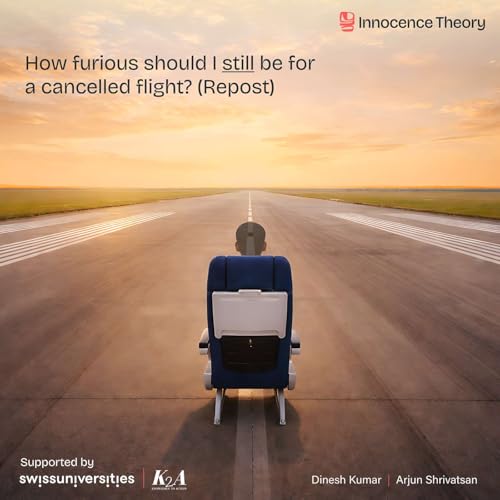
  • #35 How Furious Should I Still Be for a Cancelled Flight (Repost)
    Dec 31 2025

    In this early Innocence Theory episode, Dinesh shares a travel nightmare sparked by a cancelled flight. A late-night message. A reassuring link. A promise to reschedule. Except the link leads nowhere. Just like the flight.

    The episode moves from frustration to something more useful - Curiosity, gratitude, and perspective. Not as advice, but as a practical response to systems that fail under pressure.

    Today, the story feels familiar. In late 2025, IndiGo cancelled thousands of flights across India, stranding tens of thousands of travellers. The crisis exposed operational limits, poor communication, and how quickly institutional stress gets transferred to individuals.

    What This Episode Explores

    • The emotional anatomy of a cancelled flight
    • How institutions unintentionally create powerlessness
    • Why curiosity is hard when you feel wronged
    • Outrage versus strategic thinking
    • Travel as privilege, not entitlement
    • How “operational difficulties” become personal

    Key Takeaways

    • When communication fails, emotion fills the gap
    • Curiosity takes effort, especially when you feel invisible
    • Most failures are systemic, not personal
    • Perspective lowers psychological cost
    • Clarity often works better than outrage

    Connect with Us

    • Share your thoughts: listen@innocencetheory.com
    • If this episode resonates, please share it or leave a review—it truly helps us grow.

    Hosts: Dinesh Kumar C, Arjun Shrivatsan
    Editor: Abhinav Suresh
    Cover Art: Akshay Joshi

    Do you like the Innocence Theory Podcast? Tell your friends, support ITP on Patreon, and have your boss sponsor an episode.

    Show More Show Less
    22 mins
No reviews yet