Episodes

  • #36 Trusting Treated Water - A city's struggle for clean water (An Inflection Point episode by Innocence Theory)
    Jan 10 2026

    In this episode of Innocence Theory, we speak with Vishwanath to rethink how water actually works in a city like Bengaluru.

    ​Instead of asking whether cities are running out of water, the conversation asks a more uncomfortable question: if water exists, why do so many people still struggle to access it - and why do they struggle to trust it even when it is treated and proven safe?

    ​This episode reframes water as a socio-hydrological resource, shaped as much by human behaviour, institutions, and the 'yuck' factor as by rainfall or rivers.

    The central idea is simple: people don’t have water problems - water has people problems.

    What This Episode Explores

    • Why water scarcity is often about access and equity, not absolute shortage.
    • How water reaches cities and the energy cost behind every tap.
    • Treated wastewater as a resource, not a liability.
    • Psychological barriers to water reuse (and what it takes to build confidence in treated water).​
    • Lakes as critical infrastructure, not aesthetics.

    Key Takeaways

    • Water security is more about governance than geology.​
    • Cities rarely fail because 'there is no water'; they fail because human systems break - distribution, maintenance, pricing, and accountability.​
    • Reuse is essential, but acceptance is the real challenge: the 'yuck factor' and low trust in how consistently treatment systems are operated.
    • Citizens share responsibility with communities and the state

    ​Why Listen Now
    As Indian cities face flooding, groundwater depletion, tanker dependence, and infrastructure strain, this episode offers clarity without panic.

    It replaces fear with practical thinking and shows that solutions already exist, but they only work when people, policy, and systems align

    Useful Resources

    Manohar, R. P. (2025, December 18). From waste to wealth, wealth to worth: Shaping Bengaluru’s next water frontier [LinkedIn post]. LinkedIn. https://www.linkedin.com/posts/drramprasath-ias_bwssb-brandbengaluru-watersecurity-activity-7406200421377032192-S18d

    Biome Environmental Services - https://biometrust.org/

    Connect with Us

    • Share your thoughts: listen@innocencetheory.com
    • If this episode resonates, please share it or leave a review - it truly helps us grow.

    Guests : Vishwanath S

    Host: Dinesh Kumar C
    Editor: Abhinav Suresh
    Cover Art: Akshay Joshi

    Do you like the Innocence Theory Podcast? Tell your friends, support ITP on Patreon, and have your boss sponsor an episode.

    Show More Show Less
    45 mins
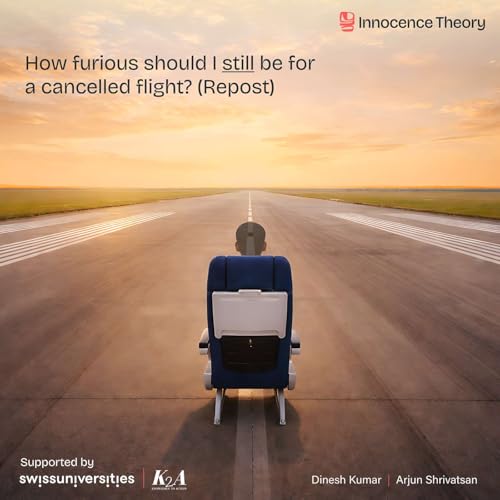
  • #35 How Furious Should I Still Be for a Cancelled Flight (Repost)
    Dec 31 2025

    In this early Innocence Theory episode, Dinesh shares a travel nightmare sparked by a cancelled flight. A late-night message. A reassuring link. A promise to reschedule. Except the link leads nowhere. Just like the flight.

    The episode moves from frustration to something more useful - Curiosity, gratitude, and perspective. Not as advice, but as a practical response to systems that fail under pressure.

    Today, the story feels familiar. In late 2025, IndiGo cancelled thousands of flights across India, stranding tens of thousands of travellers. The crisis exposed operational limits, poor communication, and how quickly institutional stress gets transferred to individuals.

    What This Episode Explores

    • The emotional anatomy of a cancelled flight
    • How institutions unintentionally create powerlessness
    • Why curiosity is hard when you feel wronged
    • Outrage versus strategic thinking
    • Travel as privilege, not entitlement
    • How “operational difficulties” become personal

    Key Takeaways

    • When communication fails, emotion fills the gap
    • Curiosity takes effort, especially when you feel invisible
    • Most failures are systemic, not personal
    • Perspective lowers psychological cost
    • Clarity often works better than outrage

    Connect with Us

    • Share your thoughts: listen@innocencetheory.com
    • If this episode resonates, please share it or leave a review—it truly helps us grow.

    Hosts: Dinesh Kumar C, Arjun Shrivatsan
    Editor: Abhinav Suresh
    Cover Art: Akshay Joshi

    Do you like the Innocence Theory Podcast? Tell your friends, support ITP on Patreon, and have your boss sponsor an episode.

    Show More Show Less
    22 mins
  • #34 A.I. Music, We Got This Wrong (An Inflection Point episode by Innocence Theory)
    Nov 7 2025

    In this episode, Arjun and Dinesh unpack what happens when the act of making music is no longer entirely human.

    From the neuroscience of creation — dopamine, oxytocin, and the state of flow — to the platforms banning artists caught between art and automation, this is a conversation about meaning, mastery, and identity.

    Because maybe the real disruption isn’t that machines can make music.
    Maybe it’s that they’ve exposed how fragile our business of music and arts were really.

    Maybe we’ve had it wrong all along.

    What you’ll discover this week

    1. AI-Generated Music’s Emotional Impact
      Discover how AI-generated music can evoke real emotional reactions comparable to human-created music, challenging traditional ideas about music creation and perception.
    2. The Evolution of Music Creation
      Understand the dramatic advancements in AI music generation by 2025, enabling near human-quality production that mimics creative flow states and artistic nuances.
    3. Changing Role of the Creator
      Explore how AI challenges the traditional role of the creator in music, questioning whether the creator’s identity or effort is critical to the listener’s emotional experience.
    4. Disruption of Music Business Models
      Learn about the impact of AI on music copyrights, distribution, and monetization, highlighting flaws in current systems and opportunities for new business models.
    5. Future of Music Engagement
      Gain insights on how listener engagement with music is shifting from focusing on authorship to emotional connection, and how creators can embrace AI tools for enhanced creativity.

    Key Takeaways

    • AI-generated music can produce genuine emotional resonance, sometimes even provoking stronger reactions than human music.
    • Technological progress means AI can create high-quality music rapidly, offering new creative possibilities while raising ethical and artistic questions.
    • The question of "who created the music" becomes less important as the listener's emotional response takes precedence.
    • Current music industry structures face challenges due to AI, necessitating new thinking in copyrights and monetization.
    • Both creators and listeners must adapt their approaches toward a new landscape where AI and human creativity coexist.

    Tune in to observe, not just listen.
    We’re not experts above it all. We’re observers wrestling with the same questions you hold. What’s changing in your world? Where do you feel the inflection point?

    Connect with Us

    • Share your thoughts: listen@innocencetheory.com
    • If this episode resonates, please share it or leave a review—it truly helps us grow.
    • Stay tuned: Next up, we explore how the music industry is reinventing itself from the inside out.

    Hosts: Dinesh Kumar C, Arjun Shrivatsan
    Editor: Abhinav Suresh
    Cover Art: Akshay Joshi

    Do you like the Innocence Theory Podcast? Tell your friends, support ITP on Patreon, and have your boss sponsor an episode.

    Show More Show Less
    53 mins
  • #33 Inflection Point - Its not personal, its just business
    Oct 3 2025

    Welcome to a brand new season of the Innocence Theory Podcast! Our Inflection Point Series dives deep into moments where everything changes—across creativity, design, technology, world events, and sustainability. In this kickoff episode, we blend personal storytelling and industry insight to uncover the hidden forces shaping our world and our decisions.

    What you’ll discover this week:

    • A True Story: What does “It’s not personal, it’s just business” really mean in day-to-day life?
    • The Empathy Gap: How “move fast and break things” as a motto sidelined empathy and what it means for our culture.
    • Climate in Words and Wallets: How subtle climate denial in public speeches ripples out to policy—and your grocery bill.
    • Empathy Economics: Why empathy, though costly, might be the most vital skill of our future.

    Key Takeaways

    • Every business decision ripples outward and touches real lives.
    • Industry rules (like new tariffs or spotifys payout model) directly shape the lives of everyday creators.
    • Trust in technology is layered—bigger doesn’t always mean safer, and transparency often matters more than size.
    • The way we use language influences how we see climate realities, economic futures, and even personal responsibility.
    • Building empathy is one of the hardest things in business—and one of the most necessary.
    • Don’t just listen—observe the patterns around you. Inflection points are closer than you think.
    • We’re not here as experts above it all. We’re here as fellow observers, wrestling with the same questions you hold.
    • So, what’s changing in your world? Where do you feel the inflection point?

    Tune in to observe, not just listen.
    We’re not experts above it all. We’re observers wrestling with the same questions you hold. What’s changing in your world? Where do you feel the inflection point?

    Connect with Us

    • Share your thoughts: listen@innocencetheory.com
    • If this episode resonates, please share it or leave a review—it truly helps us grow.
    • Stay tuned: Next up, we explore how the music industry is reinventing itself from the inside out.

    Host: Arjun Shrivatsan
    Editor: Abhinav Suresh
    Cover Art: Akshay Joshi

    Do you like the Innocence Theory Podcast? Tell your friends, support ITP on Patreon, and have your boss sponsor an episode.

    Show More Show Less
    14 mins
  • #32 Environmental Law in Action : Turning Snakebites into Policy Reform
    Aug 26 2025

    It is estimated that annually 58000 people die of snakebites in India. The WHO considers snakebite envenoming a neglected tropical disease (NTD). Yet, the issue receives less attention.

    Meet Shubhra Sotie, an environmental lawyer who was part of the team that helped turn this neglected crisis into action, making snakebite a notifiable disease in Karnataka, a step that later paved the way for national adoption.

    Through candid stories of exotic pet trade chaos, diluted environmental laws, and unexpected policy gaps, she uncovers the unglamorous but crucial work of translating science into actionable policy. This is a refreshingly honest conversation about confronting powerful interests, building unlikely coalitions, and how real environmental change happens from a legal point of view.

    Guests : Shubhra Sotie
    Host: Dinesh Kumar C, Arjun Shrivatsan
    Editor: Abhinav Suresh
    Cover Art: Akshay Joshi

    Do you like the Innocence Theory Podcast? Tell your friends, support ITP on Patreon, and have your boss sponsor an episode.


    keywords : environmental lawyer , snake bite, notifiable disease, wildlife policy reform ,conservation, ethical reform,public health

    Show More Show Less
    51 mins
  • #31 Jakkur lake and the life it supports
    Aug 14 2025

    Often seen as intruders in our homes; butterflies, spiders, ants and termites are rarely appreciated for the role they play in the environment.

    This episode is a field recording of a walk organised by Science Gallery Bengaluru. We uncover the wonders surrounding Jakkur Lake, a living museum where nature showcases its artistry. Amidst the rustling leaves and gentle ripples of the water, Karthik and Vishawanath guide us in interpreting natures work of art, revealing the hidden stories of the natural world.

    Guests : Vishwanath S,Karthikeyan S
    Host: Dinesh Kumar C
    Editor: Abhinav Suresh
    Cover Art: Akshay Joshi

    Do you like the Innocence Theory Podcast? Tell your friends, support ITP on Patreon, and have your boss sponsor an episode.

    Show More Show Less
    46 mins
  • #30 Back to school
    Apr 6 2025

    Back to school

    After a long time, we return to school—different places, different roles, different seats in the classroom.

    In this episode, we discuss our shared (and wildly different) experiences in stand-up comedy, improv, teaching, cognitive ergonomics, ai, sustainability and now, academia again—this time from the other side of the desk.

    It’s the start of a new series—two friends, two hemispheres, one familiar classroom from different points of view.

    Do you like the Innocence Theory Podcast? Tell your friends, support ITP on Patreon, and have your boss sponsor an episode.

    Show More Show Less
    1 hr and 13 mins
  • #29 Snakebites and the fight for rural health
    Dec 2 2024

    Snakebites in rural India kill six people every hour, yet the issue remains overshadowed by its urban counterpart. Sumanth Bindumadhav, Director of wildlife programs at Human Society International India, discusses why snakebites disproportionately affect rural communities and how evidence-based solutions, like making snakebites a notifiable disease, can yield actionable insights.

    From addressing treatment challenges to designing culturally sensitive prevention strategies, This episode stresses the need for nuanced contextual research.

    Do you like the Innocence Theory Podcast? Tell your friends, support ITP on Patreon, and have your boss sponsor an episode.

    Show More Show Less
    1 hr and 6 mins