• What's Changed and What's Coming in Climate Investing with Rob Day and Raj Atluru, Ep #127
    Jan 13 2026

    We’re back with the sixth installment of our Missing Middle in Climate Tech series, produced in partnership with Spring Lane Capital.

    As we kick off 2026, this episode offers a timely, grounded conversation with two seasoned investors who bring decades of perspective to where climate investing has been and where it’s headed next. Rather than focusing on predictions alone, the discussion goes deeper into the nuance of how capital is actually being deployed in today’s market.

    Rob Day, Co-Founder of Spring Lane Capital, and Raj Atluru, Managing Partner at Activate Capital, trade ideas and reflect on how the climate tech landscape has evolved.

    Together, they unpack how investor priorities have shifted over time, the metrics they look for in growth-stage companies, and the opportunities emerging from today’s macro forces, including interest rates, deglobalization, and AI’s rapidly escalating energy demand.

    For listeners looking to understand how experienced investors are navigating complexity, risk, and scale in climate tech right now, this is a conversation worth spending time with.

    Explore the full Missing Middle in Climate Tech series or reach out with ideas for future collaborations at investedinclimate.com.

    On today’s episode, we cover:
    1. 02:20 – Guest Intros & The “Missing Middle” Problem
    2. 04:39 – A Second Lens on the Missing Middle
    3. 07:00 – Origin Story of Activate Capital
    4. 10:40 – Energy, Load Growth & Macro Shifts
    5. 12:09 – “Why Now?” and Today’s Load Shock
    6. 17:27 – Structural Causes of the Missing Middle
    7. 19:26 – Heavy Lifting at Growth Stage
    8. 25:43 – Hardware Is Back: Fund III Themes
    9. 30:16 – Scaling, Learning Curves & Project Execution
    10. 33:00 – From Founder-Led to Scalable Sales
    11. 40:13 – Being Contrarian (EVs, AI & Hype Cycles)
    12. 43:57 – EV Fundamentals & Infrastructure Gaps
    13. 45:15 – Policy vs. Interest Rates
    14. 47:55 – Home Electrification & Rooftop Solar
    15. 48:06 – Speed-Round Predictions for 2026
    16. 49:26 – Dry Powder & Exit Fuel
    17. 51:50 – Climate Tech Becomes “Just Tech”
    18. 53:06 – Closing & Call to...
    Show More Show Less
    54 mins
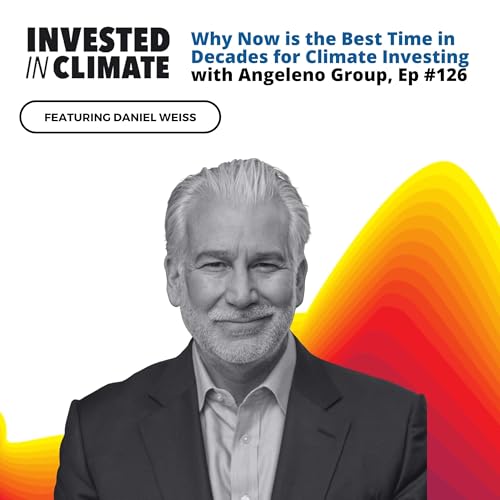
  • Why Now is the Best Time in Decades for Climate Investing with Angeleno Group's Daniel Weiss, Ep #126
    Jan 6 2026

    We always love a chance to hear from someone who’s been investing in climate for a long time. Daniel Weiss fits the bill. His firm, Angeleno Group, was founded in 2001 and since then has led or co-led over $3 billion into clean energy and climate solutions.

    Daniel and the Angeleno Group also surround themselves with accomplished leaders that bring true global expertise. Their advisory board includes a former US Secretary of Energy, former Secretary of Treasury, UN Ambassador, Nobel Laureate, and several other top scholars and industry leaders.

    Lean in closely for this conversation and learn from Daniel’s perspective. What we heard was somewhat surprising: that despite the headwinds coming from Washington and rippling around the world, strong deal flow, ever improving talent, and low valuations make this the best time in decades to invest in climate solutions. We spoke about Daniel’s background, this unique moment in climate investing, Angeleno Group’s thesis and recent investments, and much more.

    Lots to learn about and consider in this episode. Enjoy.

    On today’s episode, we cover:
    1. 02:30 – Daniel’s Personal Climate Journey
    2. 05:30 – From Law to Climate Investing & Founding Angeleno Group
    3. 07:39 – World Resources Institute (WRI) & Global Systems Change
    4. 12:29 – Optimism & “The New Global Possible”
    5. 13:21 – Building Angeleno Group Through Turbulent Times
    6. 14:36 – Check Sizes, Stages & How Angeleno Invests
    7. 15:18 – Evolution of Climate Investing & Why 2025 Is So Compelling
    8. 19:56 – Megatrends: Load Growth, AI & Energy Security
    9. 22:27 – Angeleno’s Advisory Board & Why It Matters
    10. 24:19 – Angeleno Group’s Investment Thesis
    11. 25:18 – Example Investments: Software for the Grid & Wildfire Risk
    12. 29:08 – Headwinds in Climate Tech: Fundraising & Exits
    13. 33:05 – Scaling Climate Finance & Global Opportunity
    14. 34:35 – Climate Week NYC & Hope from the Next Generation
    15. 36:33 – Closing Thoughts

    Resources Mentioned
    1. Angeleno Group
    2. World Resources Institute (WRI)
    3. Book: The New Global...
    Show More Show Less
    37 mins
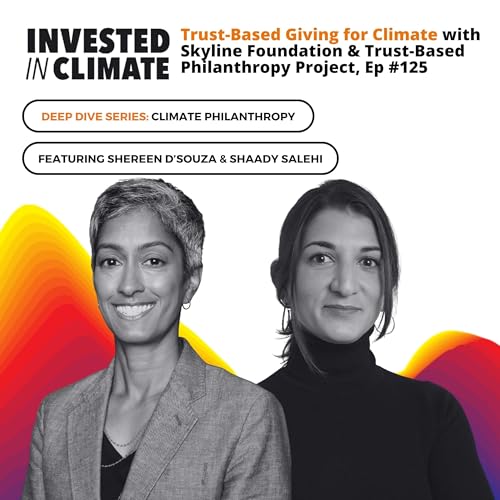
  • Trust-Based Giving for Climate with Skyline Foundation & Trust-Based Philanthropy Project, Ep #125
    Dec 11 2025

    Philanthropy plays a uniquely critical role in climate action—it can fund the bold, early-stage, community-led, and systems-changing work that markets and governments too often overlook. And with the federal government cutting funding to a wide range of climate, energy and conservation efforts, philanthropy plays a more important role than ever before.

    That’s why we’re teaming up with the Skyline Foundation and their Climate Lead, Shereen D’Souza on a series of conversations on climate philanthropy.

    Over the coming episodes, we’ll explore how philanthropy can accelerate climate solutions—not just by moving more money, but by moving it differently and to high impact topics and geographies. We’ll talk to leaders who are rethinking power, reimagining partnerships, and reshaping the way resources flow.

    Today, we’re starting with a conversation that sets the tone for the entire series: trust-based philanthropy. What does it look like to fund climate work in ways that are long-term, rooted in real relationships, and prioritize the expertise of grantee organizations? How can funders shift from control to collaboration, and what happens when they do?

    Shereen and I are joined by Shaady Salehi, Executive Director of the Trust-Based Philanthropy Project. Shaady has been at the forefront of this movement, helping foundations transform their practices and support grantees with more transparency, humility, and flexibility. We talk about Shaady and Shereen’s backgrounds in philanthropy, what trust-based philanthropy is and how it can help non-profit partners be more effective, why it’s relevant to Skyline Foundation’s approach and ways other donors can learn more.

    This series is one of several deep dive series we’ve created this year. Find the others on InvestedinClimate.com and reach out through the website if you’d like to partner on a deep dive series of your own.

    On today’s episode, we cover:
    • 03:30 – Shadi’s Background & Origins of Trust-Based Philanthropy
    • 05:34 – Shireen’s Climate Journey & Work on the Paris Agreement
    • 08:38 – Inside the Skyline Foundation’s Climate Program
    • 10:21 – The Role of Philanthropy vs. Markets in Climate
    • 12:20 – What Makes Skyline Different as a Climate Funder
    • 13:29 – What Is Trust-Based Philanthropy? Core Practices
    • 17:11 – Accountability & Critiques of Trust-Based Philanthropy
    • 19:20 – Power Dynamics & Mutual Accountability
    • 20:58 – Inside the Trust-Based Philanthropy Project
    • 23:12 – How Trust-Based Philanthropy Shows Up at Skyline
    • 25:35 – Why Trust-Based Philanthropy Is Critical for Climate Now
    • 27:55 – How Trust Builds Honesty & Problem-Solving
    • 29:32 – Shadi’s Motivation & What’s at Stake Systemically
    • 33:12 – Barriers to Trust-Based Climate Philanthropy
    • 34:21 – How Skyline Shares Control with Field Experts
    • 38:11 – Entry Points for Funders New to Trust-Based Philanthropy
    • 40:23 – Closing & Call to Action

    Resources Mentioned
    • Skyline Foundation
    • Trust-Based Philanthropy Project
    • The Whitman Institute
    Show More Show Less
    41 mins
  • Filling the Climate Finance Gap with TED's Chris Anderson's All Aboard Fund & Spring Lane's Jason Scott, Ep #124
    Nov 25 2025

    We’re back with another episode in our series on the Missing Middle in Climate Tech in partnership with Spring Lane Capital. This is the fifth episode in the series. If you didn’t catch the others, check out InvestedinClimate.com/series and you’ll find our other episodes. If you have ideas for other series and would like to partner, get in touch through the website as well.

    The missing middle is a structural problem – a lack not only of available capital for climate companies, but also of the kinds of firms able to invest in them. New firms with new types of investment mandates are needed, and so I was thrilled to learn about a new fund called All Aboard. It’s a truly innovative firm developed by someone who has long had his finger on the pulse of the world’s biggest problems and boldest solutions. If you’ve ever watched a TED Talk you probably know Chris Anderson, who has led TED for the last 25 years. Chris is probably one of the best networked people on the planet, and that he decided to focus on building a new fund designed to address the missing middle in climate finance speaks volumes.

    Spring Lane Capital Partner and Entrepreneur in Residence Jason Scott gets credit for putting together this episode and joins us in what was a truly fascinating conversation. All Aboard reflects the type of creativity and ambition needed to fill a critical climate finance gap, and I think we all hope their model inspires you in some way. Enjoy.

    On today’s episode, we cover:
    • 0:03:31 – Chris explains his shift to climate investing and TED’s climate initiatives
    • 0:04:53 – Setting the stage: The funding gap in climate tech
    • 0:05:23 – Jason describes the three buckets of the "missing middle" and All Aboard fund’s mission
    • 0:09:33 – Exploring the structural capital problem in the energy transition and limitations of current financial markets
    • 0:11:16 – Chris & Jason discuss scale challenges and why current investment models fall short for climate solutions
    • 0:14:12 – Impact of collaboration in the climate investing community, with examples from Spring Lane and All Aboard
    • 0:16:57 – Chris describes All Aboard: how convening and pooling investors can solve the missing middle
    • 0:22:42 – The role of “social proof,” building momentum and ecosystems around climate ventures
    • 0:25:12 – Fundraising goals for All Aboard and the scale of opportunity in climate tech
    • 0:29:00 – Recognizing growth and potential exits for climate companies; learning from historical performance
    • 0:31:14 – How companies may become eligible for All Aboard, criteria for selection, and the practical mechanics of funding
    • 0:34:51 – The necessity of both capital and sustained support for scaling climate solutions
    • 0:36:30 – Vision for the future: If All Aboard succeeds, expectations for climate tech and financial markets
    • 0:37:54 – Other approaches and financial innovations to address the missing middle
    • 0:40:24 – The role of government and public-private partnerships in de-risking and scaling clean tech
    • 0:42:56 – Closing remarks

    Resources Mentioned
    • All Aboard
    • Spring Lane Capital
    • Invested in Climate – Missing Middle series
    • TED and TED Countdown
    Show More Show Less
    44 mins
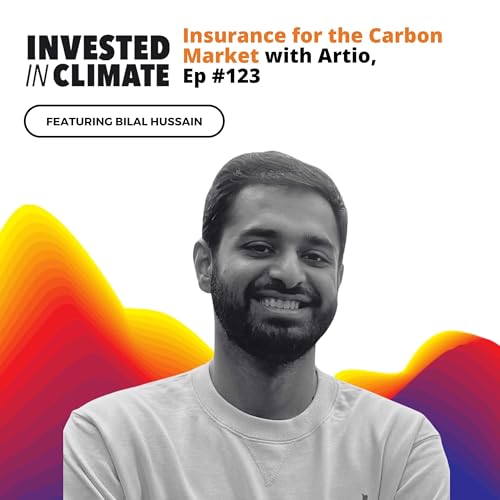
  • Insurance for the Carbon Market with Artio, Ep #123
    Oct 30 2025

    There’s been a lot of news in recent years about the risks within carbon markets. Companies buying carbon credits to offset their emissions have struggled with the uncertainty that a carbon project might not reduce as much carbon as they project. A forest could burn or a technology could fail to work properly and the project will underdeliver. Yet, hundreds of billions of dollars are spent on carbon credits, a figure that could grow well into the trillions.

    Bilal Hussain is targeting this uncertainty in this market by offering insurance through his company Artio. Fun fact: Bilal actually saw the need for insurance while working at Sylvera – a carbon market sourcing and diligence platform and recent guest on our show – when he realized that investors were asking for collateral that no one had. Artio enters early – before the first tree is planted – to help more carbon reducing projects become viable. If you consider the size of the carbon market and the shortage of ways to insure new projects, the opportunity for Artio is quite significant.

    Bilal makes this complex space rather simple and easy to understand. We spoke about his background, the need for insurance, the risks different types of projects face, the growth he’s anticipating and much more. If you’ve long wondered about the risks of carbon projects, this conversation will shed some light on the space and one approach to unlocking its potential.

    On today’s episode, we cover:
    • 00:58 — Introduction to carbon market risks and Artio’s approach
    • 02:40 — Bilal’s background and transition into carbon insurance
    • 04:25 — The creation of Artio and addressing insurance needs in carbon markets
    • 07:52 — Artio’s impact on financial and climate markets, and market sizing
    • 11:13 — Early-stage risk phases and insurance for carbon projects
    • 14:05 — Types of projects Artio insures; afforestation, biochar, rock weathering
    • 15:25 — Risk assessment by project type and key differences
    • 17:14 — Artio’s market positioning, product traction, and offering insurability assessments to developers
    • 20:41 — How Artio’s workshops educate insurers and demonstrate risk modeling
    • 22:46 — Case study: How coverage and claims/settlements work in practice
    • 27:25 — Market challenges: Standing out in a crowded space, growth ambitions, and automation
    • 29:10 — Key surprises about the carbon market and importance of policy
    • 31:47 — The role of data transparency and risk assessment in broader climate domains
    • 34:59 — Other insurance use cases for managing climate transition risk
    • 38:10 — Artio’s roadmap: expanding coverage, supporting developers, and scaling up

    Resources Mentioned
    • Artio
    • Sylvera
    • Maya Climate
    • Asia Climate Summit
    • SF Climate Week
    • CORSIA Insurance

    Connect with us
    • Bilal Hussain
    Show More Show Less
    41 mins
  • The $9 Trillion Adaption Opportunity with Adapt[us], Ep #122
    Oct 17 2025

    The vast majority of my interviews have focused on innovations, investing and advocacy related to climate mitigation – that is, what we can do to cut greenhouse gases and minimize the rise in global temperatures. What we do or don’t do now, will have lasting consequences and it is climate mitigation that is driving the transformation of the global economy. So it’s not surprising that mitigation dominates climate investing.

    Adaptation and resilience, meanwhile, focus not on limiting or reversing climate change but rather on improving quality of life in a warmer world. Adaptation ventures receive only a small fraction of climate investments, but rising temperatures are creating tremendous demand for a new category of products. In a joint report by Boston Consulting Group (BCG) and Temasek, it’s estimated that between $500 million and $1.3 trillion could be spent annually by 2030 on technologies that help people adapt to a changed climate.

    That’s the opportunity Darren Clifford is targeting with a new fund called Adapt[us]. Darren has worked for two decades on new markets as a founder, consultant at McKinsey & Co, and as an angel investor, and I found his perspective on the climate adaptation market to be packed with nuance and insight. We spoke about his background, three different categories of adaptation tech, the unique challenges they face, how they’ll make the future more livable, and much more.

    On today’s episode, we cover:
    • [02:45] Darren’s Background & Career Journey
    • [06:39] Why Focus on Climate Adaptation?
    • [08:07] Insights from Angel Investing & Supporting Founders
    • [12:14] Why Adaptation is Underfunded; Adapt[us] Fund Overview
    • [16:19] Challenges in Scaling Adaptation Solutions
    • [17:31] Adapt[us] Fund: Focus & Stage, Why For-Profit
    • [18:53] Measuring Impact & Third-Party Well-being Validation
    • [23:10] Market Segmentation: Resilience, Repair & Recovery, Demand Adaptation
    • [25:38] Market Size and Investment Allocation
    • [27:50] Business Model Challenges for Adaptation Startups
    • [30:23] Concrete Examples of Target Companies
    • [32:59] Adapt[us] Venture Building Approach & Founder Support
    • [36:42] The Venture Builder/Capital Model: Criteria & Structure
    • [38:27] Norwegian Talent & Global Competitive Advantages
    • [41:03] Building a Movement, Not Just a Fund
    • [42:06] Short-Term Goals for Adapt[us] & Team Building
    • [44:41] Closing Remarks

    Resources Mentioned
    • Adapt[us]
    • BCG x Temasek Report: The Private Equity Opportunity in Climate Adaptation and Resilience
    • Toronto Climate Week
    • GIC Report: Sizing the Inevitable Investment Opportunity: Climate Adaptation
    • WRI Study: Strengthening the Investment Case for Climate Adaptation: A Triple Dividend Approach

    Connect with us
    Show More Show Less
    45 mins
  • LA Climate Week Founders on Spreading Everywhere, Ep #121
    Sep 30 2025

    In case you missed it, last week was NY Climate Week. There were well over 1,000 events — from summits with CEO and heads of state, to film screenings, concerts, parties, boat cruises, pitch sessions, hackathons and much more. I tried to sum up my experience at New York climate week in a special episode two years ago. This year, of course, the context was different with a US administration no longer interested in climate, and a lot of green hushing, hand wringing and new language that aims to be less politicizing.

    To me, one of the most interesting things about NY Climate Week is that it's not the only one. Climate weeks are spreading. San Francisco, Los Angeles, Washington DC, San Diego, Shanghai, Bangkok, Panama City all have climate weeks. There might be dozens more in the works. No city on the planet is immune from the impact of climate, and most cities have thriving ecosystems of organizations, innovators, investors, policymakers, researchers and more working to advance climate solutions and adapt to a changing planet.

    In this conversation I’m joined by Nishant Mani and Dan Thorman, co-founders of the LA Climate Week. Nishant and Dan saw a need to bring together their community. They volunteered to lead and have built LA Climate Week into a successful example that people anywhere can follow to create their own week of solidarity, learning and action. We talk about their backgrounds, the founding story of LA Climate Week, the impact of the LA wildfires on last year’s event, lessons they’ve learned and much more. So whether or not you were in New York last week, I hope you’ll enjoy this conversation and consider how you can help your local climate community wherever you are.

    On today’s episode, we cover:
    • 1:22 – Recap of New York Climate Week & Spread of Climate Weeks
    • 3:43 – Nishant’s Personal & Professional Background
    • 6:19 – Dan’s Personal & Professional Background
    • 10:16 – The Origin Story of LA Climate Week
    • 14:40 – The Role of Entertainment & Culture in LA Climate Week
    • 17:08 – Entertainment Industry’s Role in Climate Movement
    • 18:33 – Impact of Wildfires on LA Climate Week
    • 24:47 – The Broader Role of Climate Weeks & Local Collaboration
    • 27:51 – Lessons Learned from Organizing LA Climate Week
    • 32:20 – Evolving the Structure and Infrastructure Involvement
    • 33:02 – Measuring Success and Growth of LA Climate Week
    • 36:44 – Community Engagement & Accessibility
    • 39:32 – Aspirations for the Future: Magic Wand Scenario
    • 42:21 – Future Planning and Event Announcement
    • 44:14 – Closing Remarks and Call to Action

    Resources Mentioned
    • LA Climate Week
    • Climate Capital
    • Terra.do
    • Reunion
    • Collidescope Foundation
    • Jane Goodall Institute

    Connect with us
    • Nishant Mani
    • Dan Thorman
    • Jason Rissman

    Keep...
    Show More Show Less
    45 mins
  • Bridging the Climate Finance Gap with Blackhorn Ventures & Spring Lane Capital, Ep #120
    Sep 16 2025

    Climate tech companies face a range of structural challenges to securing the mid stage investment needed to scale their solutions. The lack of capital at this stage prevents many viable, potentially transformative technologies from going mainstream and eliminating gigatons of emissions. That’s why we’ve been running a series of episodes on the Missing Middle in Climate Tech in partnership with Spring Lane Capital.

    If you haven’t heard our previous three episodes in this series, check them out at investedinclimate.com, and if you have ideas of other topics that warrant a Deep Dive series please reach out through the contact form on our website.

    For the fourth episode in our series, I’m joined by Spring Lane Capital Co-Founder and Partner Rob Day who guest hosts the conversation with Blackhorn Ventures Managing Partner Melissa Cheong.

    On today’s episode, we cover:
    • 2:23 – Introducing Blackhorn Ventures & Melissa Chong
    • 3:31 – Melissa’s Path to Venture Capital & Impact Investing
    • 8:44 – Surprises & Learnings in Venture Capital
    • 10:13 – Overview of Blackhorn Ventures’ Investment Focus & Strategy
    • 13:55 – Addressing the Missing Middle: Digital vs. Hardware Solutions
    • 17:18 – Leveraging Accepted Hardware & Digital Solutions
    • 19:09 – The Role of Vertical Data Pools in Construction and Energy
    • 21:03 – AI, Utilities, and the Urgency for Digital Solutions
    • 25:10 – Building Resilience & Anti-Fragile Mindsets in Climate Tech
    • 28:14 – Exploring New Financing Instruments & Insurance
    • 32:21 – Portfolio Example: Formic – Robotics as a Service
    • 36:37 – Portfolio Example: King Energy – Solar for Multi-Tenant Properties
    • 38:55 – Lessons from Community Solar & Smart Billing
    • 40:00 – Takeaways: The Evolving Role of Venture Capital in Climate Impact
    • 43:24 – Closing Remarks

    Resources Mentioned
    • Spring Lane Capital
    • Blackhorn Ventures
    • Formic
    • King Energy

    Connect with us
    • Rob Day
    • Melissa Cheong
    • Jason Rissman

    Keep up with Invested In Climate
    • Sign up for our Newsletter
    • LinkedIn
    Show More Show Less
    44 mins