• Netflix, YouTube, Meta and the Connected TV Wars: What’s Really Going On — with Jen Topping
    Nov 12 2026

    Jen Topping, media consultant and author of the Business of TV Substack, joins Emily and Andy for a wide-ranging conversation that covers more ground in an hour than most industry panels manage in a day. The topic is the current state of the streaming and connected TV landscape — where Netflix really is, where YouTube is heading, what Meta’s move into long-form changes, and why Amazon might quietly be winning a war nobody is paying enough attention to.

    On Netflix, Jen’s framing is sharp: this is a hype-to-normal trajectory, a share price reconfiguration as investors finally stop treating it like a tech company and start applying normal business multiples. The more interesting structural argument is about what Netflix threw out — the repeat viewing, the comfort of scheduling, the long tail of 120-episode shows that sell internationally for decades — in favour of short, expensive global buyouts that sit on the platform and generate internal metrics nobody outside can properly evaluate. The missed Roku acquisition gets a namecheck as the moment Netflix failed to secure a position in the upcoming operating system wars, which Jen argues is the battle that actually matters next.

    On YouTube, the tension is between two incompatible ambitions: competing upmarket with Netflix for premium TV advertising pounds, while remaining a user-generated content platform that brands can never fully trust. Jen’s provocative suggestion — that YouTube may eventually need a walled garden premium tier to square that circle — is the episode’s sharpest moment. On Meta, the excitement around Instagram for TV is real but qualified: producers are already there, the audience is there, the wave is coming. The question is whether Meta is a reliable enough long-term partner to bet on.

    Show More Show Less
    51 mins
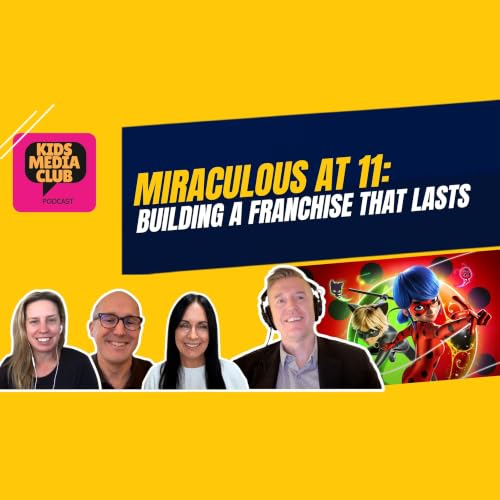
  • Miraculous at 11: Building a Franchise that Lasts
    Nov 5 2026

    Heath Kenny, Chief Content Officer at Miraculous Corp, joins Andy, Emily, and Jo for a conversation that covers a lot of ground — from how you steward an IP when its original creators are still in the room, to what it actually means to remain accountable to your characters after 170 episodes and a global fandom.

    Miraculous Ladybug is eleven years old, has seven seasons, a billion lifetime views on Chibis alone, a live action series in development with Seesaw, a preschool spin-off, and a fanbase that spans from Brazilian Comic Con to teenagers who have been with it since they were eight. Heath’s job is to expand that universe without losing what made it work — and the conversation is as much about the philosophy of that as it is about the practicalities. The original creators are still there, still sense-checking, still pushing back, and Heath makes a compelling case that this is precisely why the brand has kept its elasticity rather than ageing down into a preschool corner like so many female-led IPs before it.

    There’s a lot in here worth sitting with — the difference between reach and fandom, why fans feel more ownership of an IP when the original creators leave, what accountability to characters actually means in practice, and why Chibis went from an organic experiment to a genuine strand of the franchise in its own right. The promise of a future recording at the Miraculous Paris studio — with Thomas and Sebastian in the room — is one to hold the podcast to.

    Show More Show Less
    43 mins
  • Why the Next Big Kids IP Was Born on Roblox — with Twin Atlas
    Oct 29 2026

    Recorded live at MIP Junior in Cannes, Jo grabs Andrew and Jonathan from Twin Atlas — the studio behind Creatures of Sonaria, one of Roblox’s deepest and most beloved game worlds — for a conversation that doubles as a preview of their panel session on stage an hour later.

    Twin Atlas are at MIP Junior because the line between gaming and entertainment is blurring in real time, and Creatures of Sonaria is the proof. Built six years ago, grown through community co-creation, now moving into merchandise, licensing, an animated series on Sky, and active conversations around film — it’s the reverse distribution model that keeps coming up across kids media, this time born entirely on Roblox. The conversation covers how community-driven lore works as a content development engine, what authentic brand collaboration on Roblox actually looks like (the Avatar: Last Airbender event that brought Appa into the game as a playable creature is the standout example), and why Roblox’s safety investments — however painful in the short term for developers and the stock price — are the right long game.

    • The episode’s sharpest moment is on data. Thirteen million concurrent players for the Bruno Mars concert versus eleven million NBA Finals viewers makes for a striking headline, but the more interesting point is what Roblox data can actually tell an IP owner: not just how many people showed up, but where they stood, what they interacted with, and which unexpected character became the event’s breakout star. That kind of behavioural intelligence is simply not available from broadcast, and Twin Atlas’s argument is that smart IP owners should be treating Roblox as a real-time testing ground for everything that comes after.

    Show More Show Less
    26 mins
  • Why Reach Isn’t the Same as Trust
    Oct 22 2026

    Emma Witkowski, VP of Media Solutions at WildBrain, returns to the podcast for a conversation that started as a LinkedIn exchange between her and Jo about trust in kids media and grew into something worth doing properly on the podcast.

    The central argument is one that feels obvious once it’s stated but is surprisingly underserved in the industry conversation: reach and trust are not the same thing. Just because a platform can put content in front of millions of kids doesn’t mean it has earned the relationship that makes that content — and the advertising around it — actually land. Emma breaks trust down into three layers: parental confidence in the environment, children’s familiarity with characters and creators, and advertiser confidence in brand-safe context. All three are needed, and none of them is guaranteed by scale alone.

    • The conversation covers co-viewing as the most undervalued audience segment in advertising right now, Gen Alpha’s role as household CMO and their inbuilt spam filter for inauthentic brand behaviour, the case for branded content over programmatic placement, and why joy should be a KPI not just a creative nice-to-have. Emma’s closing line is the one worth sitting with: stop asking whether kids audiences are worth investing in and start building the right ways to invest in them — because the long-term sustainability of kids content is genuinely at risk.

    Show More Show Less
    38 mins
  • Beyond the Screen: Jon Mason on Why Kids IP Needs to Measure Impact, Not Just Views — Live from MIP Junior
    Oct 15 2026

    A live recording from MIP Junior in Cannes, with Andy, Emily and Jo grabbing Jon Mason, founder of Jollywise and creator of Stan and Gran, for a conversation that cuts against the grain of most MIP conversations. Instead of talking about how to get a show made, Jon is asking whether the show is the right format at all — and whether the industry is measuring the wrong things entirely.

    The provocation at the heart of the discussion is a LinkedIn article Jon wrote questioning whether dwell time and views are sufficient metrics for kids content, at a moment when a World Economic Forum white paper on AI and children is asking the same question from a policy direction. Jon’s argument is that the industry has allowed data that is easy to collect — clicks, completion rates, engagement — to become the only data that matters, when what actually counts is what a child does after the content ends. Whether they go outside, ask a question, make something, explore. That’s much harder to measure, but arguably much more important. Bluey, he notes, are starting to think about exactly this.

    • The conversation ranges across screen-free AI products (Mallow, Freckle, Yoto), the gap between the ed-tech world and the kids IP world that MIP could usefully bridge, the risk of AI companions that are permanently available and relentlessly sycophantic, and Jon’s core creative mission with Stan and Gran: getting kids outside. His closing challenge to the room is a good one — does your IP have to be a TV show? And if the answer is yes, are you absolutely sure?

    Show More Show Less
    24 mins
  • From YouTube to Cinemas: The Moonbug Playbook
    Oct 8 2026

    This pre-MIP Junior sponsored episode brings Nicholas Ziegler, Managing Director of EMEA, APAC and Global Distribution at Moonbug Entertainment, into conversation with Andy, Emily, and Jo. The timing is deliberate — Moonbug has a lot to talk about heading into Cannes.

    Nicholas traces the logic of what he calls Moonbug's reverse distribution model: where traditional studios start with premium pay TV and work their way down to YouTube, Moonbug started on YouTube and has worked its way up — through premium streamers, linear channels in 100-plus markets, consumer products, gaming, live events, and now, with the Cocomelon movie landing in February, theatrical. Owning all of their IP outright is what makes the model work; it means no permissions to seek, no rights to negotiate, and the ability to move from idea to execution in months rather than years. The linear channel launch in the Philippines took five months from concept to air. Emmy's Wonder Wardrobe — a live action Little Angel spin-off built around a character the audience was already asking for — went from data insight to Disney and Netflix in similarly short order.

    • The newest announcement is Big Feelings, a music company Moonbug has built to open up its distribution and monetisation infrastructure to third-party artists and creators — with Snoop Dogg and Doggyland among the first partners. It's a bet that what Moonbug has built for its own music-led IP can be valuable to others who have the talent but not the network. The episode closes on the Cocomelon movie, which Nicholas describes as the climax of everything the model has been building toward — and on which he is, emphatically, not scared.

    Show More Show Less
    36 mins
  • Kids Media Club at Young Horizons Warsaw - bonus episode
    Oct 7 2026

    A bonus mini episode from Jo, recorded at the Young Horizons Film Festival in Warsaw — a relatively small but well-curated industry event that she reports punching above its weight. Two conversations captured at cocktail hour, both worth hearing.

    First, David Kleeman on why "a good story well told" is no longer enough as a creative ambition. His argument is that kids engage with stories through three fundamental need states — wanting to be involved, wanting to explore freely, and wanting to be part of a community — and that the industry keeps accidentally frustrating all three through IP protectionism, algorithmic curation, and age-gating from social spaces. His closing point is sharp: start with a core, let the audience tell you where they want to go next, and don't try to build everywhere at once.

    Then Janine Weigold former Netflix executive now consulting across the industry, on the funding gap that nobody has solved: the space between an early idea and a full commission, where animation in particular keeps falling through the cracks. Her argument is that broadcasters, ad sales teams, and private companies with audience reach could function as incubators — offering channels, expertise, and promotional muscle to help creators find proof of concept before the big platforms come looking. The conversation ends on data sharing, where Janine is unambiguous: platforms hoarding engagement data isn't just bad for the industry, it's preventing the discovery of the next SpongeBob.

    Show More Show Less
    12 mins
  • Business of Children's Media Summit Announced, and Jeffrey Katzenberg on AI and the Soul of Hollywood
    Oct 1 2026

    Jo is absent again, so Andy and Emily have a two-topic episode: first, the announcement of the Business of Children's Media Summit, taking place November 12th in Dublin; then a deep dive into Jeffrey Katzenberg's viral essay on AI and the future of animation.

    Dennis Crushall from Precisify joins briefly to help launch the summit, which Emily has been quietly building for months in partnership with Cultural and Creative Industries Skillnet. Taking place at the Alex Hotel in Dublin, the day-long event is focused on going direct to audience — YouTube, gaming, consumer products, and franchise strategy — and features keynote speaker Erica Quinn, Director of Kids and Family Consumer Insights at Disney, alongside BBC Children's and Education's Anna Taganov. Tickets are €75 via Eventbrite, and there will be a live podcast recording on the day. Emily has also promised a pint of Guinness to every international attendee, a commitment Andy intends to make very expensive.

    The second half is a sharp dissection of Katzenberg's 2,000-word Twitter essay positioning AI as the next Toy Story moment for Hollywood — expansive rather than destructive, with tech providing the tools and Hollywood providing the soul. Andy's most interesting observation is around the John Philip Sousa parallel Katzenberg draws: the real fight may not be about the technology at all, but about copyright compensation — and studios sitting on vast IP libraries, including the newly merged Paramount-Warner entity, could stand to benefit significantly if the law catches up. The episode closes on a fittingly ironic note: someone ran the essay through an AI checker and it came back 60% AI-generated.

    🎟️ Get your tickets for the Business of Children's Media Summit: https://www.eventbrite.ie/e/the-business-of-childrens-media-summit-tickets-1998215489319

    📊 Explore Precisify's research and reports: https://www.precisify.com/reports-and-playbooks

    Show More Show Less
    26 mins