• 17 The Meaning of Negation in Heart Sutra and the Object of Negation 12-Sept-2004
    Jun 19 2026

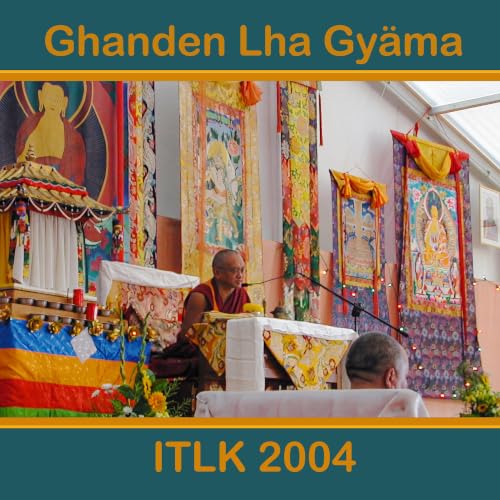
    This teaching was given by Lama Zopa Rinpoche at Lama Tsonkhapa Institute in Italy as part of the Ganden Lha Gyama retreat between September 3-30, 2004.

    00:00:01 Rinpoche tells about the meaning of negation in the Heart Sutra. "No" doesn't mean that things do not exist, it is negating the way phenomena appear - as truly existent from their own side. Understanding this point helps not to fall into extremes of nihilism and eternalism.

    00:10:05 How to avoid the mistake from the very beginning of your analysis by identifying the correct object of refutation - gak-cha.

    00:33:00 Phenomena exist, but they exist in mere name, merely imputed by mind. They do not exist from their own side.

    01:04:00 From the I down to the split seconds of consciousness, all phenomena exist in mere name, merely imputed by mind. Without mind labeling them, they cannot exist.

    01:27:00 When meditating on emptiness, if fear arises, that is a good sign - it means your meditation is harming the object of ignorance, the root of samsara. One should go through the fear, not stop the meditation.

    01:48:00 The word "Ah" in the Heart Sutra is like an atomic bomb that destroys the hallucination of true existence projected onto all phenomena by ignorance. It shows phenomena are empty of existing from their own side.

    02:24:00 When reciting the Heart Sutra, one should apply it to one's own problems and sufferings, meditating that they are empty of true existence. This becomes a powerful puja to pacify obstacles.

    02:30:00 Rinpoche explains that Kirti Tsenshab Rinpoche used to recite Extensive Dispelling of Hindrances after the Heart Sutra as a way of pacifying all obstacles for the teachers, students, and Dharma centers due to sickness, spirit possession, unfavorable conditions, past karma, and immediate conditions.

    02:37:30 The group recites Lama Tsongkhapa Guru Yoga and Rinpoche leads the extensive offerings practice and dedications.

    Find out more about Lama Zopa Rinpoche, his teachings and projects at https://fpmt.org/

    Show More Show Less
    2 hrs and 56 mins
  • 16 Motivation for Receiving Jenang of Lama Tsongkhapa Guru Yoga 11-Sept-2004
    Jun 12 2026

    This teaching was given by Lama Zopa Rinpoche at Lama Tsonkhapa Institute in Italy as part of the Ganden Lha Gyama retreat between September 3-30, 2004.

    00:00:01 To receive the jenang (permission to practice) of a deity from the four-class Tantra, one needs to first receive the initiation of that class of Tantra.

    00:06:31 Even though one has received a precious human body, it can be stained by desire, carelessness, laziness, sleep, gossiping, and seeking offerings and respect. This leads to wasting the precious human body on meaningless activities.

    00:10:34 To take the essence of the perfect human body, one must train well in the gradual path of the lower, middle, and higher capable beings.

    00:11:51 All sentient beings have been one's mother countless times in past lives, but due to taking rebirth, they are unable to recognize each other. Generating love and compassion for them, one should strive to achieve enlightenment for their benefit.

    Find out more about Lama Zopa Rinpoche, his teachings and projects at https://fpmt.org/

    Show More Show Less
    16 mins
  • 15 Lama Tsongkhapa's Holy Mind Embodies Manjushri, Vajrapani, and Chenrezig 11-Sept-2004
    Jun 5 2026

    This teaching was given by Lama Zopa Rinpoche at Lama Tsonkhapa Institute in Italy as part of the Ganden Lha Gyama retreat between September 3-30, 2004.

    00:00:01 The Migtsema prayer, composed by Lama Tsongkhapa, is the king of prayers that embodies the essence of the 84,000 teachings of the Buddha.

    00:33:40 At Lama Tsongkhapa's birthplace Kumbum, a tree grew from his birth blood with 100,000 images of Manjushri and mantras on its leaves, indicating he is the emanation of Manjushri.

    00:37:44 Before Lama Tsongkhapa's birth, his mother dreamt of a Chinese monk from Wutai Shan (Manjushri's holy place) dissolving into her, signifying that the child is Manjushri's emanation.

    00:49:50 In the tradition of secret mantra, one must accept that all the buddhas are one mind. The previous lama of Sägyu tantric college added the line about Vajrapani to Migtsema and it became a five-line Migtsema. Gyalwa Ensapa’s disciple wrote the nine-round migtsema.

    Find out more about Lama Zopa Rinpoche, his teachings and projects at https://fpmt.org/

    Show More Show Less
    54 mins
  • 14 Overcoming Obstacles with Logic: Transforming Suffering into Cause of Happiness 11-Sept-2004
    May 29 2026

    This teaching was given by Lama Zopa Rinpoche at Lama Tsonkhapa Institute in Italy as part of the Ganden Lha Gyama retreat between September 3-30, 2004.

    00:00:01 Lama Zopa Rinpoche explains the meaning of protector prayers and the motivation for doing protector prayers dedicating them for success in Dharma activities around the world for benefiting sentient beings.

    00:11:04 The fundamental Buddhist philosophy is that happiness and suffering are created by one's own mind, not by others. One has complete freedom to stop suffering and achieve happiness up to enlightenment by changing how one thinks.

    00:23:05 Dharma centers play an important role in world peace by educating people about the mind, karma, compassion, and thought transformation.

    00:42:10 By practicing thought transformation (lojong), one can transform all obstacles and problems into causes for enlightenment. If you are happy, practice Dharma, if you are unhappy, practice Dharma.

    01:00:00 Centers benefit sentient beings by teaching lojong.

    Find out more about Lama Zopa Rinpoche, his teachings and projects at https://fpmt.org/

    Show More Show Less
    1 hr and 25 mins
  • 13 Realizing Emptiness Leads to Great Compassion and Prayers from Lama Chopa Practice 10-Sept-2004
    May 22 2026

    This teaching was given by Lama Zopa Rinpoche at Lama Tsonkhapa Institute in Italy as part of the Ganden Lha Gyama retreat between September 3-30, 2004.

    00:00:01 The mind is obscured by many superstitious thoughts, like attachment, anger, and self-cherishing, which are based on grasping at an exaggerated object.

    00:06:47 While everything is empty of true existence, the ignorance projects true existence onto phenomena, like wearing colored glasses that make everything appear a certain color. We then allow our mind to believe this hallucination is real.

    00:14:52 Realizing emptiness helps generate strong compassion for sentient beings, seeing how they are suffering due to being ignorant of the way things actually exist. Their suffering comes from wrong concepts and mistaken ways of thinking.

    00:22:24 Realizing emptiness doesn't contradict bodhicitta, but rather makes one generate stronger bodhicitta. The positive thoughts like compassion and bodhicitta are not caused by or based on the ignorance grasping at true existence.

    00:26:20 Reciting Calling the Guru from Afar. The way to clean away the superstitious thoughts is through guru devotion - making requests to the guru from one's heart. One should strive to devote to the guru with the nine attitudes, such as viewing the guru as a buddha, following the guru's advice, and seeing the guru's actions as perfect and so on.

    00:36:30 Lama Zopa Rinpoche leads the recitation of Lama Tsongkhapa Guru Yoga, offering of a short mandala, and recitation of Migtsema mantras.

    00:51:35 The group recites the Lamrim prayer from Lama Chopa.

    00:59:05 The group recites the Eight Verses of Thought Transformation and other prayers from Lama Chopa.

    1:23:32 Lama Zopa Rinpoche leads the protector prayers and dedications.

    02:08:55 Lama Zopa Rinpoche tells about Geshe Lama Konchog's Life. Dedication prayers.

    Find out more about Lama Zopa Rinpoche, his teachings and projects at https://fpmt.org/

    Show More Show Less
    2 hrs and 9 mins
  • 12 Rejoicing in Lama Tsongkhapa's Qualities and Guru Yoga Meditation 10-Sept-2004
    May 15 2026

    This teaching was given by Lama Zopa Rinpoche at Lama Tsonkhapa Institute in Italy as part of the Ganden Lha Gyama retreat between September 3-30, 2004.

    00:00:07 Lama Tsongkhapa practiced Dharma and completed the path, unstained by the three types of worldly dharma: black worldly dharma, mixed worldly dharma, and white worldly dharma. This means unstained by attachment clinging to this life, unstained by self-cherishing thought, and unstained by ignorance, the concept holding true existence. Each time we rejoice, we create the cause to have Lama Tsongkhapa's qualities.

    00:21:32 When saying "Lama Tsongkhapa", one must remember it refers to the oneness of the lama and Tsongkhapa. If only thinking of Tsongkhapa, it does not become Guru Yoga. By looking at Tsongkhapa as inseparable from one's guru, one is able to see all of Tsongkhapa's qualities and activities as the guru's.

    00:32:01 The absolute guru is the dharmakaya, the primordial holy mind, which has no beginning, no end, and pervades all existence. The absolute guru takes the form that you have the karma to see and to communicate with, that is the conventional guru.

    00:52:19 Rinpoche tells about his first retreat in Tibet focused on Lama Tsongkhapa Guru Yoga.

    Find out more about Lama Zopa Rinpoche, his teachings and projects at https://fpmt.org/

    Show More Show Less
    56 mins
  • 11 Extensive Offerings: Benefits and How To Do the Practice 09-Sept-2004
    May 8 2026

    This teaching was given by Lama Zopa Rinpoche at Lama Tsonkhapa Institute in Italy as part of the Ganden Lha Gyama retreat between September 3-30, 2004.

    00:00:00 Rinpoche gives an extensive teaching on benefits of offerings. As taught by Manjushri to Lama Tsongkhapa, the quick path to enlightenment involves purifying obstacles, collecting merit, and one-pointedly requesting the guru’s blessings, and even offering one flower to a Buddha leads to the entire path to enlightenment and continues to bring benefit endlessly.

    00:46:33 A life without compassion, even with a human body, is empty. Therefore, regardless of one’s level of Dharma knowledge, compassion is the most important practice, as it brings happiness to all beings and naturally fulfills one’s own wishes up to enlightenment. Rinpoche also emphasizes the importance of wisdom and demerits of self-cherishing.

    02:06:40 Rinpoche continues teaching on the benefits of offering practice and leads an extensive offering practice and gives commentaries on how to do it step by step.

    03:02:15 Rinpoche leads the practice of rejoicing in the realizations of Lama Tsongkhapa.

    03:06:50 Rinpoche continues leading Lama Tsongkhapa Guru Yoga and ends with extensive dedications.

    Find out more about Lama Zopa Rinpoche, his teachings and projects at https://fpmt.org/

    Show More Show Less
    3 hrs and 56 mins
  • 10 No One Achieved Enlightenment Without Hardships and Blessing the Speech Practice 08-Sept-2004
    May 1 2026

    This teaching was given by Lama Zopa Rinpoche at Lama Tsonkhapa Institute in Italy as part of the Ganden Lha Gyama retreat between September 3-30, 2004.

    00:00:01 Our delusions have no beginning, so we cannot expect to achieve realizations or enlightenment quickly or easily. No one achieved enlightenment without hardships, without practicing three types of patience. We must plan to practice for many lifetimes.

    00:42:38 There is a big difference between experiencing hardships to practice Dharma, which leads to happiness, versus experiencing temporary pleasure that results in future suffering.

    00:45:44 We have died numberless times working for delusions. Even if we have to die practicing Dharma, it is worthwhile and completes our life meaningfully.

    00:50:04 We are extremely fortunate to have met the Dharma. If we don't practice and spend our lives following delusions, our lives will finish sadly.

    01:13:09 It's very important to make our decisions in life with Dharma wisdom rather than ignorance. This makes a huge difference in the results we experience from life to life.

    01:29:32 Rinpoche gives a commentary on blessing the speech practice.

    01:56:55 Rinpoche teaches on how to relate to criticism and praise. If words affect one easily, and one's life becomes up and down, that means one is not practicing the right view.

    02:06:45 Rinpoche continues giving a commentary on blessing the speech practice.

    02:32:53 Students recite prayers.

    02:49:15 The benefits of reciting Maitreya Buddha mantra. Students recite Maitreya Buddha mantra.

    03:00:40 Dedication prayers.

    Find out more about Lama Zopa Rinpoche, his teachings and projects at https://fpmt.org/
    Show More Show Less
    3 hrs and 7 mins