AI to ROI (fka Metrics that Measure Up) cover art

AI to ROI (fka Metrics that Measure Up)

AI to ROI (fka Metrics that Measure Up)

Written by: Ray Rike
Listen for free

About this listen

AI to ROI is a podcast that shares how enterprises translate AI investments into measurable business value. Hosted by Ray Rike, Founder and CEO of Benchmarkit, the show features senior enterprise leaders and AI software executives who share how AI initiatives move from pilots to production, and how ROI is actually measured and achieved. In addition, each week, we publish a bonus episode with AI to ROI Newsletter co-author, Peter Buchanan to discuss the Big Story of the Week.

The AI to ROI podcast is the evolution of the original "Metrics to Measure Up" podcast.

Economics Management Management & Leadership
Episodes
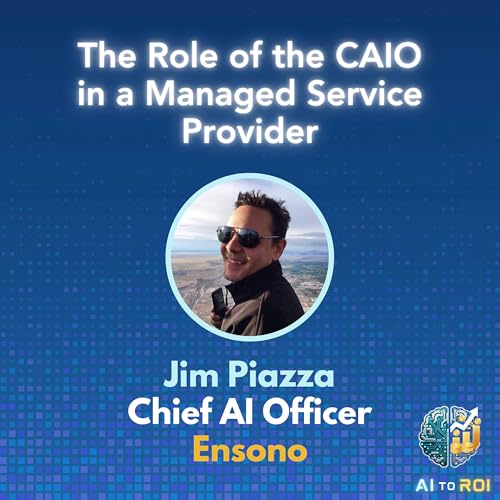
  • The Role of the CAIO in a Managed Service Provider - with Jim Piazza, CAIO Ensono
    Apr 28 2026
    Ray Rike sits down with Jim Piazza, Chief AI Officer at Ensono, a managed services provider scaling AI across both its internal operations and customer environments. Jim brings a rare combination of deep infrastructure experience, nearly a decade at Meta scaling data center operations with machine learning, and a rigorous framework for connecting AI investments to business outcomes that executive operators can actually measure.Key Topics:Defining the Chief AI Officer Role in an MSP: Jim describes the CAIO role as a blend of CDO, CIO, and CTO with an AI lens, but with a critical distinction: the job is not to ask what AI can do. It is to identify where AI improves service delivery, customer outcomes, and financial performance. At Ensono, that meant starting small as VP of Predictive Systems, demonstrating results, and earning the mandate to expand. Prioritization, not ideation, is the core skill.Building AI Tools That Drive Internal Operational ROI: Ensono developed three production AI systems for internal use. Envision Predictive Engine analyzes telemetry data across systems to predict failures before they cause business impact, including one case where a problem was detected 144 minutes before it would have affected a major logistics customer outside Ensono's own scope of responsibility. Diagnose Now puts the right diagnostic data in front of engineers at the right moment and has delivered up to a 66% reduction in mean time to repair in A/B testing. ChangeGuardian assesses risk scores for the 8,000-plus changes Ensono executes monthly, auto-generating methods and procedures from a decade of historical change data to reduce both risk and manual effort.Structuring AI Governance: The Three Musketeers Model: Jim, the CTO, and the CIO operate as a deliberate leadership triad. The CTO owns the platforms. The CIO owns data quality and structure. The CAIO owns the build-versus-buy decision and solution development. Shared accountability, not siloed ownership, drives alignment. Each business unit also contributes one to two subject matter experts through a formal value stream mapping process to identify where AI should focus first.Measuring AI ROI Before Writing a Line of Code Jim's most consistent lesson: define your value metrics before touching the technology. AI use cases must tie back to core business metrics such as mean time to repair, customer satisfaction, SLA risk reduction, and gross margin improvement. Business unit leaders own the outcome measurement. The CAIO owns the budget and the technology. That separation of responsibility keeps AI programs anchored to results rather than activity.The CAIO and CIO Relationship: Where the Lines Get Drawn: For companies bringing in a Chief AI Officer alongside an existing CIO, Jim offers a practical delineation. The CIO owns data infrastructure and quality. The CAIO is a consumer and a builder who depends on that foundation. Without clean, accessible data, AI programs stall regardless of the use case. The CAIO's job is to surface missing or insufficient data and partner with the CIO to close the gap.Lessons Learned and Career Advice for the AI Era: Jim's framework for AI program success: start with one or two high-probability use cases where data is already in good shape, build credibility through results, then expand. Avoid the ten-pilot trap. Kill weak use cases early. For early-career professionals, his advice is equally direct: learn to work with AI, not compete with it. Build problem framing, critical thinking, and business judgment. Technical fluency matters, but business judgment is what separates the people AI replaces from the ones AI makes more valuable.This episode is essential listening for technology and operations executives navigating the practical reality of AI deployment inside complex enterprise environments. If you are a CIO, CTO, COO, or Chief AI Officer trying to figure out how to structure governance, measure impact, and build internal credibility for AI programs, Jim Piazza gives you a real-world operating model, not theory. For managed services leaders and enterprise buyers evaluating MSP capabilities, the Ensono case studies show what it looks like when an MSP moves from reactive service delivery to predictive, AI-driven outcomes. And for executives still debating whether to hire a Chief AI Officer, this conversation makes a direct case for what the role should own, how it should partner, and what success looks like when it is done right.See Privacy Policy at https://art19.com/privacy and California Privacy Notice at https://art19.com/privacy#do-not-sell-my-info.
    Show More Show Less
    29 mins
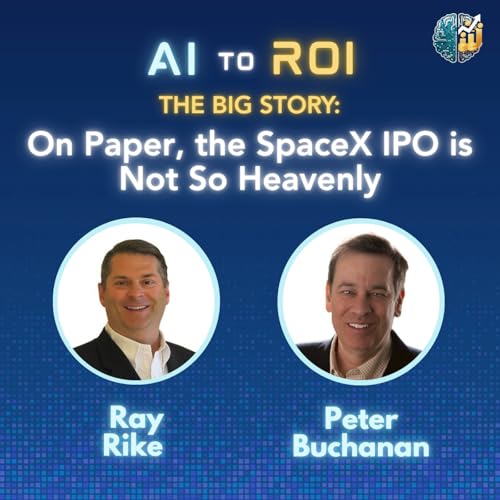
  • On Paper, the SpaceX IPO is Not So Heavenly
    Apr 24 2026

    SpaceX filed for what could be the largest IPO in history, targeting a $1.75 trillion valuation and $75 billion raise on NASDAQ in June. Ray Rike and Peter Buchanan cut through the narrative and go straight to the numbers, business unit by business unit.

    Key Topics:

    The Launch Services Monopoly Falcon 9 launches cost roughly $67 million, compared to $110-160 million for competitors. With over 100 launches per year, $4 billion in NASA contracts, and a freshly awarded Space Force contract, SpaceX has no meaningful competitor at scale. The catch: the next-generation Starship rocket, critical to everything else in the bull case, is already five years behind its original commercial timeline.

    Starlink: The $10 Billion Business You Never Think About Starlink generates nearly $10 billion in annual revenue from 10 million global subscribers, representing 54% of SpaceX's total revenue. The real margin engine is not residential subscribers but aviation and maritime, where per-customer annual revenue runs $300K and $34K respectively. Amazon's Project Kuiper remains far behind with under 700 satellites versus Starlink's 10,000-plus.

    XAI and X: The Problem Child SpaceX acquired XAI in February 2026 in an all-stock deal valued at $250 billion. The financial reality is stark. XAI burned $9.5 billion in cash during the first nine months of 2025 on only $210 million in revenue, nearly $28 million per day. A combined 2025 P&L would have shown a $5 billion net loss on $18.5 billion in revenue, reversing SpaceX's standalone $8.5 billion profit in 2024. Grok, its large language model, is described in internal SpaceX memos as clearly behind Anthropic, OpenAI, and Gemini, and Elon Musk himself has said publicly it needs to be rebuilt.

    The IPO Mechanics: Structure, Retail Allocation, and a Controversial NASDAQ Rule Change Five banks are co-leading the offering with no single lead book-runner, and each was reportedly required to purchase Grok subscriptions as a condition of participation. Retail investors receive a 30% share allocation, three times the typical size. Most controversially, NASDAQ shortened its index inclusion waiting period from 90 days to 15, which could trigger mandatory passive fund buying from vehicles like Invesco's QQQ shortly after listing. Market veterans are calling it structural manipulation.

    The Bull and Bear Case The bull case requires Starship reaching commercial operations within 18 months, Grok building a real enterprise sales engine beyond Elon's existing relationships, and the vertical integration thesis playing out as planned. Starlink as a global AI distribution layer, Grok trained on real-time X data, and orbital data centers as a structural competitive moat. The bear case is simple: every element depends on Starship staying on schedule, and if it slips again, the entire investment thesis slips with it.

    Executive Takeaways for Technology Leaders The valuation is not priced on current fundamentals. It is priced on a version of this business that does not exist yet and may not until the early 2030s. For technology executives evaluating SpaceX or XAI as vendors or partners, multi-year contract stability is a real consideration. The NASDAQ rule change also has downstream implications for OpenAI, Anthropic, and other AI companies in the IPO pipeline.


    This episode is designed for B2B SaaS and enterprise AI executives who need to understand where capital is flowing and why it matters in their own strategic context. If you are making decisions about AI vendor relationships, enterprise infrastructure partnerships, or simply need a clear-eyed read on how AI-era IPO valuations are being constructed, Ray and Peter give you the data behind the headlines, not just the hype. No investment advice. Just the numbers, the business model mechanics, and the questions every executive should be asking before the June listing.

    See Privacy Policy at https://art19.com/privacy and California Privacy Notice at https://art19.com/privacy#do-not-sell-my-info.

    Show More Show Less
    34 mins
  • AI's Organizational Impact: McKinsey's State of Organizations 2026 Report
    Apr 22 2026

    Ray Rike and Peter Buchanan dig into McKinsey's 2026 State of Organizations Report, a landmark study drawing on more than 10,000 senior executives across 15 countries and 16 industries. The central finding is both simple and uncomfortable: the vast majority of organizations are actively experimenting with AI, and that same majority reports no meaningful impact on their bottom line. This episode is about closing that gap.

    Topics Covered

    • Three Tectonic Forces Reshaping Every Organization. McKinsey identifies AI and agentic systems, economic and geopolitical fragmentation, and workforce transformation as structural shifts rather than temporary headwinds. Ray and Peter unpack why these forces are interdependent and why three in four leaders say their organizations are not ready to face what is coming, including leaders who describe themselves as optimistic.
    • Why AI Initiatives Keep Falling Short. The diagnosis is clear: most organizations are running scattered pilots and point solutions that augment individuals but never transform the enterprise. McKinsey's data shows that organizations redesigning entire domains, marketing, finance, and operations, see dramatically greater financial impact than those pursuing isolated use cases. Ray calls this systems thinking and walks through five specific variables required to move from pilot to production at scale.
    • Humans and AI Agents: A New Collaboration Model. Only one in four executives expect AI to take on truly agentic, autonomous roles in the next 12 to 24 months. Ray and Peter discuss why senior leaders are more conservative than younger high-potential talent, what the Hitachi and Allianz case studies reveal about workforce redesign versus workforce replacement, and why demand for AI fluency has increased 7x faster than any other skill tracked in job postings.
    • Geopolitical Disruption and the Cost of Organizational Rigidity. Three in four leaders report a material impact from geopolitical uncertainty on their organizations. Ray and Peter discuss the Tonies case study, a German toy company that launched a production facility in Vietnam on the same day US tariffs were announced, as a model of what organizational preparedness looks like in practice. Two thirds of surveyed executives also said their organizations are overly complex and inefficient, and McKinsey's diagnosis of why traditional structural fixes are no longer working is worth hearing.
    • People and Performance: The Four-Times Multiplier. McKinsey's data shows that organizations investing equally in people development and operational performance are four times more likely to sustain top-tier financial results, grow revenue twice as fast, and carry half the earnings volatility of peers. Ray and Peter connect this to why 80% of leaders leave non-financial motivation levers completely untouched, and to what GE's model of purpose, autonomy, recognition, and growth still gets right.
    • Business as Change: The New Operating Condition. McKinsey's closing argument is that transformation is no longer a periodic program with a defined start and end. It is a permanent operating condition. Ray frames four implications for leaders, and Peter adds the critical point that the gap between AI activity and AI impact is an organizational problem, not a technology problem. The tools exist. The redesign is the work.


    Why Listen

    This episode is for senior executives who are experiencing growing discomfort between how much their organization is investing in AI and how little of it is showing up in the numbers. Ray and Peter move well beyond summarizing the McKinsey findings. They connect the research to hands-on operating experience, call out where most organizations get stuck, and give listeners a practical framework for thinking about workforce redesign, change management, and leadership accountability. If you are responsible for AI strategy, organizational performance, or the people agenda at a B2B software or enterprise company, this is one of the most data-rich and actionable conversations you will find on the topic.

    See Privacy Policy at https://art19.com/privacy and California Privacy Notice at https://art19.com/privacy#do-not-sell-my-info.

    Show More Show Less
    34 mins
No reviews yet